
IRS Dispute Lawyers in Jackson
Retaining a skilled Jackson IRS dispute lawyer protects your income, bank accounts, and business assets from aggressive federal tax enforcement and levies. Experienced local tax controversy attorneys handle IRS audits, release bank levies, structure Offers in Compromise, and litigate before the U.S. Tax Court to achieve resolution. Browse our curated directory below to connect with vetted Hinds County IRS dispute lawyers and schedule your confidential case assessment.
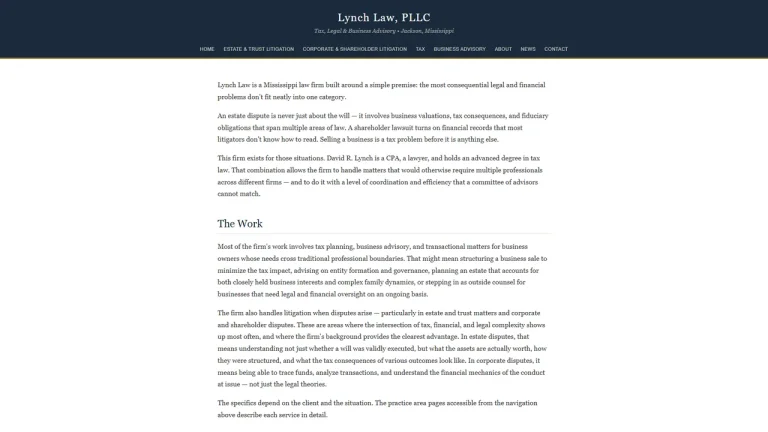
The Lynch Law Firm, PLLC - Jackson, MS

McGee Tax Law, PLLC - Jackson, MS

David R. Lynch, CPA, Esq., LL.M. - Jackson, MS

Parrish Law Office PLLC - Jackson, MS

Resolving Federal Tax Controversies & IRS Enforcement in Jackson
Facing an audit, wage garnishment, or federal tax lien from the Internal Revenue Service creates overwhelming financial and personal pressure. In Jackson, whether you operate a medical practice in Fondren, manage a commercial logistics fleet along Interstate 220, or run a small enterprise in Downtown Jackson, federal tax controversies require decisive intervention by an experienced tax attorney.
Federal tax enforcement actions in Mississippi are handled through the IRS local field offices and the IRS Independent Office of Appeals. When disputes cannot be resolved administratively, legal proceedings are instituted in the United States Tax Court, which convenes trial sessions at the Thad Cochran United States Courthouse on East Court Street in Jackson. For federal tax refund suits or criminal tax defense, original jurisdiction resides with the U.S. District Court for the Southern District of Mississippi.
Our directory features dedicated IRS dispute lawyers serving taxpayers throughout the Jackson metropolitan area-including Hinds, Madison, and Rankin counties, encompassing Clinton, Ridgeland, Flowood, Pearl, and Brandon. These attorneys halt collection actions, negotiate penalty abatements, defend against Trust Fund Recovery Penalties, and secure binding tax relief settlements.
Jackson IRS Dispute Representation & Fee Schedules
| Case Scenario | Fee Structure | Estimated Cost (USD) | Key Cost Determinants |
|---|---|---|---|
| IRS Wage Garnishment or Bank Levy Release | Flat Fee or Hourly Retainer | $1,500 - $3,500 | Collection officer posture, financial disclosures speed, unfiled return status |
| IRS Audit Representation & Revenue Agent Defense | Hourly Billing Rate | $2,500 - $8,500 | Multi-year scope, bank deposit analysis, substantiation adequacy |
| Offer in Compromise (OIC) & Doubt as to Collectibility | Flat Fee or Structured Retainer | $3,500 - $9,500 | Reasonable Collection Potential (RCP), asset equity calculations, IRS rejection appeals |
| U.S. Tax Court Petition & Trial Proceedings | Litigation Hourly Retainer | $7,500 - $35,000+ | Statutory 90-day filing deadline, discovery stipulations, expert accounting witnesses |
Critical Legal Deadlines & Statutes in Mississippi
Federal tax law is driven by unyielding statutory deadlines that govern appeals and court actions. Under 26 U.S. Code § 6213(a), upon receiving a Statutory Notice of Deficiency (often referred to as a 90-day letter), a taxpayer has strictly 90 calendar days from the mailing date to file a petition with the United States Tax Court. This deadline is strictly jurisdictional and cannot be extended under any circumstances.
When the IRS issues a Final Notice of Intent to Levy, time is of the essence. Under 26 U.S. Code § 6330, the taxpayer has exactly 30 days to file Form 12153 requesting a Collection Due Process (CDP) hearing. Filing a timely CDP request legally suspends ongoing levy and garnishment actions, preserving the taxpayer's right to judicial review. Settling tax liabilities for less than the full balance is authorized under 26 U.S. Code § 7122 through an Offer in Compromise based on doubt as to collectibility, doubt as to liability, or effective tax administration.
For business owners and corporate officers, payroll tax delinquencies carry severe exposure. Under 26 U.S. Code § 6672, the IRS can assess the Trust Fund Recovery Penalty against any person responsible for collecting and paying trust fund taxes who willfully failed to do so, imposing personal liability for 100% of unpaid taxes. For spouses facing joint liabilities, 26 U.S. Code § 6015 provides Innocent Spouse Relief. Under 26 U.S. Code § 6502, the IRS generally has ten years from the date of assessment to collect unpaid federal taxes before the Collection Statute Expiration Date (CSED) extinguishes liability.
Hinds County Justice Court vs. Federal Tax Controversy Counsel
Hinds County Justice Court handles small civil controversies up to $3,500 under Miss. Code § 9-11-9, and Hinds County Court exercises jurisdiction up to $200,000 under Miss. Code § 9-9-21. However, neither court has jurisdiction to review, stay, or modify federal tax enforcement actions.
Under the doctrine of federal sovereign immunity, IRS disputes can only be litigated in federal forums: the United States Tax Court, the U.S. District Court for the Southern District of Mississippi, or the U.S. Court of Federal Claims. Communicating directly with an IRS Revenue Officer without counsel exposes taxpayers to significant risks, including unintentional disclosures that broaden audits or trigger criminal investigations. An experienced Jackson IRS dispute attorney provides attorney-client privilege, halts intrusive enforcement, and formulates an effective defense before the IRS Appeals Office and federal courts.
Red Flags When Hiring a Jackson IRS Dispute Lawyer
- National out-of-state "tax relief" telemarketing firms promising guaranteed settlements without analyzing your Form 433-A collection potential.
- Lawyers who fail to mention the critical 90-day U.S. Tax Court filing deadline under 26 U.S. Code § 6213(a), risking forfeiture of pre-payment judicial review.
- Charging substantial non-refundable upfront fees while delegating your case to unlicensed sales representatives or unqualified call center staff.
- Lack of experience handling Trust Fund Recovery Penalty interviews (IRS Form 4180) or Collection Due Process hearings before the IRS Office of Appeals.
Frequently Asked Questions
What is a Collection Due Process (CDP) hearing and why is it important?
Under 26 U.S. Code § 6330, a CDP hearing is an administrative appeal that freezes IRS levies and garnishments if requested within 30 days of receiving a Final Notice of Intent to Levy. It provides an opportunity to negotiate collection alternatives before an independent appeals officer.
Can the IRS seize my retirement accounts or wages in Jackson?
Yes. The IRS possesses sweeping statutory authority to garnish continuous percentages of your paycheck and levy retirement savings, such as 401(k) plans or IRAs. An attorney can petition for an immediate hardship release or negotiate an installment agreement to stop seizures.
What is the Trust Fund Recovery Penalty for business owners?
Under 26 U.S. Code § 6672, if a business fails to remit payroll taxes withheld from employees, the IRS can pierce the corporate shield and hold officers, directors, or check-signers personally liable for 100% of the unpaid trust fund taxes.
What happens if I miss the 90-day U.S. Tax Court deadline?
If you miss the 90-day deadline set by 26 U.S. Code § 6213(a), you forfeit your right to contest the tax assessment before paying it in the U.S. Tax Court. Your only remaining judicial remedy is to pay the full tax balance and sue for a refund in federal district court.
How does an Offer in Compromise work under federal tax law?
Under 26 U.S. Code § 7122, an Offer in Compromise allows qualifying taxpayers to settle federal tax debt for less than the full amount owed based on their Reasonable Collection Potential (RCP), which evaluates net equity in assets and future disposable income.