
Business Litigation Lawyers in Montana
Retaining an experienced Montana business litigation attorney safeguards your enterprise against commercial disputes, partnership dissolutions, and breach of fiduciary claims. Seasoned trial counsel employs aggressive negotiation and mediation strategies to protect your balance sheet. Explore our verified statewide directory below to schedule an in-depth case evaluation.

Hunt and Fox PLLP Helena, MT

Tolliver Law Firm PC - Billings, MT
West Law Firm, P.C. - Billings, MT

Usleber Law Firm, PLLC - Billings, MT
Browning Kaleczyc Berry & Hoven, P.C., Helena, MT

Jones Law Firm, PLLC - Billings, MT

Parker Heitz and Cosgrove - Billings, MT

Felt Martin PC - Billings, MT

Varela Law Firm PLLC - Billings, MT

Last Chance Legal, PLLC - Helena, MT

Crowley Fleck PLLP - Billings, MT

Laird Cowley PLLC Helena, MT

McDonald Law Office, PLLC - Helena, MT

Crowley Fleck PLLP - Helena, MT
Patten, Peterman, Bekkedahl and Green - Billings, MT
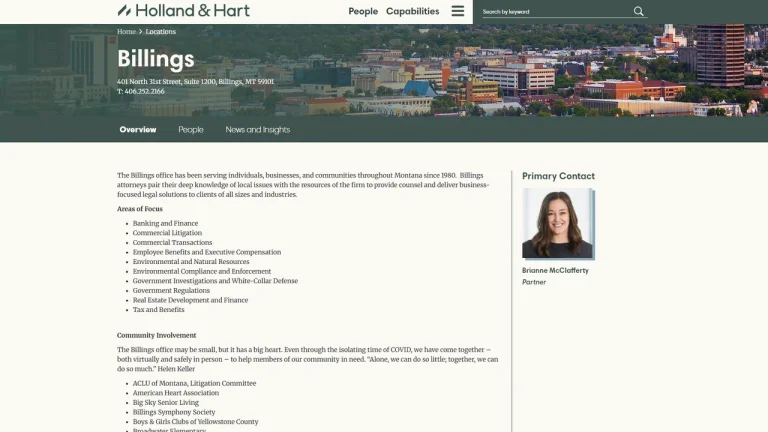
Holland & Hart LLP - Billings, MT

Matovich & Keller - Billings, MT

Elk River Law Office, PLLP - Billings, MT

Parsons Behle and Latimer - Helena, MT
Christensen & Prezeau, PLLP - Helena, MT

Harman Law Firm, PC - Billings, MT
MurphyMyers PLLC - Billings, MT
David Legare Law - Billings, MT
Commercial Litigation in Montana Judicial Districts
Commercial litigation in Montana involves resolving high-stakes corporate disputes across the state's judicial districts, including the 13th Judicial District in Billings (Yellowstone County), the 18th Judicial District in Bozeman (Gallatin County), the 4th Judicial District in Missoula, and the 1st Judicial District in Helena. Complex federal commercial controversies proceed before the U.S. District Court for the District of Montana, with divisions situated in Billings, Missoula, Great Falls, Butte, and Helena.
Business litigation practitioners must be admitted to practice by the State Bar of Montana in Helena. Local litigators provide essential legal counsel across Montana's growing economic sectors, including commercial construction, technology, agriculture, natural resource operations, and tourism. Counsel guides business leaders through shareholder disputes, LLC member dissolutions, trade secret misappropriation, tortious interference, and complex commercial fraud matters.
Engaging a seasoned business litigation lawyer ensures that immediate legal protections-such as temporary restraining orders and preliminary injunctions-are sought to halt ongoing financial harm. Counsel evaluates the strengths of the case, initiates strategic pre-trial discovery, and participates in mandatory court-ordered mediation to achieve a favorable commercial resolution while remaining fully prepared for trial.
Legal Fee Frameworks for Montana Business Litigation
| Case Scenario | Fee Structure | Estimated Cost (USD) | Key Cost Determinants |
|---|---|---|---|
| Pre-Suit Demand & Structured Mediation | Retainer plus Hourly ($275 - $450/hr) | $3,500 - $8,500 | Damage documentation volume, financial audit review, and mediation session length. |
| LLC Member Dissolution & Fiduciary Breach | Hourly Rate ($300 - $550/hr) | $10,000 - $35,000+ | Forensic accounting scope, company valuation disputes, and judicial receivership requests. |
| Complex Commercial Contract & Fraud Trial | Staged Retainer ($350 - $600/hr) | $15,000 - $50,000+ | Volume of electronic discovery, expert witness requirements, and District Court trial length. |
| Emergency Injunction & Restraining Order | Urgent Litigation Retainer | $7,500 - $20,000 | Filing turnaround time, evidentiary burden of irreparable harm, and hearing preparation. |
Critical Litigation Deadlines and Montana Business Statutes
Commercial litigation in Montana is governed by statutory deadlines established in the Montana Code Annotated. Actions for breach of a written business contract must be filed within eight years under Mont. Code Ann. § 27-2-202(1), whereas unwritten commercial contracts carry a five-year limitation period under Mont. Code Ann. § 27-2-202(2). Lawsuits alleging fraud or constructive fraud must be initiated within two years of the discovery of the underlying facts pursuant to Mont. Code Ann. § 27-2-203. Tortious interference with business relations and general business injury claims must be filed within three years under Mont. Code Ann. § 27-2-204.
Misappropriation of corporate trade secrets is governed by the Montana Uniform Trade Secrets Act, which mandates filing within three years after the misappropriation is discovered or should have been discovered under Mont. Code Ann. § 30-14-407. In corporate deadlocks or minority oppression disputes, shareholders can seek judicial dissolution under Mont. Code Ann. § 35-14-1430. Parties seeking emergency relief to prevent immediate corporate waste or preserve assets can petition for an injunction or temporary restraining order pursuant to Mont. Code Ann. § 27-19-201. In all contract litigation, attorney fee recovery is governed by Mont. Code Ann. § 28-3-704, ensuring that contractual fee provisions apply reciprocally to whichever party prevails.
Informal Dispute Resolution vs. Montana District Court Litigation
While minor accounts receivable disputes under $7,000 can be resolved in Justice Court Small Claims under Mont. Code Ann. § 3-10-1004, and up to $15,000 in Justice Court civil actions under Mont. Code Ann. § 3-10-301, substantive commercial controversies fall exclusively within the jurisdiction of Montana District Courts. High-stakes litigation requires strict compliance with the Montana Rules of Civil Procedure and formal evidence standards.
Attempting to handle partnership dissolutions, trade secret litigation, or high-value commercial breaches pro se exposes business owners to severe risks. Unrepresented companies face summary judgments, procedural defaults, and the inadvertent waiver of affirmative defenses or counterclaims. A business litigation lawyer manages electronic discovery, conducts critical depositions, engages economic damage experts, and presents a compelling case before Montana juries and judges.
Red Flags When Hiring a Montana Business Litigation Attorney
- Lawyers who guarantee a specific trial outcome or promise a swift summary judgment before reviewing the opposing party's evidence and discovery responses.
- Law firms that fail to provide clear, detailed monthly invoices outlining specific litigation activities, legal research hours, and court costs.
- Counsel who refuses to explore court-ordered mediation or early settlement opportunities, focusing solely on protracted billable litigation.
- Attorneys who lack courtroom trial experience in the Montana District Courts or the U.S. District Court for the District of Montana.
Frequently Asked Questions
What court handles complex business lawsuits in Montana?
Significant commercial lawsuits are heard in Montana District Courts, which exercise general civil jurisdiction. Disputes involving federal law or diversity of citizenship between parties from different states proceed in the U.S. District Court for the District of Montana.
What is the statute of limitations for commercial fraud in Montana?
Claims based on commercial fraud or constructive fraud must be filed within two years from the date the injured party discovered, or through reasonable diligence should have discovered, the facts constituting the fraud.
Can a prevailing party recover attorney fees in Montana commercial litigation?
Under Montana's reciprocal attorney fee statute, if a contract allows one party to recover legal fees, that right applies equally to whichever party prevails in the lawsuit. Fee shifting may also be authorized under specific statutory causes of action.
How are minority shareholder oppression claims addressed in Montana?
Minority shareholders facing oppressive, illegal, or fraudulent conduct by majority owners can petition a Montana District Court for judicial dissolution of the corporation or equitable buyout remedies under the Montana Business Corporation Act.
Is mediation mandatory in Montana business litigation?
Many Montana District Courts routinely order parties in commercial disputes to participate in good-faith mediation prior to trial, allowing businesses to explore confidential settlement options before incurring trial expenses.