
Business & Real Estate Lawyers in New Hampshire
Retain skilled New Hampshire business and real estate lawyers to close property deals, structure LLCs, and resolve boundary disputes statewide. Experienced attorneys protect commercial investments and draft airtight operating agreements to safeguard your ventures. Explore our verified statewide directory below to consult an attorney licensed with the New Hampshire Bar Association.

Devine Millimet: Jason Cole, Esq., CPA - Manchester, NH

DE Whiting LLC - Concord, NH

Klug Law Offices, PLLC - Manchester, NH

Law Offices of Paul C. English, PLLC - Manchester, NH

Sheridan Real Estate Law - Concord, NH
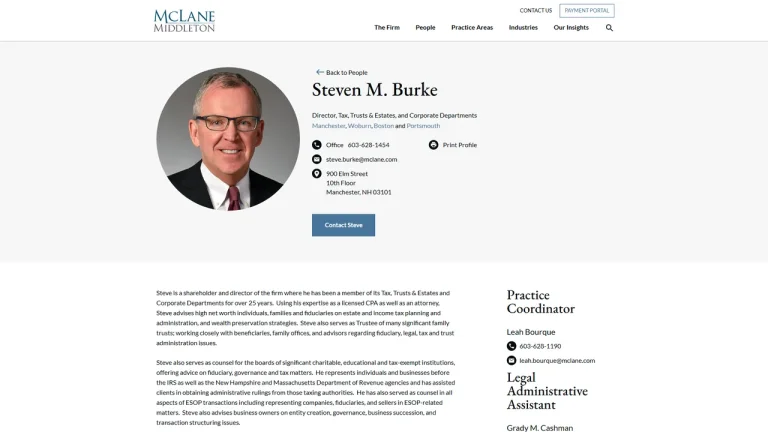
Steven M. Burke - McLane Middleton - Manchester, NH

Mc Nicholas Law Offices - Concord, NH

Flood, Sheehan & Tobin, PLLC - Concord, NH

Bianco Professional Association - Concord, NH

Amann Burnett, PLLC - Manchester, NH
Wadleigh, Starr & Peters, P.L.L.C. - Manchester, NH

Orr & Reno - Concord, NH

Preti Flaherty Beliveau & Pachios LLP - Concord, NH

Heiser Richard W - Concord, NH

Blackwood Law, PLLC - Manchester, NH

Law Office of Robert J Bradfield III - Concord, NH
Cronin Bisson & Zalinsky P.C. - Manchester, NH
Solomon Law Firm - Manchester, NH
Ketel Law, PC - Manchester, NH
Bailinson Capuchino & O'Leary: O'Leary Charles F - Manchester, NH

Shaheen & Gordon, P.A. - Concord, NH
Craighead & Martin, PLLC - Manchester, NH

Hudkins Law & Title - Concord, NH

603 Legal Aid - Concord, NH
Navigating New Hampshire Corporate Governance and Real Estate Transactions
Commercial transactions and real estate holdings in New Hampshire operate within a unique state statutory and tax environment. From commercial manufacturing corridors in Manchester and Nashua across Hillsborough County to Seacoast maritime and technology enterprises in Portsmouth within Rockingham County, corporate founders and landowners require knowledgeable counsel. Corporate structuring must address the state's Business Profits Tax (BPT) and Business Enterprise Tax (BET), while real property conveyances demand strict adherence to county recording protocols.
Business formations and corporate filings are submitted to the New Hampshire Department of State Corporate Division in Concord through the NH QuickStart digital portal. Real estate litigation and commercial contract disputes are tried in the New Hampshire Superior Court, which maintains exclusive general jurisdiction over title disputes, easements, and boundary actions. Landlord-tenant matters and commercial lease enforcement proceed in the New Hampshire Circuit Court District Division. Retaining counsel licensed through the New Hampshire Bar Association ensures operating agreements satisfy statutory requirements, deed chains are clear, and zoning permits survive municipal administrative scrutiny.
New Hampshire Business & Real Estate Legal Scenarios and Fee Structures
| Case Scenario | Fee Structure | Estimated Cost (USD) | Key Cost Determinants |
|---|---|---|---|
| LLC Formation & Corporate Governance Structuring | Flat Fee | $800 - $2,200 | Secretary of State charter fees ($100), customized operating agreements, member equity buyout terms |
| Commercial Real Estate Acquisition & Title Examination | Flat Fee or Hourly | $2,000 - $6,500 | Deed chain complexity at County Registry, environmental reviews, zoning compliance verification |
| Quiet Title Action & Boundary Dispute Litigation | Hourly ($275 - $525/hr) | $5,000 - $20,000+ | Licensed surveyor testimony, historical title searches, Superior Court evidentiary hearings |
| Commercial Eviction & Lease Enforcement | Flat Fee or Hourly | $1,200 - $4,500 | RSA 540 statutory notice compliance, tenant defenses, writ of possession execution |
Critical Legal Deadlines & Statutes in New Hampshire
Corporate management and real property ownership in New Hampshire are bound by strict statutory deadlines. Limited Liability Companies are governed by the New Hampshire Revised Limited Liability Company Act under N.H. Rev. Stat. Ann. § 304-C:1 et seq. To maintain active legal standing, all domestic and foreign business entities must submit an Annual Report to the New Hampshire Department of State by April 1 of each year pursuant to N.H. Rev. Stat. Ann. § 304-C:191.
Real estate conveyances must comply with execution formalities under N.H. Rev. Stat. Ann. § 477:1 and be recorded with the appropriate County Registry of Deeds to protect title against subsequent purchasers. Under N.H. Rev. Stat. Ann. § 78-B:1, New Hampshire assesses a mandatory Real Estate Transfer Tax (RETT) of $0.75 per $100 on both the buyer and the seller ($1.50 per $100 total transaction value) at the time of deed recording. The Statute of Frauds, codified at N.H. Rev. Stat. Ann. § 506:1, mandates that all contracts for the sale of real estate must be in writing. For commercial contracts and personal actions, N.H. Rev. Stat. Ann. § 508:4 enforces a general three-year statute of limitations. When challenging municipal land use or zoning decisions, a motion for rehearing before the local Zoning Board of Adjustment must be filed within 30 days under N.H. Rev. Stat. Ann. § 677:2, followed by an appeal to Superior Court within 30 days of rehearing denial under N.H. Rev. Stat. Ann. § 677:4.
Small Claims Limitations vs. Superior Court Real Estate Jurisdiction
While New Hampshire Circuit Court District Divisions process small claims actions up to $10,000 pursuant to N.H. Rev. Stat. Ann. § 503:1, the statute explicitly excludes any claim involving title to real estate. Furthermore, under N.H. Rev. Stat. Ann. § 503:1(III), when debt or damages exceed $1,500, a defendant may demand a jury trial and remove the action to Superior Court.
Attempting to handle commercial transactions or land disputes without experienced legal counsel introduces substantial financial risk. Real estate controversies-including adverse possession, easement disputes, mechanics' liens under N.H. Rev. Stat. Ann. § 447:1, and commercial tenant evictions under N.H. Rev. Stat. Ann. § 540:1-require formal pleading practice in the Superior Court. Defective deed language can cloud title for decades, and operating agreements lacking tailored member buyout provisions can result in costly judicial dissolutions. Dedicated counsel examines historical title records, ensures municipal zoning compliance, and structures commercial agreements that prevent costly disputes.
Red Flags When Hiring a New Hampshire Business & Real Estate Lawyer
- Using Generic Out-of-State LLC Forms: Avoid counsel who sells standard boilerplate operating agreements that do not account for New Hampshire LLC statutes or state business tax rules.
- Missing the 30-Day Zoning Rehearing Window: Land use appeals require strict adherence to the 30-day timeline under N.H. Rev. Stat. Ann. § 677:2; failing to file a motion for rehearing waives the right to appeal to Superior Court.
- Neglecting Transfer Tax Calculations: Disqualify closing attorneys who fail to account for the mandatory 1.5% Real Estate Transfer Tax under N.H. Rev. Stat. Ann. § 78-B:1 in closing statements.
- Incomplete Title Searches: Ensure your attorney performs comprehensive 35-to-50-year title examinations at the local County Registry of Deeds to identify unreleased encumbrances or utility easements.
Frequently Asked Questions
What is the Real Estate Transfer Tax rate in New Hampshire?
New Hampshire assesses a statutory Real Estate Transfer Tax of $0.75 per $100 of property value on the buyer and $0.75 per $100 on the seller, resulting in a total tax of $1.50 per $100 ($15 per $1,000) of the transaction price, collected upon deed recording at the County Registry of Deeds.
How much time do I have to appeal a municipal zoning board decision?
Under New Hampshire law, you have exactly 30 calendar days from the date of the local Zoning Board of Adjustment's decision to file a motion for rehearing. If the rehearing is denied, you have 30 days from the date of that denial to appeal to the New Hampshire Superior Court.
Is an operating agreement legally required for an LLC in New Hampshire?
While New Hampshire law does not mandate filing an operating agreement with the state, executing a written agreement is vital. Without one, internal company operations and disputes are governed entirely by default statutory provisions, which may not protect members against personal liability or establish clear voting rights.
What is the statute of limitations for contract lawsuits in New Hampshire?
Under New Hampshire statutory provisions, breach of contract claims and general personal civil actions must be commenced within three years from the date the breach or injury occurred, or within three years from when the cause of action was discovered.
Which New Hampshire court resolves boundary and easement disputes?
Real estate boundary disputes, actions to quiet title, and easement controversies fall under the exclusive general jurisdiction of the New Hampshire Superior Court in the county where the real property is located.