
Criminal Defense Lawyers in New Hampshire
Retaining a skilled New Hampshire criminal defense lawyer protects your freedom and constitutional rights when facing misdemeanor or serious felony charges. Dedicated defense counsel investigates police conduct, files suppression motions, and negotiates charge reductions or dismissals before trial. Browse our verified New Hampshire directory below to consult top-rated criminal defense attorneys serving communities statewide.

Steiner Law Office, PLLC - Concord, NH

Hinckley Allen - Manchester, NH

Law Office of Michael J. Sheehan - Concord, NH

Tamayo Law Firm, PLLC - Manchester, NH

Crisp Law Firm PLLC - Concord, NH

Becker Legal - Concord, NH
Draghi Law Offices - Concord, NH

Law Offices of F. Michael Keefe, PLLC - Manchester, NH

The Law Offices of Daniel C. Proctor - Concord, NH

Bailinson Capuchino & O'Leary: O'Leary Charles F - Manchester, NH

Devine Millimet | Attorneys at Law - Manchester, NH
Associated Attorneys of New England - Manchester, NH

Cynthia P Gilman Law Office - Manchester, NH

Cleveland, Waters and Bass, P.A. - Concord, NH

Cohen & Winters, PLLC - Manchester, NH
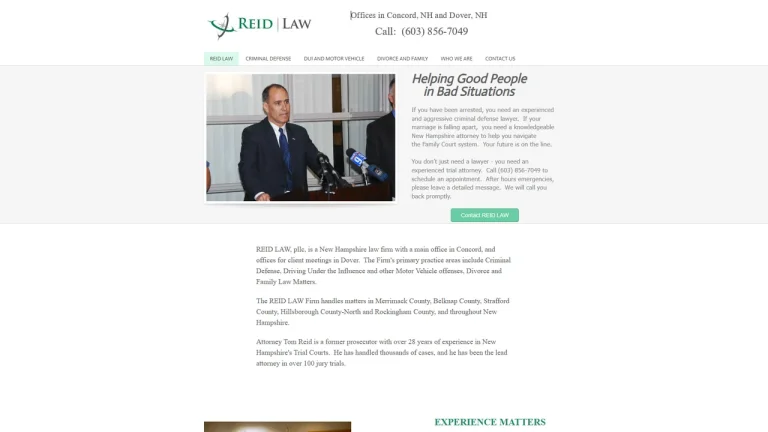
Reid Law, pllc - Concord, NH

Andrew J Harmon Attorney at Law - Manchester, NH

Charles A. Russell, Attorney at Law - Concord, NH
New Hampshire Attorney General's Office - Concord, NH

603 Legal Aid - Concord, NH

Tenn And Tenn, PA - Manchester, NH

McLane Middleton, Professional Association - Concord, NH

Lothstein Guerriero, PLLC - Concord, NH

Navigating Criminal Defense Across New Hampshire Courts
Facing criminal prosecution in New Hampshire places your personal liberty, reputation, and employment opportunities in immediate jeopardy. Whether responding to misdemeanor offenses in Manchester, Nashua, or Concord, or facing major felony indictments in Rockingham, Strafford, or Merrimack counties, state prosecutors pursue convictions aggressively. A seasoned New Hampshire criminal defense lawyer provides vital strategic advocacy, scrutinizing law enforcement procedures and asserting constitutional protections from the moment of arrest.
New Hampshire operates a two-tiered court structure for criminal matters. Misdemeanor charges, motor vehicle violations, and initial felony bail hearings originate in the New Hampshire Circuit Court District Division-such as the 9th Circuit Court in Manchester or the 10th Circuit Court in Brentwood. When felony charges proceed following an indictment by a county grand jury, cases are transferred to the New Hampshire Superior Court for trial, including Hillsborough County Superior Court (North and South) and Merrimack County Superior Court.
Criminal offenses in the Granite State are codified under Title LXII of the New Hampshire Revised Statutes Annotated. Class A felonies carry potential sentences of up to fifteen years in the New Hampshire State Prison, while Class B felonies expose defendants to up to seven years under N.H. Rev. Stat. § 651:2. Working with an attorney admitted to the New Hampshire Bar Association ensures that suppression motions are filed to contest illegal searches under Part 1, Article 19 of the New Hampshire Constitution and that defense strategies are designed to secure dismissals, favorable plea agreements, or full acquittals.
Typical Fee Structures for New Hampshire Criminal Defense
| Case Scenario | Fee Structure | Estimated Cost (USD) | Key Cost Determinants |
|---|---|---|---|
| Circuit Court Misdemeanor Defense (Class A/B) | Flat Fee | $1,500 - $4,000 | Number of court appearances, body-worn camera evidence, and diversion program eligibility. |
| Felony Property or Non-Violent Offense (Class B) | Flat Fee / Staged Retainer | $3,500 - $9,500 | Grand jury indictment review, restitution negotiations, and suppression hearings. |
| Major Violent Crime or Drug Distribution (Class A) | Hourly Retainer ($275 - $500/hr) | $8,500 - $25,000+ | Forensic testing analysis, expert witness retainers, and Superior Court jury trial duration. |
| Criminal Record Annulment Petition | Flat Fee | $1,000 - $2,500 | Offense grade, background checks with the Department of Safety, and contested hearings. |
Critical Legal Deadlines & Statutes in New Hampshire Criminal Law
Criminal defense proceedings in New Hampshire are governed by strict statutory rules and procedural limitation periods:
- Statute of Limitations for Prosecution: Under N.H. Rev. Stat. § 625:8, prosecutions for general felony offenses must be commenced within six years, while misdemeanor prosecutions must be initiated within one year after the offense is committed.
- Statutory Sentencing Classifications: Sentencing ranges are codified under N.H. Rev. Stat. § 651:2, establishing sentences of up to fifteen years for Class A felonies, seven years for Class B felonies, and up to one year in the house of corrections for Class A misdemeanors.
- Bail and Pretrial Detention: Under N.H. Rev. Stat. § 597:2, courts must hold an individualized bail hearing determining release conditions or preventive detention based on danger to the public or flight risk.
- Record Annulment Waiting Periods: Pursuant to N.H. Rev. Stat. § 651:5, individuals may petition to annul a criminal record after completing all sentence terms, requiring waiting periods ranging from one year for violations to ten years for violent felonies.
- Speedy Trial Guarantees: Defendants maintain statutory and constitutional speedy trial rights under Part 1, Article 14 of the New Hampshire Constitution, with trials subject to time standards established by the Superior Court.
Small Claims Limitations vs. Professional Criminal Defense
In New Hampshire, the Circuit Court District Division handles small claims actions for monetary damages up to $10,000 pursuant to N.H. Rev. Stat. § 503:1. Small Claims Courts resolve purely civil financial disputes and have zero authority over criminal warrants, bail modifications, or criminal sentencing. Criminal prosecutions are conducted exclusively through Circuit Court criminal divisions and the Superior Courts.
Attempting to represent oneself in a criminal proceeding exposes an individual to catastrophic legal risks. A criminal conviction can result in incarceration in the county house of corrections, substantial statutory fines, loss of firearms rights, and a permanent criminal record. Experienced New Hampshire defense counsel cross-examines arresting officers, investigates forensic evidence, challenges defective complaints, and navigates alternative sentencing options such as Drug Courts and mental health diversion.
Red Flags When Hiring a New Hampshire Criminal Defense Lawyer
- Guaranteed Outcomes or Dismissals: Ethical criminal defense attorneys cannot guarantee case dismissals or promise that a defendant will avoid jail time.
- Urging a Guilty Plea at Initial Arraignment: Avoid lawyers who advise accepting a plea deal during your initial Circuit Court appearance without reviewing discovery and police reports.
- Lack of Superior Court Trial Experience: If you face felony indictments, ensure your attorney has active trial experience defending cases before Superior Court juries.
- Vague or Non-Itemized Retainer Agreements: Reputable defense firms provide clear written fee agreements detailing flat rates, hourly charges, and separate costs for independent investigators.
Frequently Asked Questions
What is the difference between the Circuit Court and Superior Court in New Hampshire?
The New Hampshire Circuit Court District Division handles non-jury trials for misdemeanors, municipal violations, and initial felony bail hearings. The Superior Court has exclusive jurisdiction over jury trials, felony indictments, and misdemeanor appeals originating from the Circuit Court.
Can a criminal record be expunged in New Hampshire?
In New Hampshire, the legal process for clearing a criminal record is called an 'annulment' under N.H. Rev. Stat. § 651:5. If approved by the court, the record is sealed and treated as if the conviction never occurred, with certain exceptions for law enforcement background checks.
What happens if I miss a court date in New Hampshire?
Failing to appear for a scheduled court hearing in either Circuit or Superior Court typically results in the issuance of an immediate electronic bench warrant for your arrest, potential forfeiture of bail, and an additional criminal charge for bail jumping.
What is a Class A misdemeanor versus a Class B misdemeanor in New Hampshire?
Under N.H. Rev. Stat. § 651:2, a Class A misdemeanor carries a potential sentence of up to one year in the house of corrections and a fine up to $2,000, with a right to court-appointed counsel. A Class B misdemeanor carries a maximum fine of $1,200 but no possibility of jail time.
Are breathalyzer tests mandatory during a DUI stop in New Hampshire?
Under New Hampshire's implied consent law codified at N.H. Rev. Stat. § 265-A:14, refusing a post-arrest chemical test results in an administrative driver's license suspension of at least 180 days for a first offense, independent of criminal court penalties.