
Defective Product Injury Lawyers in New Hampshire
Retaining an experienced New Hampshire defective product injury lawyer ensures your rights are protected against powerful manufacturers and corporate insurers. Skilled product liability counsel works on contingency to conduct rigorous forensic investigations and secure fair financial compensation before court trials. Explore our directory below to connect with verified New Hampshire attorneys for a free case evaluation.

Shaheen & Gordon, P.A. - Concord, NH
Gideon Asen LLC - Manchester, NH
Teale Law - Manchester, NH

Loo Law - Manchester, NH

Thomas Craig Law Office - Manchester, NH

Stephen Law Group Injury Lawyers - Manchester, NH

Law Office of Manning Zimmerman & Oliveira PLLC - Manchester, NH
Stephen R Fine Law Office - Manchester, NH

Crisp Law Firm PLLC - Concord, NH

Boyle | Shaughnessy Law - Manchester, NH

Nicholson Law Firm, PLLC - Concord, NH
Douglas, Leonard & Garvey, P.C. - Concord, NH

Alfano Law, PLLC - Concord, NH
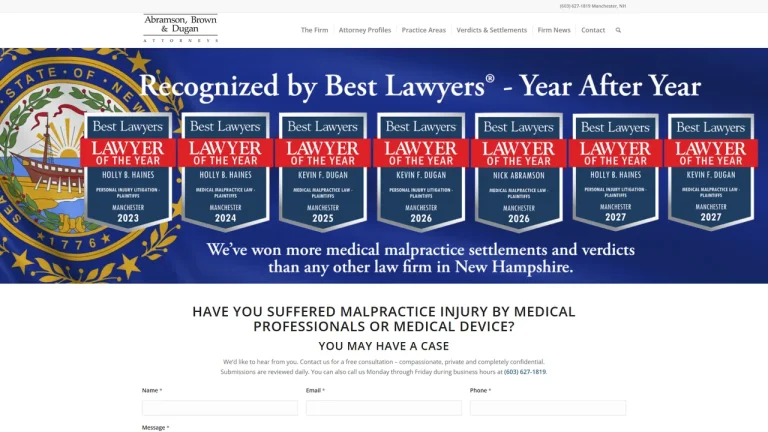
Abramson, Brown & Dugan Attorneys - Manchester, NH
Litigating Defective Product Claims in the New Hampshire Superior Court
Product liability claims in the Granite State are primarily adjudicated in the New Hampshire Superior Court, the trial court of general jurisdiction handling civil matters exceeding statutory monetary thresholds. Major caseloads proceed through county seats such as Hillsborough County Superior Court (with branches in Manchester and Nashua), Merrimack County Superior Court in Concord, and Rockingham County Superior Court in Brentwood. Claims against diverse multi-state corporations may also be heard in the U.S. District Court for the District of New Hampshire, located in Concord.
New Hampshire adheres to strict product liability standards, allowing injured consumers to seek redress without having to prove direct manufacturer negligence. Claimants must establish that the product was in a defective condition unreasonably dangerous to the user, whether originating from a manufacturing flaw, a defective design, or inadequate warnings and instructions. Because corporate defense teams deploy specialized engineering teams, retaining an attorney seasoned in local courtrooms is vital to leveling the playing field.
Civil filings are submitted and managed electronically via the New Hampshire Judicial Branch Electronic Filing system. Legal counsel manages initial disclosures, preserves critical chain-of-custody evidence, deprives defendants of procedural delay tactics, and engages seasoned medical and metallurgical experts to substantiate the full scope of damages.
Typical Fee Structures and Legal Cost Determinants for Product Liability Cases
| Case Scenario | Fee Structure | Estimated Cost (USD) | Key Cost Determinants |
|---|---|---|---|
| Defective Consumer Household Product | Contingency Fee (33.3% - 40%) | $0 Upfront ($15,000 - $45,000 case expenses) | Product retrieval, mechanical engineering failure analysis, documentation of burn or laceration injuries. |
| Automotive Defect / Crashworthiness Failure | Contingency Fee (33.3% - 40%) | $0 Upfront ($35,000 - $100,000+ case expenses) | Crash data retrieval, vehicle storage preservation, accident reconstruction, biomechanical medical modeling. |
| Defective Medical Device or Pharmaceutical | Contingency Fee (33.3% - 40%) | $0 Upfront ($25,000 - $80,000 case expenses) | Review of FDA compliance records, expert medical testimony, revision surgery documentation, lost wage audits. |
| Industrial Machinery Malfunction | Contingency Fee (33.3% - 40%) | $0 Upfront ($30,000 - $90,000 case expenses) | Workplace safety audits, OSHA reports, third-party liability coordination alongside workers compensation. |
Critical Legal Deadlines & Statutes in New Hampshire
Filing a defective product injury claim requires strict adherence to statutory timelines and liability doctrines:
- General Statute of Limitations: Under N.H. Rev. Stat. Ann. § 508:4, personal injury actions, including product liability, must be commenced within three years from the date of the injury or the date the claimant discovered, or reasonably should have discovered, the causal connection between the injury and the defective product.
- Modified Comparative Fault Rule: Under N.H. Rev. Stat. Ann. § 507:7-d, an injured party may recover damages only if their contributory negligence is not greater than the total negligence of the defendants (the 51% bar). If the claimant bears 50% or less of the fault, their recovery is reduced proportionally.
- Wrongful Death Actions: In cases involving fatal injuries caused by defective equipment or consumer goods, actions must be brought pursuant to N.H. Rev. Stat. Ann. § 556:11 by the personal representative of the decedent estate.
- Evidence Preservation: Immediate formal spoliation letters must be served to prevent defendants from destroying, altering, or returning the defective product before independent expert inspection occurs.
Small Claims Jurisdiction vs. Retaining a Product Liability Attorney
In New Hampshire, the Circuit Court District Division maintains jurisdiction over small claims cases capped at $10,000 pursuant to N.H. Rev. Stat. Ann. § 503:1. While an unrepresented individual might use small claims to seek replacement costs for minor property damage caused by a failed appliance, severe injury claims belong exclusively in the Superior Court.
Product liability litigation involves complex evidentiary rules, design blueprints, depositions of corporate representatives, and costly independent testing that make self-representation impractical. Skilled personal injury lawyers advance all upfront litigation costs on contingency, ensuring injured consumers can battle well-funded multinational corporations without personal financial exposure.
Red Flags to Avoid When Selecting a New Hampshire Product Injury Lawyer
- Demanding Upfront Retainer Fees for Injury Cases: Defective product injury claims are handled on a contingency basis where the attorney receives payment only after securing a settlement or trial judgment.
- Lack of Capital for Independent Experts: Product litigation requires substantial capital for engineers, materials scientists, and medical specialists; firms lacking litigation funding cannot effectively challenge manufacturers.
- Guaranteeing Specific Settlement Figures: Ethical attorneys licensed by the New Hampshire Bar Association cannot promise guaranteed settlement amounts or quick payouts before concluding scientific discovery.
- No Trial Experience in Superior Court: Corporate insurers track which law firms routinely settle for low offers and which firms possess the courtroom ability to try complex cases to a jury verdict.
Frequently Asked Questions
What elements must be proven in a New Hampshire product liability claim?
Claimants must prove that the product contained a design defect, manufacturing defect, or inadequate warning that made it unreasonably dangerous, that the defect existed when it left the manufacturer's control, that the product was used in a foreseeable manner, and that the defect directly caused physical injuries or financial damages.
What is the difference between design defect and manufacturing defect?
A design defect means the entire product line is inherently dangerous due to a flawed initial blueprint or inadequate safety safeguards, whereas a manufacturing defect occurs when an error during the production or assembly process causes a specific unit to depart from its intended design specifications.
Can I recover damages if I was partially at fault for my injury in New Hampshire?
Yes, under N.H. Rev. Stat. Ann. § 507:7-d, New Hampshire applies a modified comparative fault rule with a 51% bar. You can recover damages as long as your fault does not exceed 50%, though your final compensation will be reduced by your percentage of responsibility.
How long do I have to file a product defect lawsuit in New Hampshire?
Under N.H. Rev. Stat. Ann. § 508:4, the statute of limitations is generally three years from the date the injury occurred or when the connection between the defect and the harm was reasonably discovered. Failing to initiate suit within this statutory period permanently bars recovery.
How do contingency fees work in New Hampshire product injury cases?
Under standard contingency agreements, you pay no out-of-pocket legal fees. Your attorney advances litigation costs, and legal fees are collected as an agreed-upon percentage of the final recovery obtained through settlement or trial judgment. If no recovery is obtained, you owe no attorney fees.