
Patent Attorneys in Manchester
Engaging a registered patent attorney in Manchester safeguards proprietary technological breakthroughs, manufacturing innovations, and biomedical designs. Qualified patent counsel conducts comprehensive prior art searches, drafts robust patent specifications, and protects your intellectual property from unlawful infringement. Explore our directory below to consult an experienced patent lawyer licensed before the USPTO.
Hinman, Howard & Kattell, LLP - Manchester, NH

Sheehan Phinney Bass & Green, PA - Manchester, NH

Virtual IP Law - Manchester, NH
Grossman Tucker Perreault - Manchester, NH
Devine Millimet | Attorneys at Law - Manchester, NH
The Inventor's Friend Patent Law Firm - Manchester, NH
Patent Negotiator, P.L.L.C. - Manchester, NH
McLane Middleton, Professional Association - Manchester, NH
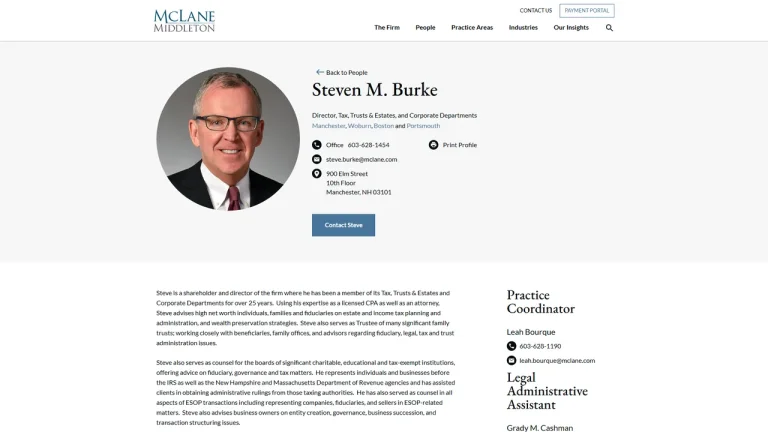
Steven M. Burke - McLane Middleton - Manchester, NH
Nixon Peabody LLP - Manchester, NH
Finch & Maloney PLLC - Manchester, NH

Hinckley Allen - Manchester, NH
The Patent Innovation Landscape in Manchester
Manchester serves as New Hampshire's foremost center for industrial innovation, advanced manufacturing, and technological development. From the revitalized historic mill buildings of the Amoskeag Millyard housing robotics engineering and regenerative medicine laboratories to the thriving tech corridors flanking the Merrimack River, regional entrepreneurs continually develop valuable proprietary technologies. Securing statutory exclusivity for these technological assets requires rigorous compliance with federal patent jurisprudence.
All patent grants in the United States fall under the exclusive administrative authority of the United States Patent and Trademark Office (USPTO). When patent validity, licensing conflicts, or infringement claims escalate to litigation, exclusive jurisdiction resides in the federal courts, specifically the United States District Court for the District of New Hampshire at the Warren B. Rudman U.S. Courthouse. Successfully navigating this system requires counsel with both formal technical credentials and direct admission to practice before the USPTO.
Consulting a registered patent attorney early in the invention lifecycle is essential to prevent the loss of patent rights. Experienced patent counsel evaluates patentability, drafts precise claims that establish enforceable commercial boundaries, and responds strategically to USPTO office actions. By conducting comprehensive patent clearance searches, counsel frequently resolves infringement conflicts and negotiates licensing agreements out of court, securing long-term market dominance.
Manchester Patent Legal Fee Structures
| Case Scenario | Fee Structure | Estimated Cost (USD) | Key Cost Determinants |
|---|---|---|---|
| Prior Art Search & Patentability Legal Opinion | Flat Fee | $1,500 - $3,500 | Scope of prior art databases, technology complexity, freedom-to-operate analysis depth. |
| Provisional Patent Application Preparation | Flat Fee | $2,500 - $5,000 | Technical disclosure volume, engineering schematic detail, software architecture complexity. |
| Non-Provisional Utility Patent Drafting & Filing | Flat / Phased Fee | $7,500 - $15,000+ | Number of independent/dependent claims, formal patent drawings, technical field intricacies. |
| USPTO Office Action Prosecution & Responses | Hourly Rate | $350 - $650/hr ($2,000 - $6,000 per response) | Prior art rejection severity under 35 U.S.C. §§ 102/103, examiner interview necessity. |
Critical Legal Deadlines & Statutes in New Hampshire
Securing and protecting patent rights demands adherence to rigid statutory timetables under Title 35 of the United States Code. Under 35 U.S.C. § 102(b), the United States enforces a 1-year statutory grace period; if an inventor publicly discloses, sells, or commercially offers an invention, a patent application must be filed within 12 months, or all patent rights are forfeited. To establish early priority, inventors frequently file a provisional application under 35 U.S.C. § 111(b), which creates an unextendable 12-month window to convert to a formal non-provisional application.
Applications must establish non-obvious subject matter pursuant to 35 U.S.C. § 103 and provide an enabling written description under 35 U.S.C. § 112. During examination, responses to USPTO substantive office actions must be filed within 3 months under 37 C.F.R. § 1.136, subject to statutory extension fees capped at 6 months. In cases of patent infringement, patent owners can seek reasonable royalties and enhanced damages for willful infringement under 35 U.S.C. § 284, subject to a 6-year damages limitation window under 35 U.S.C. § 286.
Small Claims Court vs. Federal Patent Representation
The 9th Circuit Court - District Division - Manchester presides over small claims controversies capped at $10,000 under N.H. Rev. Stat. Ann. § 503:1. While an innovator might utilize small claims to recover unpaid consulting fees or simple contract balances, local state courts have zero legal authority over patent matters.
Under 28 U.S.C. § 1338(a), federal district courts exercise exclusive original jurisdiction over civil actions relating to patents. Furthermore, only attorneys admitted to the USPTO Patent Bar under 37 C.F.R. § 11.6 are legally permitted to prosecute patent applications before the patent office. Attempting to draft patent claims without a registered patent attorney frequently results in fatally defective disclosures, inadequate claim scope, and complete loss of intellectual property exclusivity.
Red Flags to Avoid When Selecting Patent Counsel
- Non-Attorney Invention Promotion Companies: Commercial marketing entities that solicit inventors with promises of manufacturing or licensing without patent bar licensing.
- Attorneys Lacking USPTO Registration: Retaining general civil lawyers who do not hold an active registration number issued by the USPTO Office of Enrollment and Discipline.
- Guarantees of Immediate Patent Issuance: Counsel promising guaranteed patent grants without conducting thorough prior art clearance searches.
- Inadequate Claim Drafting Experience: Law firms that fail to demonstrate relevant scientific or engineering backgrounds suited to your specific technical domain.
Frequently Asked Questions
What is the difference between a provisional and non-provisional patent?
A provisional patent application establishes an early filing priority date for 12 months without formal examination, while a non-provisional application is formally examined by the USPTO for patent issuance.
What is the one-year grace period for filing a patent in the United States?
Under federal patent law, an inventor has up to 12 months after public disclosure or commercial sale to file a patent application before the invention enters the public domain.
Can a general corporate attorney file a patent application?
No. Practicing before the USPTO in patent matters requires passing the patent bar examination and holding a specialized registration license as a registered patent attorney or agent.
How long does a utility patent remain in effect?
A U.S. utility patent generally protects an invention for 20 years from the earliest effective filing date of the non-provisional application, provided maintenance fees are paid.
Where is patent infringement litigated for Manchester businesses?
Patent infringement actions are litigated under exclusive federal jurisdiction in the United States District Court for the District of New Hampshire.