
DUI/DWI Defense Lawyers in New Jersey
Arrested for DUI or DWI in New Jersey? Connect with top-rated defense attorneys to challenge Alcotest results and protect your driver's license today. Knowledgeable defense counsel evaluates traffic stops, tests calibration data, and negotiates to minimize mandatory penalties or dismiss charges. Explore our verified statewide directory below to schedule an immediate consultation with premier New Jersey DWI defense lawyers.
Henry Savelli & Associates - Trenton, NJ

Raff & Raff, LLP - Paterson, NJ

The Law Offices of Anthony N. Palumbo - Elizabeth, NJ
Ellis Law, P.C. - Jersey City, NJ

The Law Firm of Irving & Mendenhall - Newark, NJ
Arcé Law Group - Newark, NJ

Law Offices of Alex Cirocco, LLC - Clifton, NJ

Davis Law Center, LLC - Newark, NJ
Law Office of Michael Pastacaldi, LLC - Jersey City, NJ
Law Offices of Greg Prosmushkin, P.C. - Trenton, NJ
Garcia Pantaleon & Associates, PC - Jersey City, NJ

Sciro & Marotta, P.C. - Paterson, NJ
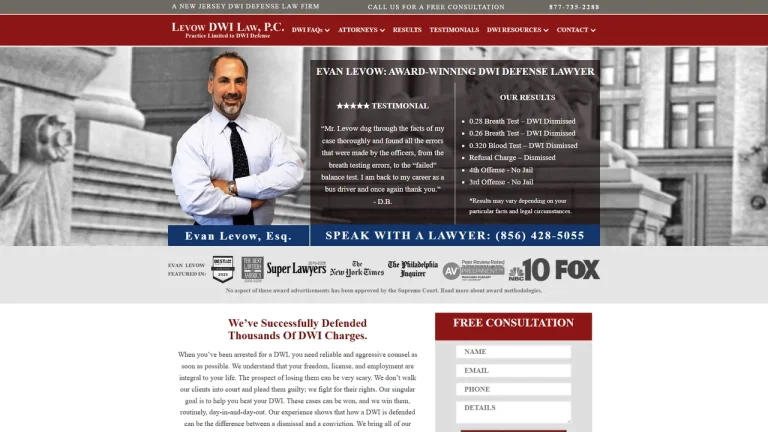
Levow DWI Law, P.C. - Jersey City, NJ
Giannetta & Giannetta - Newark, NJ
Robert Musto, Attorney at Law - Woodbridge, NJ
The Law Firm of Hunt, Hamlin & Ridley - Newark, NJ

Chadwick Law Firm - Newark, NJ

Law Offices of Peter G. Aziz & Associates LLC - Clifton, NJ
Herman Alarcon, Esq. - Elizabeth, NJ

Freeman & Patel LLC - Edison, NJ
Gary G. Flynn - Attorney at Law - Edison, NJ

Omojola Law - Jersey City, NJ
Ciro A. Spina, III, Esq. Attorney at Law - Clifton, NJ
Navigating New Jersey DWI Jurisdiction & Municipal Court Proceedings
Driving while intoxicated (DWI) or driving under the influence (DUI) in New Jersey is classified uniquely compared to many jurisdictions. Under Title 39 of the New Jersey Statutes, DWI is categorized as a traffic offense and a quasi-criminal violation rather than an indictable crime. Consequently, original jurisdiction over DWI charges rests within the local Municipal Court of the municipality where the traffic stop occurred, including busy municipal courts such as Newark, Jersey City, Toms River, Edison, and Cherry Hill.
Because DWI offenses are heard in Municipal Court, there is no constitutional right to a jury trial under state case law; cases are tried directly before a single Municipal Court judge. However, if a DWI incident involves severe vehicular injury, death, or eluding police, the matter escalates into an indictable offense (assault by auto or vehicular homicide) transferred to the New Jersey Superior Court Law Division, Criminal Part. Furthermore, administrative license suspensions, interlock records, and driving points are managed by the New Jersey Motor Vehicle Commission (NJ MVC).
Defense counsel representation is critical because plea bargaining for DWI offenses is strictly prohibited in New Jersey Municipal Courts pursuant to Supreme Court of New Jersey court guidelines. A favorable resolution cannot be obtained through standard plea concessions; it requires technical legal challenges targeting the initial reasonable suspicion for the stop, the administration of Standardized Field Sobriety Tests (SFSTs), or the scientific reliability of breath or blood samples.
New Jersey DWI Defense Legal Fee Structures & Representation Costs
| Case Scenario | Fee Structure | Estimated Cost (USD) | Key Cost Determinants |
|---|---|---|---|
| First-Offense DWI (BAC 0.08% to Less Than 0.10%) | Flat Fee | $1,500 - $3,500 | Motor vehicle stop legality, police bodycam video review, Alcotest data inspection, and Municipal Court conference appearances. |
| First-Offense DWI (BAC 0.10% or Greater, or Drug DUI) | Flat or Hourly ($250 - $450/hr) | $2,500 - $6,500 | Drug Recognition Expert (DRE) evaluation review, blood/urine laboratory reports, expert witness retention, and interlock duration disputes. |
| Repeat Offense (Second or Third DWI Violation) | Retainer + Hourly ($300 - $550/hr) | $4,500 - $12,000 | Mandatory incarceration exposure (up to 180 days for 3rd offense), ten-year step-down motions, prior conviction validity, and multi-session trial. |
| Refusal to Submit to Chemical Breath Testing | Flat or Hourly ($250 - $450/hr) | $2,000 - $5,000 | Verification of the officer's reading of the Standard Statement for Motor Vehicle Operators, language barriers, and physical inability to blow. |
Critical Legal Deadlines & Statutes in New Jersey
New Jersey DWI prosecutions are governed principally by N.J. Stat. Ann. § 39:4-50, while refusal violations are penalized under N.J. Stat. Ann. § 39:4-50.4a. Motor vehicle summonses carry strict statutory initiation windows. Under N.J. Stat. Ann. § 39:5-3, the state must formally file process for a DWI violation within thirty days of the commission of the offense, or within ninety days if the matter involves accidents or ongoing laboratory testing. Summonses issued beyond these statutory periods are subject to dismissal motions.
Once charged, cases proceed under the New Jersey Supreme Court Administrative Office of the Courts (AOC) directive, which establishes a policy goal of resolving municipal court DWI matters within sixty days of the summons date. Scientific evidence collection is governed by landmark state precedents including State v. Chun, which mandates strict calibration standards and a mandatory twenty-minute uninterrupted observation period prior to testing on the Draeger Alcotest machine. Failing to satisfy these scientific requirements can result in breath test suppression.
Small Claims Limitations vs. Municipal Court DWI Representation
Under N.J. Ct. R. 6:1-2, the Small Claims Section of the Superior Court Special Civil Part handles basic monetary recoveries up to $5,000. Small claims courts have no authority to hear traffic violations, dismiss summonses, or adjudicate motor vehicle laws. They are intended solely for basic commercial and property damage disputes.
Facing a DWI charge in Municipal Court without legal representation is exceptionally hazardous. Because state court rules expressly forbid plea bargaining a DWI down to a non-alcohol offense, the only path to avoiding conviction is establishing substantive legal or factual doubt. An unrepresented defendant faces mandatory installation of an ignition interlock device, thousands of dollars in NJ MVC surcharges, substantial auto insurance spikes, potential incarceration, and mandatory attendance at the Intoxicated Driver Resource Center (IDRC). Experienced legal counsel is essential to inspect technical calibration records and construct a viable defense.
Red Flags When Selecting a New Jersey DWI Defense Lawyer
- Attorneys who promise to plea bargain a DWI down to careless driving, ignoring the strict Supreme Court prohibition against DWI plea bargaining in Municipal Court.
- Lack of specialized technical training or certification in Standardized Field Sobriety Testing (SFST) or Draeger Alcotest breath testing operation.
- Failing to request the comprehensive Alcotest Foundational Document Package, which includes calibration records, solution change certificates, and firmware logs.
- Lawyers who do not inform clients about ongoing New Jersey Motor Vehicle Commission administrative surcharges and mandatory IDRC education requirements.
Frequently Asked Questions
Is a DWI a criminal conviction in New Jersey?
No. In New Jersey, a DWI is classified as a traffic offense under Title 39 rather than an indictable crime under Title 2C. As a result, a DWI conviction does not generate an indictable criminal record, although it appears permanently on your official New Jersey driving history.
Can a DWI charge be plea-bargained in New Jersey Municipal Court?
No. New Jersey Supreme Court guidelines strictly prohibit plea bargaining in DWI and chemical test refusal cases. To achieve a dismissal or reduction of penalties, your attorney must successfully challenge the legality of the traffic stop or suppress the scientific chemical evidence.
What are the penalties for a first-offense DWI in New Jersey?
First-offense penalties depend on BAC level. For a BAC between 0.08 and 0.10 percent, penalties include mandatory ignition interlock device installation for three months, fines, and twelve to forty-eight hours at an IDRC. Higher BAC levels require longer interlock duration and possible license forfeiture.
How can an attorney challenge Alcotest breath machine results?
Attorneys challenge Alcotest results by verifying that the officer adhered to the mandatory twenty-minute continuous observation period, evaluating instrument calibration records, checking simulator solution expiration dates, and verifying operator certification credentials.
What is the "step-down" provision for repeat DWI offenses in New Jersey?
Under state statute, if more than ten years have elapsed between your first and second DWI convictions, or between your second and third convictions, the court will treat the new offense as a lower-tier offense for sentencing purposes, known as the ten-year step-down rule.