
Wrongful Termination Lawyers in New Jersey
Hiring an experienced New Jersey wrongful termination lawyer safeguards your professional standing and ensures full enforcement of state anti-retaliation laws. Qualified legal counsel can frequently negotiate comprehensive severance packages or secure out-of-court settlements without protracted public litigation. Explore our vetted directory below to schedule a confidential consultation with a trusted New Jersey employment attorney.

Ansell Grimm & Aaron, PC - Newark, NJ

Gibbons P.C. - Trenton, NJ

Hunt Hamlin & Ridley - Paterson, NJ
Cahn & Parra P.A. - Edison, NJ
Capehart Scatchard - Trenton, NJ

Mazawey Law Firm LLC - Clifton, NJ
Maron Marvel Bradley Anderson & Tardy LLC - Jersey City, NJ

Brandon J. Broderick, Personal Injury Attorney at Law - Newark, NJ

Fernandez Garcia Law - Elizabeth, NJ
Moshes Law, P.C. - Jersey City, NJ

Patrick J. Whalen, Attorney at Law, LLC - Trenton, NJ
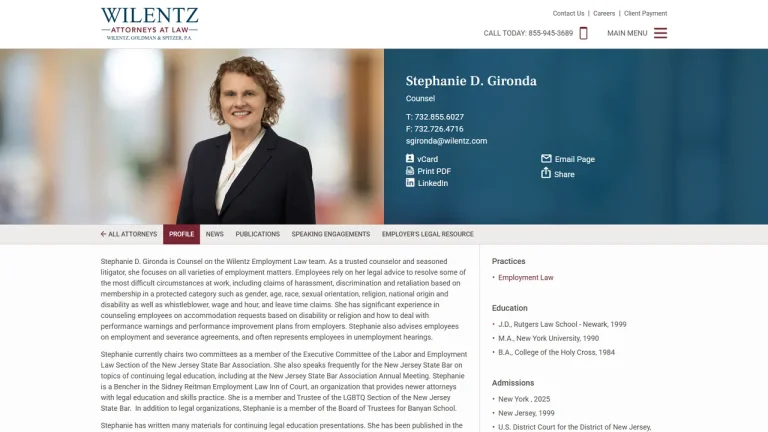
Stephanie D. Gironda - Woodbridge, NJ
Fleetwood Legal PC - Jersey City, NJ
Team Law - Edison, NJ
Riker Danzig LLP - Trenton, NJ

Adams Gutierrez & Lattiboudere, LLC - Newark, NJ
Chatarpaul Law - Jersey City, NJ
Castronovo & McKinney, LLC - Newark, NJ
Asta & Bickoff, Personal Injury Lawyers - Newark, NJ

Gibbons P.C. - Newark, NJ

Bond, Schoeneck & King PLLC - Newark, NJ

Jonathan S. Fabricant, Attorney at Law - Lakewood, NJ
Brandon J. Broderick, Personal Injury Attorney at Law - Lakewood, NJ
Protecting Discharged Employees Across New Jersey
While New Jersey recognizes the at-will employment doctrine, state statutes provide some of the strongest protections against unlawful dismissal in the nation. When an employer fires an employee in retaliation for blowing the whistle on illegal corporate practices, opposing unlawful discrimination, or asserting statutory rights, that termination constitutes an actionable wrongful discharge.
Wrongful termination disputes arise throughout commercial corridors in Essex, Bergen, Hudson, Middlesex, and Camden counties. Depending on the governing statute, lawsuits are litigated in the New Jersey Superior Court, Law Division across local county vicinages, or in the United States District Court for the District of New Jersey in Newark, Trenton, or Camden if federal questions or diversity rules apply.
Key statutory safeguards include the Conscientious Employee Protection Act (CEPA) under N.J. Stat. Ann. § 34:19-3 and common-law protections against terminations that violate clear mandates of public policy. Retaining counsel experienced in New Jersey employment jurisprudence ensures that evidence is preserved, employer defenses are challenged, and statutory claims are presented in the proper judicial venue.
New Jersey Wrongful Termination Fee & Representation Structures
| Case Scenario | Fee Structure | Estimated Cost (USD) | Key Cost Determinants |
|---|---|---|---|
| Severance Package Review & Separation Negotiation | Flat Fee or Hourly | $800 - $2,500 | Non-compete scope, release breadth, executive bonus and equity terms |
| Pre-Suit Whistleblower Demand & Mediation | Contingency or Hourly | $2,500 - $6,000 (or 33.3%) | Documentation of whistleblowing activity, economic loss scale, employer defense posture |
| Superior Court Law Division Retaliation Lawsuit | Contingency Fee | 33.3% - 40% of Recovery | Deposition volume, forensic accounting for back/front pay, summary judgment defense |
| Jury Trial Under CEPA or Public Policy Tort | Contingency (Fee-Shifting) | 40% of Net Award | Multi-week courtroom trial, expert vocational witness testimony, punitive damages proof |
Critical Legal Deadlines & Statutes in New Jersey
Strict statutory timeframes control wrongful termination litigation throughout New Jersey. Under the Conscientious Employee Protection Act, an employee must file a civil action within exactly one year of the retaliatory discharge pursuant to N.J. Stat. Ann. § 34:19-5. Missing this one-year cutoff completely extinguishes CEPA statutory whistleblower claims.
If the termination was motivated by discrimination, claims under the New Jersey Law Against Discrimination are subject to a two-year statute of limitations under N.J. Stat. Ann. § 10:5-12. Common-law wrongful discharge claims based on public policy violations must also be filed within two years pursuant to N.J. Stat. Ann. § 2A:14-2. Notably, filing a CEPA claim operates as a statutory waiver of certain parallel common-law claims, making preliminary legal evaluation crucial.
Small Claims Court vs. Retaining Legal Counsel
The New Jersey Special Civil Part, Small Claims Section is capped at a jurisdictional limit of $5,000, while the regular Special Civil Part adjudicates matters up to $20,000 under N.J. Ct. R. 6:1-2. While small claims is appropriate for collecting an unpaid final paycheck, it cannot properly address a wrongful termination lawsuit. Small claims courts have no power to award emotional distress damages, grant punitive damages, or order employee reinstatement.
Wrongful termination claims require comprehensive discovery, including internal corporate emails, HR investigation files, and comparative employee disciplinary records. Attempting to litigate against corporate defense counsel without representation frequently leads to premature dismissal on technical grounds. Because CEPA and the Law Against Discrimination contain statutory fee-shifting provisions, prevailing employees can require the employer to pay reasonable attorney fees, making skilled legal advocacy accessible.
Red Flags to Avoid When Selecting a Wrongful Discharge Attorney
- Overlooking the Strict One-Year CEPA Deadline: Practitioners unfamiliar with New Jersey employment law who treat a whistleblower matter like a standard two-year personal injury claim will forfeit your claims.
- Failing to Analyze the CEPA Statutory Waiver: Because pleading CEPA can automatically waive parallel common-law tort claims, your attorney must strategically select the most favorable legal causes of action.
- Demanding Large Non-Refundable Hourly Retainers: Where clear statutory retaliation or discrimination exists, reputable employee-side attorneys often work on contingency or hybrid fee arrangements.
- Guaranteeing Substantial Cash Verdicts Early: Ethical lawyers cannot guarantee dollar outcomes before reviewing personnel records, performance appraisals, and mitigation documentation.
Frequently Asked Questions
What constitutes wrongful termination under New Jersey law?
Wrongful termination occurs when an employer discharges an employee in violation of federal or state anti-discrimination statutes, in retaliation for whistleblowing under N.J. Stat. Ann. § 34:19-3, in violation of an employment contract, or in contravention of clear public policy.
What protections does the Conscientious Employee Protection Act (CEPA) provide?
CEPA shields workers from retaliatory actions, including termination, after they disclose, object to, or refuse to participate in an employer activity that they reasonably believe violates a law, rule, regulation, or clear mandate of public policy under N.H. Rev. Stat. Ann. § 34:19-3.
How long do I have to file a wrongful termination claim in New Jersey?
Whistleblower claims under CEPA must be filed in court within one year of discharge under N.J. Stat. Ann. § 34:19-5. Claims under the New Jersey Law Against Discrimination or common-law public policy must be filed within two years under N.J. Stat. Ann. § 10:5-12 and N.J. Stat. Ann. § 2A:14-2.
Can I sue for wrongful termination if I was an at-will employee?
Yes. While at-will employees may be terminated for any lawful business reason, employers cannot discharge an employee for unlawful discriminatory reasons, in retaliation for protected whistleblowing, or in violation of public policy.
What compensation can I recover in a New Jersey wrongful discharge case?
Recoverable damages may include back pay, front pay for future lost earnings, emotional distress damages, punitive damages for egregious employer conduct, and statutory attorney fees and litigation costs.