
Accident & Injury Lawyers in New York
Navigating serious personal injury claims in New York requires experienced legal counsel to secure full financial recovery and meet strict statutory deadlines. Skilled personal injury attorneys routinely settle complex tort disputes through pre-trial negotiation and mediation, avoiding prolonged courtroom litigation. Explore our verified directory below to connect with top-rated New York accident and injury attorneys for a free case evaluation.
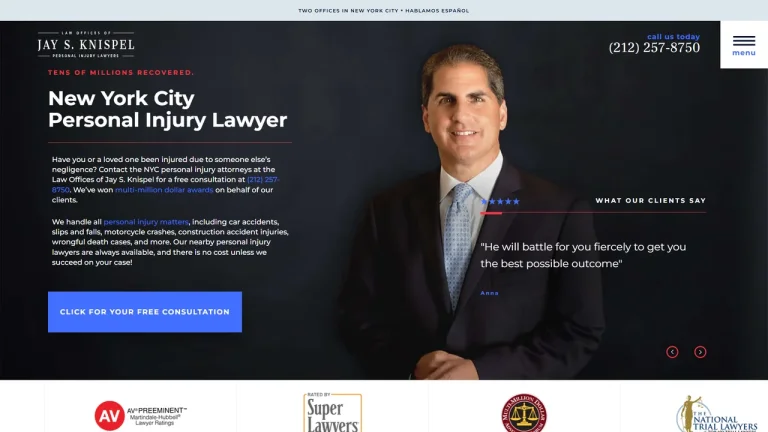
Law Offices of Jay S. Knispel Personal Injury Lawyers - New York City
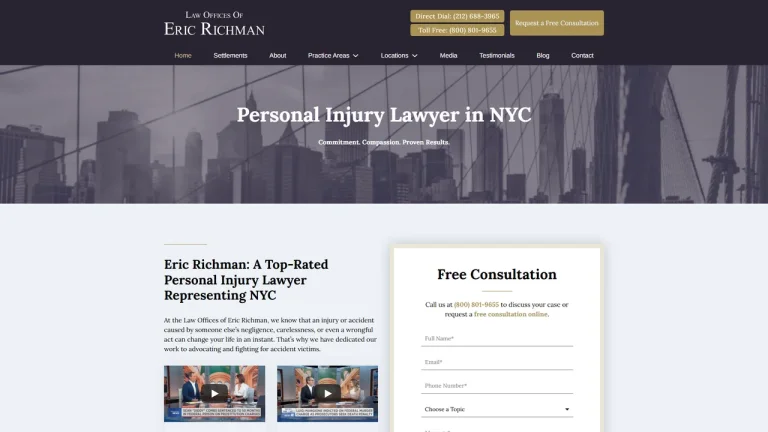
The Law Offices of Eric Richman - NYC, New York

Law Office of Natascia Ayers - NYC, New York
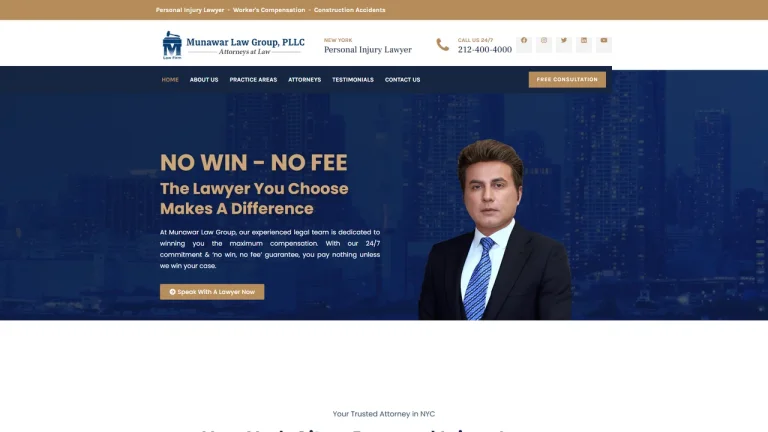
Munawar Law Group, PLLC - NYC, New York

Frekhtman & Associates - NYC, New York

Robinson Yablon Cooper & Bonfante, LLP - NYC, New York
Senior Justice Law Firm | Rochester Nursing Home Abuse Attorneys - NY

Samuel C. Breslin, Esq. - Breslin Law Group, PLLC - Albany, NY

Zaltzberg Law - NYC, New York

James Hopkins Law Firm - Syracuse, NY
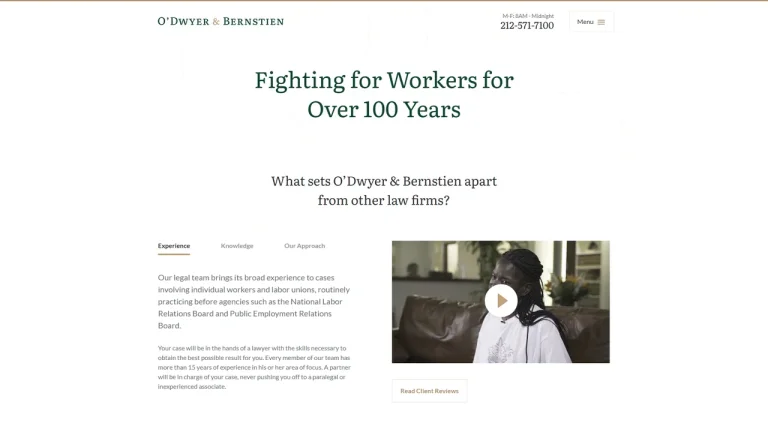
O'Dwyer & Bernstien, LLP - NYC, New York

Senior Justice Law Firm - NYC, New York

NYC Personal Injury Lawyer - Tanya Gendelman, P.C. - Midtown Office - NYC, New York
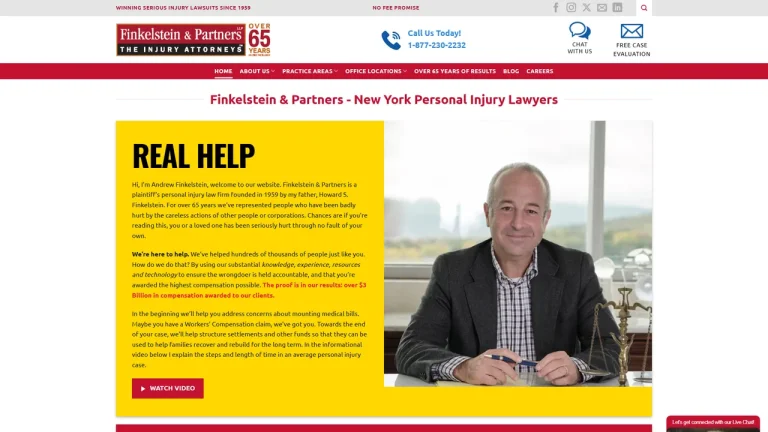
Finkelstein & Partners, LLP - Albany, NY

Syracuse Personal Injury Attorney at Law Brandon J. Broderick - NY

Wallace Turner Law, LLP - Albany, NY
McLaughlin & Stern LLP - NYC, New York

The Cochran Firm - NYC, New York

Girvin & Ferlazzo, PC - Albany, NY

Arye, Lustig & Sassower, P.C. - NYC, New York
Paul B. Weitz & Associates, PC - NYC, New York
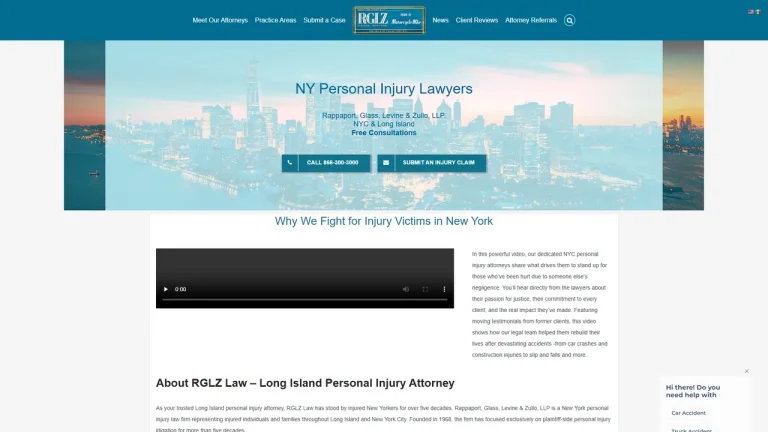
Rappaport, Glass, Levine & Zullo, LLP - NYC, New York
The Law Offices of MARSHALL S. BLUTH - NYC, New York

Pollack, Pollack, Isaac & DeCicco, LLP - NYC, New York
New York Personal Injury Law and Judicial Venues
Personal injury and tort litigation across New York State is adjudicated in the New York State Supreme Court, which maintains general trial jurisdiction across all 62 counties. From the urban courthouses of the five New York City boroughs to Supreme Court venues in Nassau, Suffolk, Westchester, Albany, Onondaga, and Erie counties, injury claims are evaluated under the New York Civil Practice Law and Rules (CPLR) and substantive state tort doctrine.
New York adheres to a pure comparative fault doctrine codified in N.Y. C.P.L.R. § 1411. Under this statutory principle, an injured plaintiff's recoverable damages are diminished in proportion to their culpable conduct, but recovery is never completely barred, even if the plaintiff is predominantly responsible. Motor vehicle accidents are subject to New York's No-Fault Insurance Law under Article 51 of the New York Insurance Law, which provides mandatory first-party medical and wage benefits regardless of fault.
Construction site accidents in New York are governed by specialized worker-protection statutes. Most prominent is New York's Scaffold Law (N.Y. Lab. Law § 240(1)), which imposes absolute statutory liability on property owners and general contractors for elevation-related injuries, alongside statutory protections under N.Y. Lab. Law § 241(6). Tort pleadings, expert exchanges, and trial notes of issue are submitted electronically statewide through the New York State Courts Electronic Filing (NYSCEF) portal.
Injury Case Scenarios, Fee Models, and Recovery Expectations
| Case Scenario | Fee Structure | Estimated Cost (USD) | Key Cost Determinants |
|---|---|---|---|
| Motor Vehicle Collision (Serious Injury Threshold) | Contingency Fee (33.33%) | $0 upfront (Statutory fee cap applies) | Serious injury verification under N.Y. Ins. Law § 5102(d), insurance policy maximums |
| Construction Site Elevation Fall (Scaffold Law) | Contingency Fee (33.33%) | $0 upfront (Statutory fee cap applies) | Absolute liability under N.Y. Lab. Law § 240(1), general contractor indemnification |
| Commercial Property Slip / Trip and Fall | Contingency Fee (33.33%) | $0 upfront (Statutory fee cap applies) | Actual or constructive notice of hazard, municipal sidewalk liability, video evidence |
| Medical Malpractice Action | Sliding Scale Contingency | $0 upfront (Statutory sliding scale under Judiciary Law 474-a) | Certificate of merit filing, medical expert witness reports, economic life care plans |
Critical Legal Deadlines & Statutes in New York
Navigating personal injury claims in New York State demands rigorous compliance with strict statutory limitation periods. Under N.Y. C.P.L.R. § 214(5), an action to recover damages for personal injury must be commenced within three years from the date of the accident. Wrongful death actions carry an abbreviated two-year statute of limitations from the date of death under N.Y. EPTL § 5-4.1, while medical malpractice actions must be brought within two years and six months under N.Y. C.P.L.R. § 214-a.
For motor vehicle accidents, injured parties must file a formal Application for Motor Vehicle No-Fault Benefits (Form NF-2) with the relevant insurance carrier within thirty calendar days of the accident pursuant to 11 NYCRR 65-1.1. When pursuing claims against municipal entities, public transit systems (such as the MTA or county transit authorities), or public benefit corporations, a formal Notice of Claim must be served within ninety days of the accident under N.Y. Gen. Mun. Law § 50-e. The subsequent action must be commenced within one year and ninety days under N.Y. Gen. Mun. Law § 50-i.
Small Claims Limitations vs. Retaining Personal Injury Counsel
New York small claims courts-which have jurisdictional caps between $3,000 and $10,000 depending on whether the action is in a Justice Court, City Court, District Court, or NYC Civil Court-are designed for property damage disputes. Pursuing a serious bodily injury claim pro se in small claims results in significant financial under-recovery and fails to account for future medical care, lost earning capacity, and pain and suffering.
In motor vehicle claims, an unrepresented party must overcome the statutory 'serious injury threshold' defined in N.Y. Ins. Law § 5102(d) to recover non-economic damages. Retaining an injury attorney on a contingency basis requires zero upfront legal fees and ensures proper medical documentation from orthopedic and neurological experts. Experienced counsel issues formal discovery demands, depose defense medical examiners, and presents compelling liability arguments before Supreme Court juries.
Red Flags When Hiring a New York Injury Lawyer
Injured individuals seeking legal counsel in New York should be vigilant against predatory practices and ethical infractions:
- Unsolicited in-person solicitations by 'runners' or non-attorney representatives at accident scenes, hospitals, or private residences, which violates New York anti-solicitation rules.
- Lawyers demanding upfront retainers or out-of-pocket payments for standard personal injury matters that are customarily handled on contingency.
- Attorneys charging contingency rates exceeding the statutory one-third (33 1/3%) limit mandated by New York court rules for personal injury matters.
- Law firms that fail to clarify whether litigation disbursements (e.g., expert fees, deposition transcripts) will be deducted before or after calculating the contingency fee.
Frequently Asked Questions
What constitutes a serious injury under New York Insurance Law?
Under N.Y. Ins. Law § 5102(d), an injured party can pursue a lawsuit for pain and suffering only if they sustain a qualifying 'serious injury,' which includes death, dismemberment, significant disfigurement, a fracture, loss of a fetus, permanent loss of use of a body organ, significant limitation of a body function, or an impairment lasting at least 90 of the first 180 days post-accident.
How does pure comparative fault operate in New York injury cases?
Pursuant to N.Y. C.P.L.R. § 1411, New York applies pure comparative negligence. Even if an injured plaintiff is found to be 80% at fault for an incident, they remain entitled to recover the remaining 20% of their total proven damages from the other responsible parties.
What is the deadline for filing No-Fault insurance paperwork in New York?
Under 11 NYCRR 65-1.1, the completed Application for Motor Vehicle No-Fault Benefits (Form NF-2) must be submitted to the automobile insurance company within thirty calendar days from the date of the motor vehicle accident to preserve medical and lost wage benefits.
What is New York's Scaffold Law (Labor Law Section 240)?
Codified in N.Y. Lab. Law § 240(1), the Scaffold Law imposes absolute liability on contractors and building owners when construction workers suffer falls from heights or are struck by falling objects due to failure to provide adequate safety equipment like scaffolding, hoists, stays, or ladders.
How are contingency fees structured for New York personal injury attorneys?
Under New York court rules (22 NYCRR 603.7 and 691.20), personal injury contingency fees are legally capped at a maximum of 33 1/3 percent of the net recovery after allowable litigation expenses have been deducted.