
DUI/DWI Defense Lawyers in Albany
Arrested for a DUI or DWI in Albany? Experienced criminal defense attorneys challenge breathalyzer calibrations, contest traffic stops, and protect your driving privileges under New York law. Dedicated Albany County DWI lawyers work to reduce charges and prevent license revocations without prolonged trials. Explore our directory below to schedule a confidential consultation with a trusted local defense attorney.

Law Office Of Georgia Murray-Bonton, P.C. - Albany, NY
O’Brien & Eggleston PLLC - Albany, NY

The Law Office of James L. Riotto - Albany, NY
Premo Law Firm PLLC - Albany, NY
Cooper Erving & Savage LLP - Albany, NY
Law offices of Joseph F. Jacob, PLLC - Albany, NY

Law Offices of Jacob Vredenburgh - Albany, NY
Blanchfield & Fallon, LLP - Albany, NY
Scheuermann & Scheuermann, LLP - Albany, NY

The Smelyansky Law Firm - Albany, NY
Gerstenzang, Sills, Cohn & Gerstenzang - Albany, NY
The Kindlon Law Firm, PLLC - Albany, NY

Law Office of James C. Davis - Albany, NY

Trevor W. Hannigan, Attorney at Law - Albany, NY

Martin Kehoe and Associates, P.C. - Albany, NY
John J. Lindsey Attorney-at-Law - Albany, NY

Rosenblum Law - Albany, NY
Matthew J. Simone, Esq. - Albany, NY
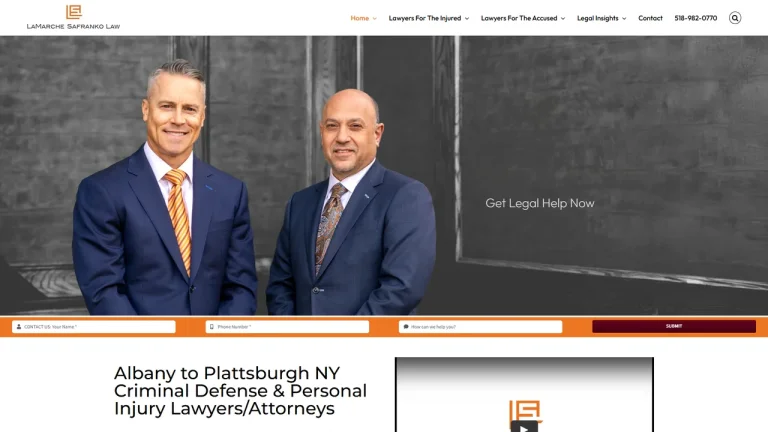
LaMarche Safranko Law PLLC - Albany, NY
Martin P. Bonventre, Esq. - Albany, NY
Spada Law Firm - Albany, NY

Derohannesian & Derohannesian - Albany, NY
Finn Law Offices - Albany, NY
Aggressive DUI and DWI Defense in Albany and Albany County
Driving While Intoxicated (DWI) and Driving While Ability Impaired (DWAI) charges in Albany carry severe statutory penalties, including immediate driver's license suspension, substantial fines, mandatory ignition interlock installation, and potential incarceration. Law enforcement agencies-including the Albany Police Department, the Albany County Sheriff's Office, and New York State Police Troop G-actively enforce drunk driving laws along major corridors such as Interstate 90, Interstate 787, Central Avenue, and Western Avenue.
Court jurisdiction is determined by the severity of the charge. Misdemeanor DWI cases and chemical test refusals within city limits are arraigned and tried at the Albany City Court (Criminal Part), located at the Morton Avenue Police Court Building, 209 Morton Avenue in Albany. When an incident involves aggravating circumstances-such as repeat offenses within 10 years or passengers under 16 years of age under Leandra's Law-the case is prosecuted as a felony by the Albany County District Attorney's Office in the Albany County Court at 6 Lodge Street.
An experienced Albany DWI defense attorney reviews the initial traffic stop for lack of reasonable suspicion, assesses the administration of Standardized Field Sobriety Tests (SFSTs), examines calibration records for the Draeger Alcotest 9510 chemical breath instrument, and represents drivers at administrative DMV refusal hearings to protect driving privileges.
New York DWI Defense Fee Structures and Charge Classifications
DWI defense legal services in Albany are generally billed under structured flat fees reflecting the anticipated court appearances, administrative hearings, and trial preparation required.
| Case Scenario | Fee Structure | Estimated Cost (USD) | Key Cost Determinants |
|---|---|---|---|
| First-Offense DWAI / DWI (Albany City Court) | Flat Fee | $2,000 - $4,500 | Chemical breath test result, conditional license eligibility, Pringle hearing outcome. |
| Aggravated DWI (BAC .18% or Higher) | Flat / Retainer | $3,500 - $7,500 | Machine maintenance records, plea bargaining limitations, mandatory ignition interlock terms. |
| Felony DWI / Leandra's Law Indictment (County Court) | Retainer / Tiered Flat | $7,500 - $18,000 | Grand Jury presentation, prior DWI convictions within 10 years, potential state prison time. |
| NYS DMV Chemical Test Refusal Hearing | Flat Fee | $1,000 - $2,500 | Cross-examination of arresting officer, preservation of hearing transcript for criminal defense. |
Critical Legal Deadlines & Statutes in New York
New York Vehicle and Traffic Law classifies alcohol and drug driving offenses under strict statutory thresholds. Under N.Y. Veh. & Traf. Law § 1192, driving while ability impaired (DWAI) is a traffic infraction under subsection (1), per se DWI (.08% BAC or higher) is a misdemeanor under subsection (2), common-law DWI is governed by subsection (3), and Aggravated DWI (.18% BAC or higher) is classified under subsection (2-a).
Under New York's prompt suspension law, N.Y. Veh. & Traf. Law § 1193(2)(e)(7), a judge must suspend a driver's license at initial arraignment if a chemical test shows a BAC of .08% or higher, unless the defense requests a Pringle hearing. If a driver refuses a chemical test, N.Y. Veh. & Traf. Law § 1194 mandates an administrative refusal hearing before a DMV Administrative Law Judge within 15 days; a refusal finding results in an automatic 1-year license revocation and a $500 civil penalty. Furthermore, under Leandra's Law, codified at N.Y. Veh. & Traf. Law § 1198, any individual convicted of misdemeanor or felony DWI must install an ignition interlock device on all operated vehicles for at least 12 months. Speedy trial rules under N.Y. Crim. Proc. Law § 30.30 require the prosecution to be ready for trial within 90 days for Class A misdemeanor DWI.
DMV Administrative Refusal Hearings vs. Criminal Court Proceedings
Following an arrest for DWI in Albany, drivers often face two separate legal proceedings. If the driver allegedly refused a chemical test, a separate administrative proceeding is conducted by the New York State Department of Motor Vehicles. In this administrative setting, if the DMV Administrative Law Judge finds that the officer had reasonable grounds for the arrest and the driver refused after statutory warnings under N.Y. Veh. & Traf. Law § 1194, the driver's license is revoked for 1 year with no hardship driving privileges, regardless of what happens in criminal court.
Concurrently, the criminal case proceeds at Albany City Court (Morton Avenue) or Albany County Court (Lodge Street). Pleading guilty without counsel creates a permanent criminal record and mandatory ignition interlock requirements under N.Y. Veh. & Traf. Law § 1198. Experienced defense counsel uses the DMV refusal hearing to cross-examine the arresting officer under oath, securing testimony that can be used to suppress evidence and achieve charge reductions to non-criminal traffic infractions in criminal court.
Red Flags When Hiring an Albany DWI Defense Lawyer
- Failing to appear at the DMV Chemical Test Refusal Hearing, resulting in an automatic default 1-year license revocation under N.Y. Veh. & Traf. Law § 1194.
- Promising that charges will automatically be reduced to DWAI without reviewing police body-worn camera footage or breathalyzer calibration logs.
- Failing to request a Pringle hearing or failing to petition for a conditional hardship license at the initial arraignment under N.Y. Veh. & Traf. Law § 1193(2)(e)(7).
- Lack of courtroom experience before the judges of the Albany City Court Criminal Part or the Albany County Court.
Frequently Asked Questions
What is the difference between DWI and DWAI in New York?
DWI under N.Y. Veh. & Traf. Law § 1192(2) is an unclassified misdemeanor involving a BAC of .08% or higher, resulting in a criminal record. DWAI under N.Y. Veh. & Traf. Law § 1192(1) is a non-criminal traffic infraction for impairment between .05% and .07% BAC.
Will my license be suspended immediately after an Albany DWI arrest?
Yes. Under N.Y. Veh. & Traf. Law § 1193(2)(e)(7), your license is suspended at your initial arraignment if you submitted to a chemical test showing a BAC of .08% or higher, though you may be eligible for a hardship privilege.
What happens if I refuse the chemical breath test in Albany?
Under N.Y. Veh. & Traf. Law § 1194, refusing a chemical test results in an administrative DMV hearing. If sustained, your license is revoked for at least 1 year, and you face a $500 civil penalty, separate from criminal court outcomes.
What is Leandra's Law in New York?
Under N.Y. Veh. & Traf. Law § 1198, Leandra's Law makes driving drunk with a child under 16 a Class E felony and mandates the installation of an ignition interlock device on any vehicle operated by anyone convicted of DWI.