
Pedestrian Injury Lawyers in New York
Retaining a seasoned pedestrian injury lawyer in New York safeguards your rights, secures vital no-fault medical coverage, and maximizes financial recovery. Qualified legal counsel regularly resolves complex motor vehicle liability disputes through strategic insurance negotiations, avoiding prolonged court trials. Explore our directory below to consult verified New York pedestrian accident attorneys across the state.

Scott Baron & Associates P.C. - Yonkers, NY

Finkelstein & Partners, LLP - Syracuse, NY

The Ward Law Group, PLLC - NYC, New York
Law Office of Manuel D. Gomez P.C - NYC, New York
Grandelli & Eskenasi - NYC, New York
The Law Offices of Eric Richman - NYC, New York

Queller, Fisher, Washor, Fuchs & Kool and The Law Office Of William A. Gallina, LLP - NYC, New York

Finz & Finz, P.C. - NYC, New York

Hiller Comerford Injury & Disability Law - Rochester, NY

Cesar Zuniga Esq., Attorney at Law - Yonkers, NY
Krentsel Guzman Herbert, LLP - NYC, New York

DeMore Law Firm, PLLC - Syracuse, NY
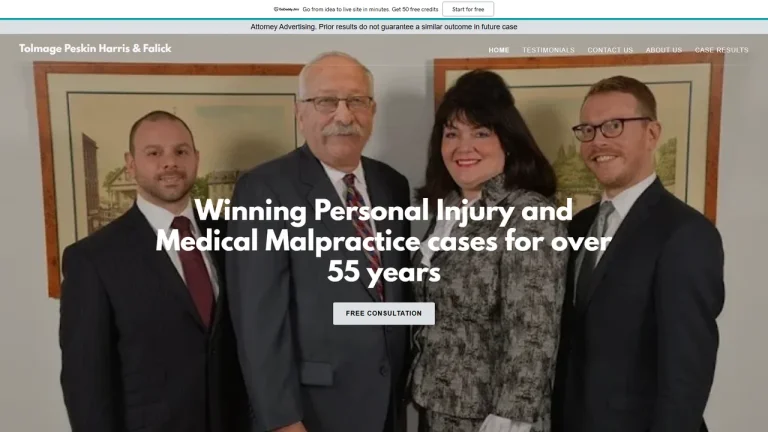
Tolmage, Peskin, Harris, Falick - NYC, New York
DeFrancisco & Falgiatano Personal Injury Lawyers - Rochester, NY

Stanley Law Offices Car Accident Lawyers - Syracuse, NY
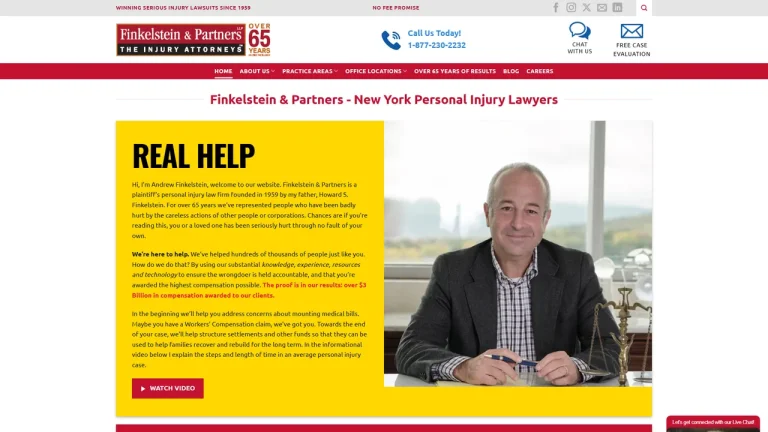
Finkelstein & Partners, LLP - Albany, NY

Konta, Georges & Buza, P.C. - NYC, New York
William Mattar Rochester Accident Lawyers - NY

Pulvers, Pulvers & Thompson, L.L.P. - NYC, New York

William Mattar Syracuse Accident Lawyers - NY

A. Cohen Law Firm, P.C. - NYC, New York

The Cochran Firm - NYC, New York
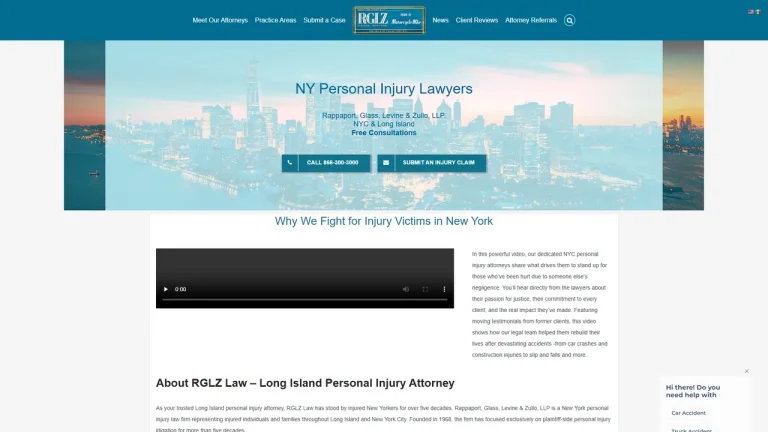
Rappaport, Glass, Levine & Zullo, LLP - NYC, New York

Kelner & Kelner - NYC, New York
New York Pedestrian Injury Framework & Court Venues
Pedestrian safety is a major legal focus throughout the Empire State, where dense urban foot traffic in New York City, busy suburban crossings on Long Island and Westchester, and arterial roads in Buffalo, Rochester, Syracuse, and Albany produce high volumes of vehicle-pedestrian collisions. Struck pedestrians face catastrophic injuries due to the total absence of physical protection.
Civil lawsuits seeking compensation for physical trauma, lost earnings, and long-term care are initiated in the Supreme Court of the State of New York in the county where the collision occurred or where the parties reside. If the incident involves a collision with a municipal vehicle-such as a city sanitation truck, police cruiser, or county utility vehicle-plaintiffs must navigate specialized municipal notice prerequisites alongside traditional civil litigation.
Partnering with a seasoned New York pedestrian accident lawyer ensures that immediate No-Fault insurance coverage is established to pay hospital bills while third-party tort claims proceed. Experienced counsel manages forensic crash reconstructions, obtains traffic light sequence logs, and prosecutes claims electronically through the New York State Courts Electronic Filing (NYSCEF) system.
Pedestrian Injury Legal Fees & Compensation Structures
| Case Scenario | Fee Structure | Estimated Cost (USD) | Key Cost Determinants |
|---|---|---|---|
| Marked Crosswalk Collision with Driver Negligence | Contingency Fee | 33.3% of recovery | Driver bodily injury policy limits, prompt No-Fault wage processing, severity of orthopedic fractures |
| Disputed Intersection & Comparative Negligence | Contingency Fee | 33.3% of recovery | Traffic control signal phase timing, security video retrieval, comparative fault percentage split |
| Hit-and-Run / Uninsured Motorist Claim (MVAIC) | Contingency Fee | 33.3% of recovery | 24-hour police report verification, MVAIC notice filing compliance, uninsured motorist policy limits |
| Municipal Roadway Defect or Crosswalk Hazard | Contingency Fee | 33.3% of settlement | 90-day Notice of Claim compliance, engineering sightline evaluations, prior written notice defense |
Critical Legal Deadlines & Statutes in New York
Pedestrian injury claims in New York require compliance with dual statutory tracks: No-Fault administrative deadlines and civil tort limitations. Immediately following a collision, the pedestrian must submit an Application for Motor Vehicle No-Fault Benefits (Form NF-2) to the insurer of the vehicle that struck them within strictly 30 calendar days under 11 N.Y.C.R.R. § 65-1.1 and N.Y. Ins. Law § 5106. Missing this 30-day window can result in denial of all medical coverage and lost wage benefits.
For bodily injury lawsuits against negligent private drivers, the statute of limitations is strictly three years from the date of the collision pursuant to N.Y. C.P.L.R. § 214(5). However, to bring a lawsuit for non-economic pain and suffering, the pedestrian must satisfy the serious injury threshold codified in N.Y. Ins. Law § 5102(d), proving a bone fracture, significant disfigurement, permanent limitation of a body organ, or a non-permanent impairment preventing normal daily activities for 90 of the first 180 days following the crash.
If the striking vehicle was operated by a municipality or public authority, a sworn Notice of Claim must be served within 90 days under N.Y. Gen. Mun. Law § 50-e, with the lawsuit filed within one year and 90 days under N.Y. Gen. Mun. Law § 50-i. In hit-and-run scenarios involving the Motor Vehicle Accident Indemnification Corporation (MVAIC), the crash must be reported to the police within 24 hours pursuant to N.Y. Ins. Law § 5208. Under N.Y. C.P.L.R. § 1411, New York applies a pure comparative negligence rule, ensuring that any comparative fault assigned to the pedestrian reduces financial recovery proportionally rather than barring compensation.
Small Claims Court vs. Supreme Court Pedestrian Litigation
Small claims courts throughout New York handle civil disputes up to $5,000 or $10,000 depending on the court. While an individual might consider small claims court for torn apparel or damaged personal property, personal injuries arising from pedestrian collisions must never be pursued pro se in small claims parts.
Pedestrians struck by motor vehicles frequently suffer traumatic brain injuries, spinal cord trauma, torn knee ligaments, or pelvic fractures requiring extensive surgery and long-term rehabilitation. Insurance defense carriers routinely seek immediate case dismissals by arguing that an unrepresented claimant does not meet the "serious injury" standard under Insurance Law § 5102(d). Establishing permanent impairment requires engaging orthopedic surgeons, radiologists, and economic life-care planners in the New York State Supreme Court.
Red Flags to Avoid When Selecting Pedestrian Accident Counsel
- Attorneys who fail to file the mandatory No-Fault application (Form NF-2) within 30 days of the collision, leaving the client personally responsible for medical debt.
- Law firms that neglect the 24-hour police reporting rule in hit-and-run accidents, forfeiting compensation available through MVAIC under Insurance Law § 5208.
- Practitioners who recommend quick settlements before diagnostic MRIs, surgical evaluations, and permanency ratings are completed.
- Lawyers whose active licensing and good standing cannot be verified through the New York State Unified Court System attorney registry.
Frequently Asked Questions
Who pays my medical bills if I was hit by a car as a pedestrian in New York?
Under New York's No-Fault insurance law, the insurance carrier of the motor vehicle that struck you is legally responsible for paying your ambulance, hospital, and medical bills, as well as statutory lost wages, up to $50,000, provided you file Form NF-2 within 30 days.
What is the 'serious injury' threshold in New York pedestrian law?
Under Insurance Law § 5102(d), you can only sue the negligent driver for pain and suffering if your injuries qualify as 'serious.' Qualifying injuries include fractures, significant disfigurement, permanent loss of use of a body function, or disability lasting 90 out of the first 180 days.
What happens if I was hit by a hit-and-run driver who was never identified?
If you or a household relative own a vehicle, you can file an Uninsured Motorist claim under that policy. If you do not have access to an auto policy, you can seek benefits through the New York Motor Vehicle Accident Indemnification Corporation (MVAIC), provided the accident was reported to police within 24 hours.
Can I recover damages if I was crossing outside a marked crosswalk?
Yes. Under New York's pure comparative fault rule (CPLR 1411), crossing outside a crosswalk does not bar financial recovery. While your compensation may be reduced by your percentage of fault, drivers still have a statutory duty under state law to exercise due care to avoid striking pedestrians.
How long do I have to file a lawsuit against the driver who hit me?
Under CPLR § 214(5), you have three years from the date of the collision to file a personal injury lawsuit against a private driver. However, if the vehicle was owned by a government municipality, you must file a Notice of Claim within 90 days.