
Divorce & Family Law Lawyers in Charlotte
Retaining skilled divorce and family law lawyers in Charlotte protects your parental rights and high-value marital assets under North Carolina domestic law. Experienced local attorneys resolve custody, support, and property division through strategic mediation, avoiding acrimonious trials. Browse our verified Charlotte directory below to schedule your consultation.

Tin Fulton Walker & Owen, PLLC - Charlotte, NC

Law Office of Thomas D. Bumgardner, PLLC - Charlotte, NC

Law Offices of Pamela A. Hunter - Charlotte, NC

Gilchrist Law Firm - Charlotte, NC

The Freedmen Law Group - Charlotte, NC

Myers Law Firm, PLLC - Charlotte, NC

Curcio Anderson Law - Charlotte, NC

Arnold & Smith PLLC - Charlotte, NC

Knox Law Center - Charlotte, NC

The Law Offices of Robert J. Reeves P.C. - Charlotte, NC
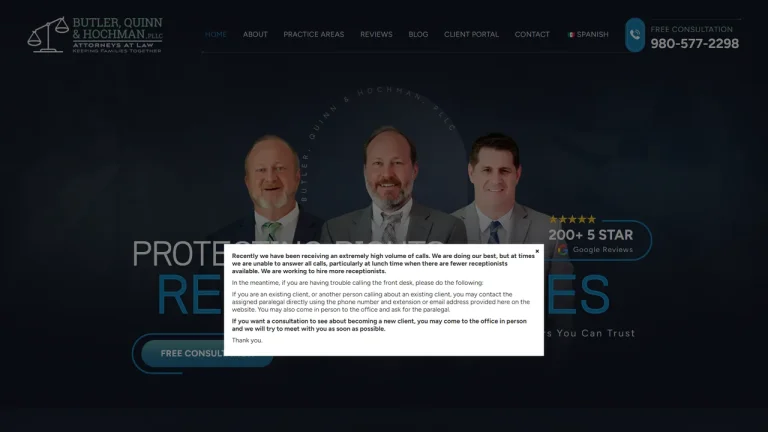
Butler, Quinn & Hochman, PLLC - Charlotte, NC

Beth Sibley Law Offices, PLLC - Charlotte, NC

Tran Law Firm, PLLC - Charlotte, NC

Phillips & McCrea, PLLC - Charlotte, NC

Sodoma Law - Charlotte, NC

SeiferFlatow, PLLC - Charlotte, NC

Hefferon Law, PLLC - Charlotte, NC

Jarvis Law, PLLC - Charlotte, NC

Central Law Group, PLLC - Charlotte, NC

The Law Offices of David A. Concha, P.C. - Charlotte, NC

Crews Law Firm, PLLC - Charlotte, NC

The Hatcher Law Office, PLLC - Charlotte, NC

Browning & Long, PLLC - Charlotte, NC

Navigating Family Law & Asset Division Across Mecklenburg County
Navigating divorce and family dissolution in Charlotte involves distinct financial and personal complexities. As the nation's second-largest banking hub, Charlotte is home to numerous corporate executives, financial sector leaders, and business founders across neighborhoods like Myers Park, Dilworth, SouthPark, and Ballantyne. Marital estates routinely involve deferred executive compensation, restricted stock units (RSUs), private equity interests, and complex real estate portfolios.
All domestic relations proceedings in Charlotte are administered by the Mecklenburg County Family Court at the Mecklenburg County Courthouse on East 4th Street in Uptown Charlotte. Operating within North Carolina's 26th Judicial District, the dedicated Family Court division coordinates child custody mediation, post-separation support hearings, and complex equitable distribution trials under specialized local domestic rules.
Engaging a seasoned Charlotte family law attorney is vital to protecting your financial future and parental rights. Local counsel understands the evidentiary expectations of Mecklenburg County Family Court judges, coordinates with certified business valuation experts and forensic accountants, and ensures all filings comply with North Carolina eCourts filing requirements.
Family Law Proceeding Scenarios & Representation Costs
| Case Scenario | Fee Structure | Estimated Cost (USD) | Key Cost Determinants |
|---|---|---|---|
| Uncontested Absolute Divorce Filing | Flat Fee | $950 - $2,500 | Mecklenburg County Sheriff service, hearing waiver submission, entry of divorce decree. |
| Comprehensive Separation Agreement (SAPS) | Hourly Rate / Retainer | $3,000 - $7,500 | Complex banking equity division, real property deeds, non-litigated alimony terms. |
| Contested Child Custody & Relocation Litigation | Hourly Rate / Retainer | $6,000 - $20,000 | Mandatory custody mediation, forensic psychological evaluations, guardian ad litem review. |
| High-Net-Worth Equitable Distribution & Alimony Trial | Hourly Rate + Retainer | $15,000 - $45,000+ | Executive stock valuation, forensic lifestyle tracing, marital misconduct evidentiary hearings. |
Critical Legal Deadlines & Statutes in North Carolina
Under N.C. Gen. Stat. § 50-6, spouses must live separate and apart in separate residences for at least 1 full continuous year, with the intention of at least one spouse to remain permanent, before an absolute divorce complaint can be filed. At least one spouse must have resided in North Carolina for 6 months prior to filing under N.C. Gen. Stat. § 50-8.
Under N.C. Gen. Stat. § 50-11, the entry of an absolute divorce judgment completely and permanently extinguishes all rights to equitable distribution of marital property and alimony, unless those claims are formally asserted and pending before the court prior to the judgment. This makes the timing of property and support filings paramount.
Equitable distribution is governed by N.C. Gen. Stat. § 50-20, which presumes an equal 50/50 division of marital and divisible property unless the court finds an equal split inequitable. Spousal support is governed by N.C. Gen. Stat. § 50-16.2A for post-separation support and N.C. Gen. Stat. § 50-16.3A for permanent alimony. If the supporting spouse committed illicit sexual behavior under N.C. Gen. Stat. § 50-16.1A(3), alimony is mandatory; if the dependent spouse committed illicit sexual behavior, alimony is barred. Child custody is decided under the best interest of the child standard pursuant to N.C. Gen. Stat. § 50-13.2.
Small Claims Limits vs. Retaining Legal Counsel
While Mecklenburg County Small Claims Court exercises jurisdiction up to $10,000 under N.C. Gen. Stat. § 7A-210 before a magistrate, magistrates have zero jurisdiction over divorce, equitable distribution, child custody, or spousal support. All family law matters are assigned exclusively to the District Court Division.
Attempting a DIY divorce in Charlotte without legal representation is extraordinarily risky. Unrepresented spouses frequently download generic online forms and obtain an absolute divorce, unintentionally waiving their statutory rights to millions of dollars in 401(k) accounts, bank pensions, real estate equity, and alimony under N.C. Gen. Stat. § 50-11. A Charlotte family attorney ensures all property claims are preserved, drafts enforceable Separation Agreements and Property Settlements (SAPS), and manages formal QDRO retirement orders.
Red Flags to Avoid When Selecting Legal Counsel
- Allowing Divorce Decrees Before Property Claims: Immediately terminate counsel who suggests finalizing an absolute divorce before filing equitable distribution or alimony claims; this mistake causes irreversible forfeiture under state law.
- Lack of Executive Compensation Knowledge: Charlotte divorces frequently involve banking RSUs, stock options, and partnership capital accounts; avoid practitioners unfamiliar with executive asset valuation.
- Unnecessary Conflict Escalation: Be cautious of litigators who oppose mediation to run up billable hours; the 26th Judicial District encourages collaborative dispute resolution.
- Overlooking Marital Misconduct Impact: Infidelity directly controls alimony determinations in North Carolina; your attorney must understand the evidentiary standards for illicit sexual behavior.
Frequently Asked Questions
How long do I have to be separated before filing for divorce in Charlotte?
Under N.C. Gen. Stat. § 50-6, you and your spouse must live physically separate and apart in different residences for at least 1 full continuous year before either spouse can file for an absolute divorce.
What happens if an absolute divorce is granted before filing for equitable distribution?
Under N.C. Gen. Stat. § 50-11, an absolute divorce judgment permanently destroys your right to seek equitable distribution of marital property or alimony, unless those claims were formally filed and pending before the court prior to the judgment.
How does marital infidelity impact alimony in Mecklenburg County?
Under N.C. Gen. Stat. § 50-16.3A, if the dependent spouse committed illicit sexual behavior, alimony is generally barred. If the supporting spouse committed illicit sexual behavior, the court is statutorily required to award alimony.
How is executive compensation and stock divided in a Charlotte divorce?
Restricted stock units (RSUs), stock options, and bonuses earned during the marriage are considered marital or divisible property under N.C. Gen. Stat. § 50-20. Courts use specialized coverture fractions to determine what portion is subject to division.
Is child custody mediation mandatory in Mecklenburg County?
Yes. Contested custody cases in the 26th Judicial District must participate in mandatory court-sponsored custody mediation before a judge will hear an evidentiary trial, unless waived for specific grounds such as domestic violence.