
Car Accident Lawyers in Raleigh
Recovering damages after a car crash in Raleigh requires skilled legal advocacy to overcome North Carolina's pure contributory negligence bar. Dedicated personal injury attorneys protect motor vehicle victims by gathering essential crash data and negotiating aggressively with insurance carriers. Explore our verified directory below to schedule a free case review with a trusted Raleigh car accident lawyer.
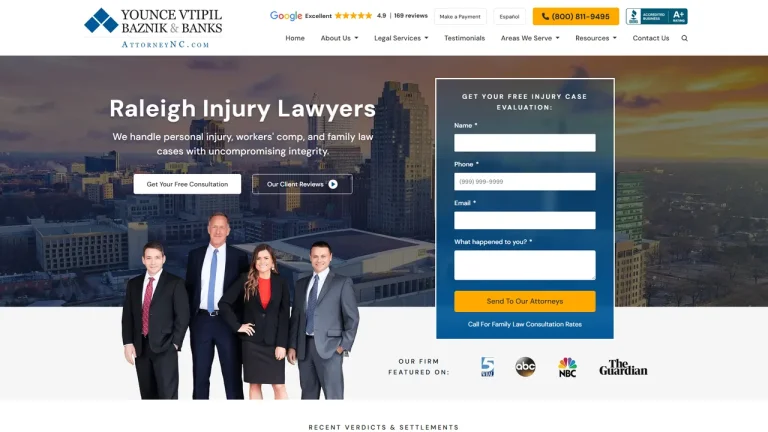
Younce, Vtipil, Baznik & Banks, P.A. - Raleigh, NC
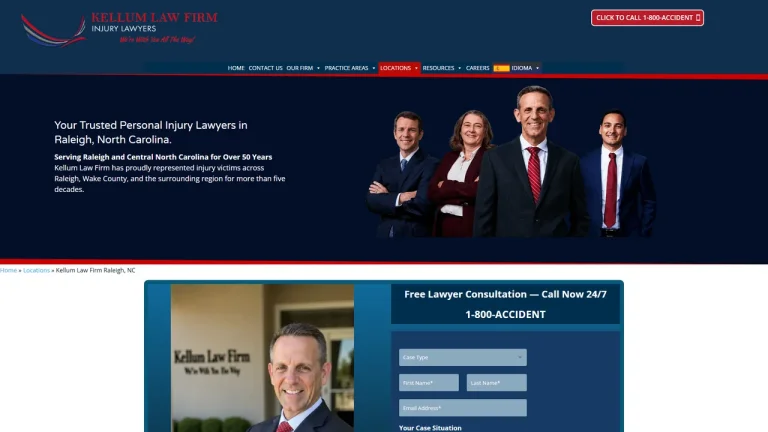
Kellum Law Firm - Raleigh, NC
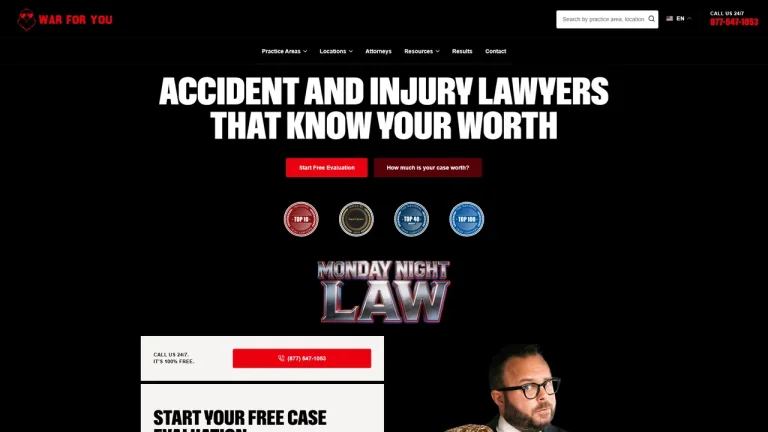
Schuerger & Shunnarah Trial Attorneys - Raleigh, NC
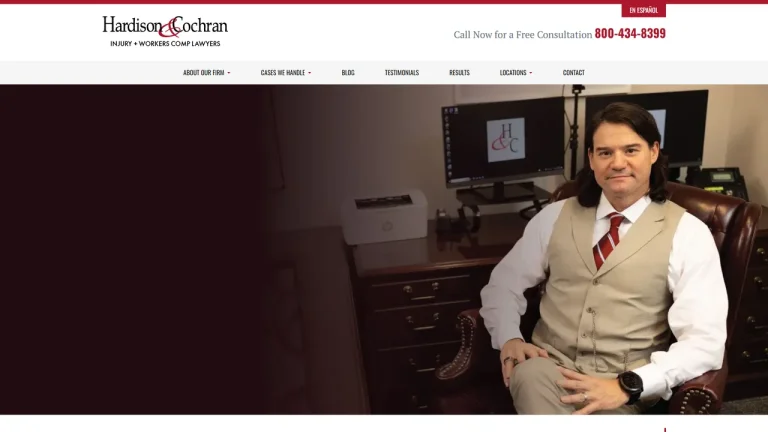
Hardison & Cochran - Injury & Workers Comp Lawyers - Raleigh, NC
James Jenkins Mills - Raleigh, NC
J. Christopher Brantley - Raleigh, NC

Irons & Irons P.A. Auto Accident and Personal Injury Attorneys - Raleigh, NC
Law Offices of Eric H. Kassor, PA - Raleigh, NC
Law Office of Jacob Goad - Raleigh, NC
Bice Law LLC - Raleigh, NC

Paynter Law - Raleigh, NC
CR Legal Team - Raleigh, NC
Ward and Smith Personal Injury - Raleigh, NC

Dement Askew Johnson & Marshall, LLP - Raleigh, NC
Marcari, Russotto, Spencer & Balaban - Raleigh, NC

KBA Attorneys - Raleigh, NC
Cardinal Law Partners - Raleigh, NC
Lanier Law Group, P.A. - Raleigh, NC

Nichols Law Firm - Raleigh, NC
Riddle & Riddle Injury Lawyers - Raleigh, NC
Osborn Injury Lawyers - Raleigh, NC
Kreger Brodish LLP - Raleigh, NC
Maginnis Howard Personal Injury Lawyer - Raleigh, NC

Car Accident Litigation & Negligence Claims in Raleigh, North Carolina
Commuter arteries across Raleigh-including the I-440 Beltline, I-540 Outer Loop, Interstate 40, Capital Boulevard (US 1), and Glenwood Avenue (US 70)-experience heavy daily traffic and severe collisions caused by distracted, speeding, or intoxicated drivers. Crash victims often suffer life-altering spinal trauma, fractures, and traumatic brain injuries.
Lawsuits arising from auto accidents in Raleigh are litigated in the 10th Judicial District at the Wake County Justice Center on South Salisbury Street. Personal injury claims in North Carolina are governed by the strict common law doctrine of pure contributory negligence. If an insurance carrier proves the injured driver was even 1% at fault, the plaintiff is completely barred from receiving any compensation.
Retaining an assertive Raleigh car accident lawyer is critical to defeat these aggressive insurance defense tactics. Local attorneys immediately issue preservation demands for dashcam footage, download vehicle electronic event data recorders (EDRs), and work with accident reconstructionists to establish 100% defendant liability before evidence is destroyed.
Raleigh Car Accident Representation & Fee Structures
| Case Scenario | Fee Structure | Estimated Cost (USD) | Key Cost Determinants |
|---|---|---|---|
| Rear-End Crash with Undisputed Liability | Contingency Fee | 33.3% of settlement | Police report findings, medical treatment duration, objective injury documentation. |
| Disputed Liability / Intersection Collision | Contingency Fee | 33.3% - 40% of recovery | Overcoming 1% contributory negligence claims, traffic signal data, independent witnesses. |
| Severe Trauma / Orthopedic Surgery / TBI | Contingency Fee | 33.3% - 40% of recovery | Policy limit tenders, future medical care plans, vocational wage-loss assessments. |
| Uninsured / Underinsured Motorist (UM/UIM) Claim | Contingency Fee | 33.3% of recovery | Intrafamily policy stacking under the North Carolina Financial Responsibility Act. |
Critical Legal Deadlines & Statutes in North Carolina
Injured drivers must strictly observe statutory deadlines under North Carolina law. Under N.C. Gen. Stat. § 1-52(16), an injured party has three years from the date of the car collision to file a personal injury lawsuit in court. For fatal accidents, the wrongful death statute of limitations is strictly two years from the date of death pursuant to N.C. Gen. Stat. § 1-53(4).
North Carolina common law enforces pure contributory negligence. An injured claimant cannot recover damages if their own negligence contributed in any degree to the accident, unless the defendant had the Last Clear Chance to avoid the crash or acted with gross negligence under N.C. Gen. Stat. § 1D-15.
Under the North Carolina Financial Responsibility Act codified at N.C. Gen. Stat. § 20-279.21, all vehicle owners must carry minimum liability coverage of $30,000 for bodily injury to one person, $60,000 for bodily injury per accident, and $25,000 for property damage.
Under N.C. Gen. Stat. § 20-279.21(b)(4), underinsured motorist coverage allows injured plaintiffs to stack policies across multiple vehicles owned by resident relatives, creating significant additional coverage when injuries exceed minimal commercial limits.
Wake County Small Claims Magistrate Court vs. Superior Court Litigation
Under N.C. Gen. Stat. § 7A-210, Small Claims Court in Wake County is capped at $10,000 before a magistrate. For isolated vehicle body damage or minor rental vehicle reimbursement where no physical injuries occurred, filing a pro se small claims action can be practical.
However, when a crash results in medical treatment at WakeMed Raleigh or Duke Raleigh Hospital, medical costs rapidly exceed the $10,000 magistrate limit. Furthermore, insurance adjusters routinely raise contributory negligence defenses against pro se claimants, arguing that slight speeding or failing to brake quickly enough eliminates all liability.
Claims between $10,000 and $25,000 are heard in Wake County District Court, while claims exceeding $25,000 proceed to Wake County Superior Court. Retaining seasoned trial counsel ensures access to subpoena powers for electronic event data recorder (black box) downloads, expert witness depositions, and thorough negotiation of healthcare liens with providers.
Red Flags When Selecting a Raleigh Car Accident Lawyer
- Solicitation calls and runners: Beware of unprincipled individuals contacting you via phone or hospital visits immediately after a crash, violating North Carolina State Bar professional rules.
- Settlement-mill volume practices: Avoid law firms where clients only speak with non-lawyer case managers and files are pushed into rapid, inadequate settlements without investigating policy stacking.
- Unprepared for contributory negligence defenses: Attorneys who do not aggressively gather evidence to defeat the defense's 1% comparative fault allegations will see their cases dismissed.
- Vague contingency fee agreements: Reputable Raleigh personal injury lawyers work strictly on contingency with zero upfront legal fees and clearly explain litigation cost deductions in writing.
Frequently Asked Questions
How does pure contributory negligence affect my Raleigh car accident claim?
North Carolina is a pure contributory negligence state. If the other driver's insurance company proves you contributed even 1% to the crash-such as driving slightly over the speed limit-you cannot recover any damages, unless your attorney proves the other driver had the Last Clear Chance or committed gross negligence.
What is the deadline to file a car accident lawsuit in Wake County?
Under N.C. Gen. Stat. § 1-52(16), you have three years from the date of the collision to file a personal injury lawsuit. If the crash resulted in a fatality, the lawsuit must be filed within two years of death under N.C. Gen. Stat. § 1-53(4).
What is policy stacking under North Carolina auto insurance law?
Under N.C. Gen. Stat. § 20-279.21, injured individuals can combine (stack) underinsured motorist (UIM) coverage limits from multiple vehicle policies within the same household, substantially expanding available insurance coverage to pay for severe injuries.
Where will my car accident lawsuit be filed if the collision occurred in Raleigh?
Lawsuits originating from crashes in Raleigh are filed in the 10th Judicial District at the Wake County Justice Center in downtown Raleigh. Severe injury claims with damages over $25,000 proceed in Wake County Superior Court.
What should I do immediately following a collision on I-440 or I-540 in Raleigh?
Call 911 so the Raleigh Police Department or North Carolina State Highway Patrol files an official crash report. Seek immediate medical evaluation, photograph all vehicle damage and road skid marks, decline to give recorded statements to insurance adjusters, and consult an attorney.