
Child Custody Lawyers in Ohio
Hiring a compassionate Ohio child custody lawyer secures your parental rights and protects your child's well-being under state allocation statutes. Experienced family law practitioners guide parents through shared parenting plans, custody modifications, and mediation to minimize courtroom trauma. Search our directory below to connect with qualified Ohio custody attorneys today.

Demetrius A. Williams, Attorney at Law - Cleveland, OH

Christine Johnson Law - Canton, OH

Attorney Kate Bowling - Dayton, OH
Alexander R. Folk, Attorney at Law - Akron, OH

Mesaros Law Office - Dayton, OH

Fogelman Law Firm - Cincinnati, OH

Heckert & Moreland Co. LPA - Columbus, OH
Law Office of Tyrone Hauritz - Canton, OH

Ahlrichs & Foran - Cincinnati, OH
Mary Lou Sekula, Attorney at Law - Canton, OH

Barr, Jones and Associates LLP - Columbus, OH
Douglas D. Jones Co., LPA - Canton, OH

SRD Law Office - Columbus, OH
Yonas and Phillabaum, LLC Attorneys at Law - Cincinnati, OH

Arthur W. Harmon, Jr. Attorney at Law LLC - Cincinnati, OH
Santen & Hughes - Cincinnati, OH
Godbey Law - Cincinnati, OH
Jerry A. Meadows, Attorney at Law - Dayton, OH
Law Office of Natalie M. Laszcz - Cleveland, OH
Kovalchik Law Office LLC - Canton, OH

Lewis Legal Solutions - Columbus, OH
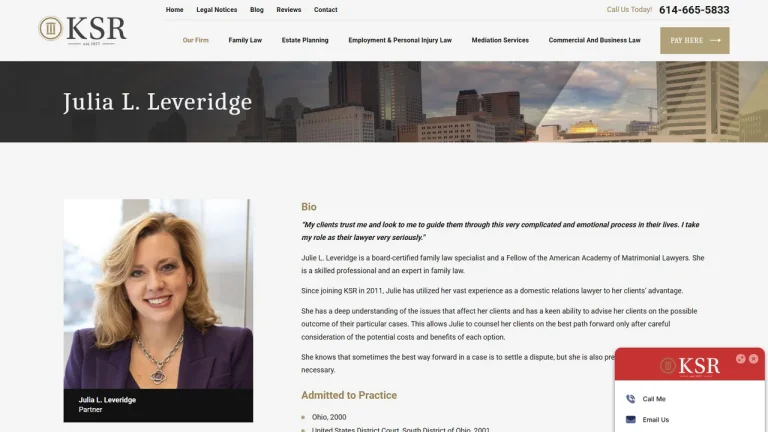
Julia L. Leveridge (Kemp, Schaeffer & Rowe Co., L.P.A.) - Columbus, OH

Soroka & Associates, LLC - Columbus, OH
Allocating Parental Rights and Responsibilities Across Ohio
In Ohio family law, child custody disputes are legally defined as the allocation of parental rights and responsibilities. The legal system prioritizes the stability and physical and psychological well-being of the child, encouraging cooperative parenting arrangements while protecting children from parental conflict and unsafe home environments.
Jurisdiction over child custody matters depends upon the marital status of the parents. Married parents seeking custody during divorce or legal separation file within the Domestic Relations Division of the County Court of Common Pleas. Unmarried parents establish parentage, custody, and companionship orders through the Juvenile Division of the County Court of Common Pleas, such as the Franklin County Juvenile Court, Cuyahoga County Juvenile Court, or Hamilton County Juvenile Court.
Securing effective legal representation ensures that your parenting plan clearly defines decision-making authority, residential school placement, and visitation routines. Qualified Ohio child custody lawyers across Columbus, Cleveland, Cincinnati, Dayton, and Akron advocate for collaborative shared parenting solutions while standing ready to litigate complex custody disputes before common pleas judges and court-appointed magistrates.
Ohio Child Custody Legal Retainers and Representation Costs
| Case Scenario | Fee Structure | Estimated Cost (USD) | Key Cost Determinants |
|---|---|---|---|
| Negotiated Shared Parenting Agreement | Fixed Flat Fee | $1,800 - $4,000 | Parental consensus on parenting time schedules, designated school district parent, holiday rotation detail |
| Contested Custody & Guardian ad Litem Evaluation | Retainer + Hourly ($250 - $450/hr) | $5,000 - $16,000+ | Guardian ad Litem (GAL) investigation fees, court-ordered psychological evaluations, evidentiary hearings |
| Interstate Custody & Relocation Litigation | Retainer + Hourly ($300 - $500/hr) | $4,500 - $13,500 | UCCJEA jurisdictional hearings, interstate home study depositions, school relocation objections |
| Post-Decree Custody & Parenting Modification | Retainer + Hourly | $3,500 - $9,000 | Substantial change in circumstances proof, child developmental maturity, parental relocation or substance abuse |
Critical Legal Deadlines & Statutes in Ohio Child Custody
Judicial allocations of parental rights are governed by Ohio Rev. Code § 3109.04, which sets forth the mandatory best interests of the child factors. Courts assess parental cooperation, geographical proximity, historical caregiving roles, and criminal records when determining whether to order shared parenting or designate one parent as the sole residential parent and legal custodian.
Parenting time (visitation) standards and model schedules are codified under Ohio Rev. Code § 3109.051. Under Ohio Rev. Code § 3109.051(G), a residential parent planning to relocate to another residence or school district must file a formal notice of intent to relocate with the court, giving the non-residential parent thirty days to request a hearing to review or modify parenting time.
Interstate jurisdictional disputes are controlled by the Uniform Child Custody Jurisdiction and Enforcement Act codified at Ohio Rev. Code § 3127.15, which establishes that Ohio retains jurisdiction if the child lived in the state for at least six consecutive months immediately prior to filing. To modify an existing custody decree under Ohio Rev. Code § 3109.04(E)(1)(a), the moving party must establish a substantial change in circumstances since the prior order. Litigants have fourteen days under Ohio Civ. R. 53(D)(3)(b) to file written objections to any custody ruling issued by a magistrate.
Small Claims Limitations vs. Juvenile and Domestic Relations Court in Ohio
Small Claims Divisions in Ohio municipal and county courts handle minor monetary disputes up to $6,000 under Ohio Rev. Code § 1925.02. Small claims courts have zero legal authority to resolve child custody disputes, modify parenting schedules, enforce visitation orders, or terminate parental rights. All child placement matters belong exclusively in County Courts of Common Pleas.
Attempting to represent oneself in contested custody litigation places parental bonds at significant risk. Pro se parents often struggle with evidentiary rules, cross-examination of court-appointed Guardians ad Litem, and presenting admissible evidence regarding school placement or home safety. An experienced Ohio child custody lawyer presents compelling evidence aligned with statutory best-interest factors to secure your ongoing involvement in your child's upbringing.
Red Flags & Consumer Protection in Ohio Child Custody Practice
- Attorneys promising guaranteed sole custody or complete termination of the other parent's visitation rights during initial intake meetings.
- Practitioners who encourage aggressive parental alienation or advise clients to deny court-ordered visitation time before obtaining judicial modification.
- Firms failing to provide clear breakdowns of outside litigation costs, such as Guardian ad Litem retainers and custody psychological evaluation fees.
- Lawyers lacking regular courtroom trial experience in your specific county Domestic Relations or Juvenile Division.
Frequently Asked Questions
What is the difference between shared parenting and sole custody in Ohio?
In Ohio, shared parenting means both parents share legal decision-making rights and responsibilities regarding major life areas like education, medical care, and religion, regardless of how parenting time is divided. Sole legal custody designates one parent as the sole legal custodian with ultimate authority to make major decisions for the child.
Can a child choose which parent to live with in Ohio?
Ohio law does not permit a child to decide which parent they live with, regardless of their age. However, a judge or magistrate may conduct an in camera (private) interview with the child to assess their maturity and reasoning, considering their wishes as one factor among many in the statutory best-interest determination.
What role does a Guardian ad Litem (GAL) play in an Ohio custody dispute?
A Guardian ad Litem is a court-appointed attorney assigned to represent the independent best interests of the child. The GAL inspects both parents' homes, interviews teachers and pediatricians, reviews medical records, and files a formal written report and recommendation to assist the judge in making custody determinations.
Which court has jurisdiction over custody if parents were never married?
When parents are not married, custody and parentage matters are adjudicated exclusively in the Juvenile Division of the County Court of Common Pleas. Under Ohio law, an unmarried mother is initially presumed to have sole legal custody until paternity is formally established and the father petitions the juvenile court for parental rights.
What is required to modify an existing child custody order in Ohio?
To modify an existing allocation of parental rights, the requesting parent must prove that a significant change in circumstances has occurred regarding the child or the residential parent since the prior order, and that modification is necessary to serve the best interests of the child.