
Wrongful Death Lawyers in Cleveland
Retaining a compassionate Cleveland wrongful death lawyer ensures surviving family members achieve justice and financial security under Ohio wrongful death laws. Strategic legal counsel coordinates probate appointments, conducts comprehensive fatal accident investigations, and holds negligent parties accountable in Cuyahoga County courts. Review our verified directory below to schedule a confidential consultation with an experienced Cleveland wrongful death attorney.

Thomas J. Silk, Attorney at Law - Cleveland, OH
Slater and Zurz LLP - Cleveland, OH
Gioffre & Schroeder Co., L.P.A. - Cleveland, OH

Michael Hill Trial Law - Cleveland, OH

Anderson Law Office LLC - Cleveland, OH

Ralls & Ralls - Cleveland, OH
Reese & Kwarciak Co., LPA - Cleveland, OH
The Debevec Law Firm, LLC - Cleveland, OH
Kisling, Nestico & Redick - Cleveland, OH
TopDog Law Personal Injury Lawyers - Cleveland, OH

Constant Legal Group LLP - Cleveland, OH
Mark S. Fishman - Cleveland, OH

Law Offices of Sobo & Sobo L.L.P. - Cleveland, OH

Lowe Trial Lawyers - Cleveland, OH

The Becker Law Firm, LPA - Cleveland, OH
The Law Offices of Michael L Eisner, LLC - Cleveland, OH

Klein and Carney Co., LLC - Cleveland, OH
Fernando Mack, Attorney at Law - Cleveland, OH
Ryan Injury Attorneys - Cleveland, OH

Brenden Kelley Law - Cleveland, OH

Goldfarb Gary M - Cleveland, OH

Paul Grieco, Esq. - Cleveland, OH
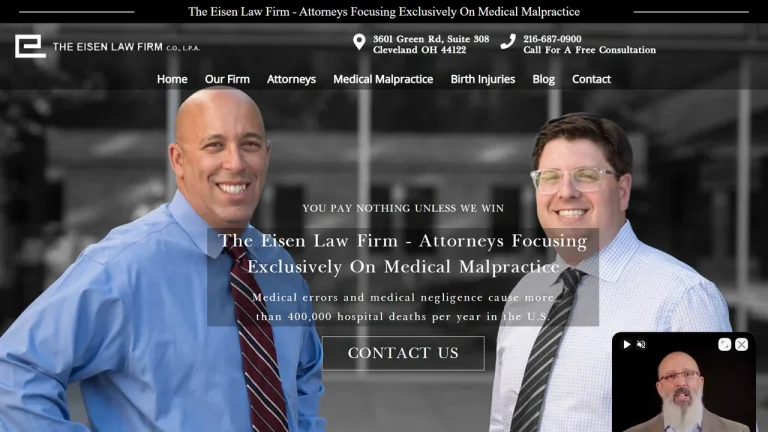
The Eisen Law Firm Co., L.P.A. - Cleveland, OH
Wrongful Death Claims in Cuyahoga County Courts
The sudden loss of a family member due to vehicular collisions, medical negligence, workplace catastrophes, or dangerous products creates profound emotional devastation and severe financial hardship. In Cleveland, wrongful death lawsuits are initiated within the General Division of the Cuyahoga County Court of Common Pleas at the Justice Center, 1200 Ontario Street in downtown Cleveland.
Simultaneously, wrongful death litigation requires formal estate proceedings through the Cuyahoga County Probate Court, located on the second floor of the Justice Center on Ontario Street. Under Ohio law, the probate court must appoint a personal representative to lead the litigation and holds statutory authority to approve any settlement distribution among surviving statutory beneficiaries.
Emergency medical care and trauma interventions often occur at Cleveland major medical centers, including Cleveland Clinic Main Campus on 95th Street, University Hospitals Cleveland Medical Center, and MetroHealth Medical Center. An experienced Cleveland wrongful death attorney leads rapid forensic investigations, secures autopsy reports from the Cuyahoga County Medical Examiner Office, and retains forensic economists to quantify lifetime economic loss to protect surviving spouses and dependents.
Cleveland Wrongful Death Legal Fee Structures
Wrongful death representation across Cuyahoga County is litigated under contingency fee arrangements, ensuring grieving families can pursue justice without personal financial exposure for upfront legal fees or case expenses.
| Case Scenario | Fee Structure | Estimated Cost (USD) | Key Cost Determinants |
|---|---|---|---|
| Commercial Trucking / Auto Fatality | Contingency (No win, no fee) | 33.3% - 40% of recovery | Commercial umbrella policy limits, black-box ECM telematics, driver log violations, and accident reconstruction testimony. |
| Medical Malpractice Resulting in Death | Contingency (No win, no fee) | 33.3% - 40% of recovery | Ohio Civ. R. 10(D)(2) Affidavit of Merit, expert physician reviews, and hospital electronic health record audits. |
| Industrial / Construction Site Fatality | Contingency (No win, no fee) | 33.3% - 40% of recovery | OSHA inspection citations, third-party general contractor liability, and intentional tort litigation. |
| Defective Product Fatal Harm | Contingency (No win, no fee) | 33.3% - 40% of recovery | Metallurgical failure analysis, product design engineering testimony, and multi-tier corporate distribution chains. |
Critical Legal Deadlines & Statutes in Ohio
Pursuing a wrongful death claim in Cleveland requires strict adherence to statutory deadlines and standing rules established by the Ohio General Assembly. Under the Ohio Wrongful Death Act, codified at Ohio Rev. Code § 2125.02(D), an action for wrongful death must be commenced within two years from the exact date of the decedent death.
Under Ohio Rev. Code § 2125.02(A)(1), a wrongful death action must be brought exclusively in the name of the personal representative (executor or administrator) appointed by the probate court. The surviving spouse, children, and parents are rebuttably presumed to have suffered compensable damages, while other next of kin must establish specific financial or emotional losses. Any negotiated settlement must be submitted to and approved by the probate court under Ohio Rev. Code § 2125.02(C). In addition, a separate survival action for conscious physical pain and suffering endured by the decedent prior to death can be brought under Ohio Rev. Code § 2305.21.
Small Claims Court vs. Retaining Wrongful Death Trial Counsel
Under Ohio Rev. Code § 1925.02, the Small Claims Division of the Cleveland Municipal Court is strictly capped at $6,000. It has zero legal authority or subject-matter jurisdiction to adjudicate wrongful death claims, appoint estate administrators, or enforce survival actions.
Wrongful death claims involve complex multi-tiered insurance coverage, severe corporate defense opposition, and intricate probate administration procedures. Under Ohio law, individual beneficiaries cannot litigate wrongful death claims pro se; claims must be prosecuted by the court-appointed fiduciary represented by licensed legal counsel. An experienced Cleveland wrongful death attorney coordinates probate filings in the Cuyahoga County Probate Court, retains forensic economists to calculate lifetime lost earnings, negotiates statutory Medicaid and hospital liens, and advocates for the family in the Cuyahoga County Court of Common Pleas.
Red Flags When Hiring a Cleveland Wrongful Death Lawyer
- Unsolicited in-person visits or communications from referral agents and runners contacting grieving relatives in the days immediately following a tragic death.
- Failing to open a formal decedent estate in the Cuyahoga County Probate Court, leaving the family without legal standing to file a claim before the two-year deadline expires.
- Settling survival claims without auditing healthcare liens, allowing hospitals or Medicaid to take settlement proceeds intended for surviving dependents.
- Lawyers who lack substantial courtroom trial experience in catastrophic injury and wrongful death cases before the Cuyahoga County Court of Common Pleas.
Frequently Asked Questions
Who has the legal right to file a wrongful death lawsuit in Cleveland?
Under Ohio Revised Code § 2125.02(A)(1), only the personal representative (executor or administrator) appointed by the probate court can file a wrongful death lawsuit. The action is brought on behalf of surviving beneficiaries, including the spouse, children, and parents.
How long do surviving family members have to file a wrongful death lawsuit in Ohio?
Under Ohio Revised Code § 2125.02(D), the lawsuit must be filed within two years from the date of the decedent death. Missing this strict two-year statute of limitations permanently bars the claim.
What is the difference between a wrongful death claim and a survival action?
A wrongful death claim compensates surviving beneficiaries for their loss of companionship, financial support, and mental anguish. A survival action under Ohio Revised Code § 2305.21 recovers damages for the conscious physical pain, suffering, and medical bills endured by the decedent prior to death.
Does the Cuyahoga County Probate Court have to approve a wrongful death settlement?
Yes. Under Ohio Revised Code § 2125.02(C), any settlement reached in a wrongful death claim must be submitted to the probate court that appointed the personal representative for review, approval, and equitable distribution among beneficiaries.
What damages are recoverable in a Cleveland wrongful death case?
Damages include loss of financial support based on the decedent earning capacity, loss of household services, loss of society and companionship, prospective inheritance, mental anguish suffered by surviving family members, and funeral and burial expenses.