
Business & Work Visa Lawyers in Oklahoma
Securing employment visas and corporate immigration status in Oklahoma requires strategic compliance with complex federal labor and immigration regulations. Experienced legal counsel guides businesses and professionals through Department of Labor certifications and USCIS adjudications to minimize processing disruptions. Review our verified statewide directory below to connect with an accomplished Oklahoma business immigration attorney.

Bowman Webb Law, PLLC - Tulsa, OK
Pointon Law Firm - Oklahoma City, OK
Think Immigration Law Center - Oklahoma City, OK
The Law Offices of James J. Pasquali - Oklahoma City, OK
Rivas & Associates - Oklahoma City, OK
Kelli J. Stump - Oklahoma City, OK
Hernandez Law Firm, PLLC - Tulsa, OK
Steven Langer, Immigration Attorneys - Oklahoma City, OK
Gies Law Firm, PLLC Oklahoma City, OK

Lawrence E. Davis, P.C., Oklahoma City, OK
Rivas & Associates - Tulsa, OK
Misgina & Associates, PLLC - Tulsa, OK
Gilarranz-Hoffman Law PLLC - Oklahoma City, OK
Arnesen Law - A Citizenship and Immigration Firm - Oklahoma City, OK
Law Office of Michelle L Edstrom - Oklahoma City, OK
Wallace Law Firm PC, Oklahoma City, OK

Mazaheri Law Firm - Oklahoma City, OK
Law Offices of Giovanni I. Perry, PLLC Oklahoma City, OK
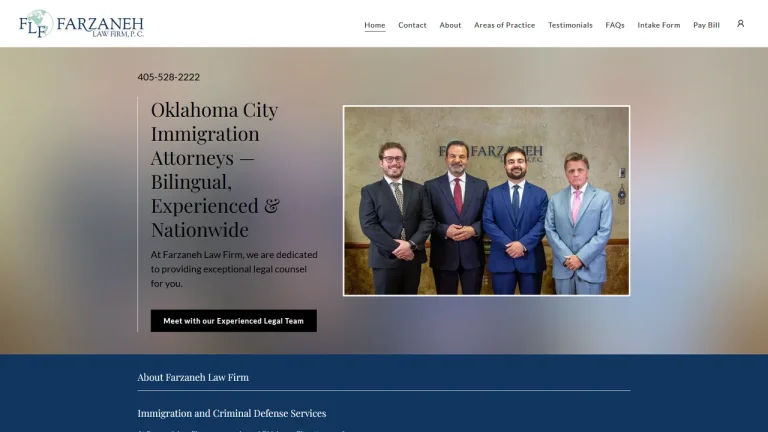
Farzaneh Law Firm, P.C. - Oklahoma City, OK
Timothy L. Cook Law Offices Oklahoma City, OK

Oklahoma Immigration Lawyers - Oklahoma City, OK
Ogletree Deakins, Oklahoma City, OK
Erwin Law Office | Immigration Attorneys - Tulsa, OK

Oklahoma Corporate Immigration and Regulatory Framework
Oklahoma dynamic economy-driven by energy exploration, aerospace manufacturing in Oklahoma City, engineering hubs in Tulsa, biomedical research, and expanding agricultural enterprises-depends increasingly on securing specialized global talent. Meeting corporate talent needs requires rigorous compliance with federal immigration and labor standards.
Business visa petitions and permanent employment filings are administered federally through the United States Department of Labor (DOL) and United States Citizenship and Immigration Services (USCIS). On-site administrative inquiries, employment audits, and interviews for corporate personnel throughout Oklahoma fall under the oversight of the USCIS Oklahoma City Field Office.
Corporate immigration attorneys, regulated by the Oklahoma Bar Association, assist human resource managers and corporate executives in navigating the intricacies of specialty occupation visas, executive intra-company transfers, and permanent labor certification audits. Skilled representation ensures workforce continuity while mitigating organizational liability.
Common Fee Structures for Oklahoma Business & Work Visa Services
| Case Scenario | Fee Structure | Estimated Cost (USD) | Key Cost Determinants |
|---|---|---|---|
| H-1B Specialty Occupation Petition (Form I-129 & LCA) | Flat Fee | $2,500 to $5,000 | Degree relevancy analysis, prevailing wage sourcing, cap-subject electronic lottery registration. |
| L-1A / L-1B Intra-Company Transferee Petition | Flat Fee | $4,500 to $8,500 | Affiliated corporate ownership proof, executive hierarchy charting, specialized proprietary knowledge validation. |
| PERM Labor Certification & EB-2 / EB-3 Green Card | Staged Flat Fee | $6,000 to $12,000 | Mandatory recruitment advertising, prevailing wage determinations, response to Department of Labor audit letters. |
| Corporate Form I-9 Audit & E-Verify Compliance Review | Hourly / Audit Flat Rate | $300 to $550 per hour | Total enterprise employee headcount, multi-facility payroll reviews, historical error remediation. |
Critical Legal Deadlines & Federal Employment Immigration Statutes
Corporate immigration strategies require careful adherence to stringent federal calendars. Specialty occupation classifications are codified under 8 U.S.C. § 1101(a)(15)(H) and 8 U.S.C. § 1184, requiring employers to obtain an approved Labor Condition Application (LCA) from the Department of Labor pursuant to 8 U.S.C. § 1182(n) verifying prevailing wage compliance.
For permanent employment sponsorship under employment-based preference categories codified at 8 U.S.C. § 1153(b), employers must satisfy the Program Electronic Review Management (PERM) labor certification process under 20 C.F.R. § 656.17. This regulation enforces strict timelines: mandatory recruitment advertisements must be conducted within an established 180-day window, followed by a mandatory 30-day waiting period prior to filing Form ETA-9089.
All Oklahoma employers must comply with employment verification mandates under 8 U.S.C. § 1324a, requiring completion of Form I-9 within three business days of an employee first day of work. Furthermore, public employers and state contractors in Oklahoma must observe electronic verification requirements under 25 O.S. § 1313. Missing statutory windows or miscalculating prevailing wage minimums can trigger mandatory disqualification or federal civil penalties.
Small Claims Limitations vs. Corporate Immigration Counsel
Pursuant to 12 O.S. § 1751, Oklahoma Small Claims Dockets operate under a strict jurisdictional ceiling of $10,000, limited strictly to basic monetary recovery on contracts and minor tort claims. The small claims docket possesses zero jurisdiction over corporate immigration approvals, labor certifications, or federal compliance disputes.
Navigating work visas without specialized legal guidance exposes businesses to operational disruption. A single technical error in a job description or wage calculation can prompt a Request for Evidence (RFE), petition denial, or DOL audit, jeopardizing crucial corporate projects and legal status for foreign national staff.
Retaining qualified business immigration counsel ensures company-wide compliance across every filing. Legal counsel designs scalable corporate visa policies, coordinates cross-border executive relocations, and prepares detailed legal briefs that satisfy USCIS evidentiary thresholds.
Red Flags to Watch for When Retaining Work Visa Counsel
- General practice attorneys without dedicated business immigration experience who fail to stay abreast of rapid shifts in USCIS adjudication standards.
- Billing practices lacking itemized breakdowns distinguishing corporate legal fees from mandatory government filing fees and fraud prevention assessments.
- Unethical guarantees regarding lottery selection outcomes or promises to bypass Department of Labor recruitment requirements.
- Proposing inaccurate job duties or wage tiers on Labor Condition Applications to evade statutory prevailing wage minimums.
Frequently Asked Questions
What are the requirements for an Oklahoma company to sponsor an H-1B visa?
Under 8 U.S.C. § 1101(a)(15)(H), an employer must prove that the position qualifies as a specialty occupation requiring at least a bachelor degree in a specific specialty, obtain a certified LCA under 8 U.S.C. § 1182(n), and register in the annual electronic lottery.
How does the PERM Labor Certification process work for employers?
Governed by 20 C.F.R. § 656.17, an employer must obtain a prevailing wage determination from the DOL, conduct mandatory recruitment campaigns to test the local labor market, and demonstrate that no willing, qualified U.S. workers are available before filing Form ETA-9089.
What Form I-9 obligations apply to Oklahoma employers?
Under 8 U.S.C. § 1324a, employers must complete Form I-9 for each hired employee within three business days of commencing employment. State entities and designated contractors in Oklahoma must also comply with E-Verify mandates under 25 O.S. § 1313.
Can an emerging startup in Oklahoma sponsor foreign professional workers?
Yes. A startup enterprise may sponsor professional foreign workers, provided it can demonstrate legitimate corporate existence, a valid tax identification number, and the financial ability to pay the required prevailing wage through capitalization or revenue.
How long can an employee remain in the United States on an L-1 visa?
Under federal regulations, L-1A executives and managers can maintain status for an aggregate maximum of seven years, while L-1B specialized knowledge employees are permitted a maximum stay of five years.