
Bankruptcy Lawyers in Oregon
Engaging an Oregon bankruptcy attorney ensures immediate protection under federal statutory stays to halt wage garnishments, repossessions, and foreclosures. Experienced consumer and commercial debt counsel guide filers through Means Testing and the critical choice between Oregon state and federal exemptions. Review our verified directory below to schedule a confidential debt assessment with trusted local practitioners across Oregon.

The Scott Law Group - Eugene, OR

Behrends Carusone Attorneys at Law PC - Eugene, OR

The Law Office of Jonathan D. Mishkin, P.C. - Portland, OR

Legal Aid Services of Oregon - Portland, OR
Brent Wells - Eugene, OR

Armstrong Bankruptcy Law Office - Eugene, OR

OlsenDaines - Eugene, OR

Kevin D Swartz Bankruptcy Attorney - Salem, OR

Brian Wheeler Attorney At Law - Portland, OR

Oregon Lawyer for the Underdog Michael Fuller - Portland, OR

Todd S. Hammond, P.C. - Salem, OR
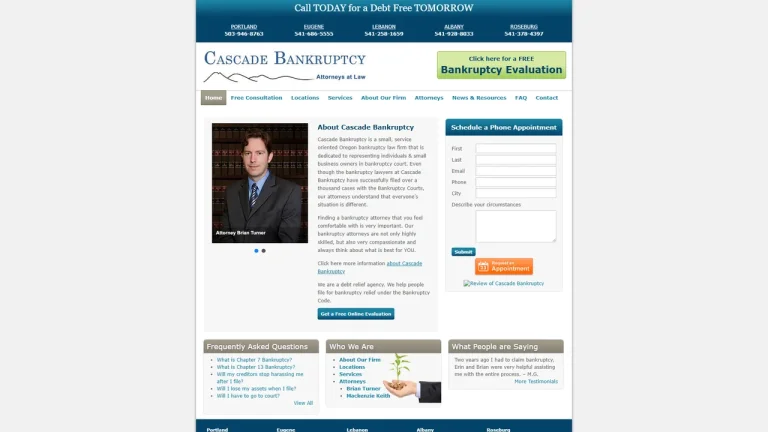
Cascade Bankruptcy - Portland, OR

Ghiorso Law Firm - Salem, OR

Lyndon Ruhnke, P.C. - Portland, OR
Kent Anderson Law Office - Eugene, OR

Kelly D. Jones, Attorney at Law - Portland, OR
Legal Aid Services of Oregon - Salem, OR

Law Office of Corey B. Smith - Salem, OR
Law Offices of Rodolfo Camacho - Salem, OR
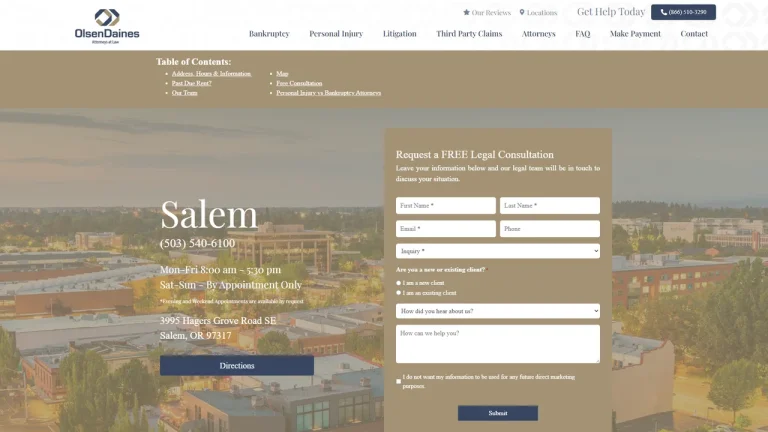
OlsenDaines - Salem, OR

Law Office of Kim Covington - Eugene, OR

Christopher J. Kane, P.C. - Portland, OR
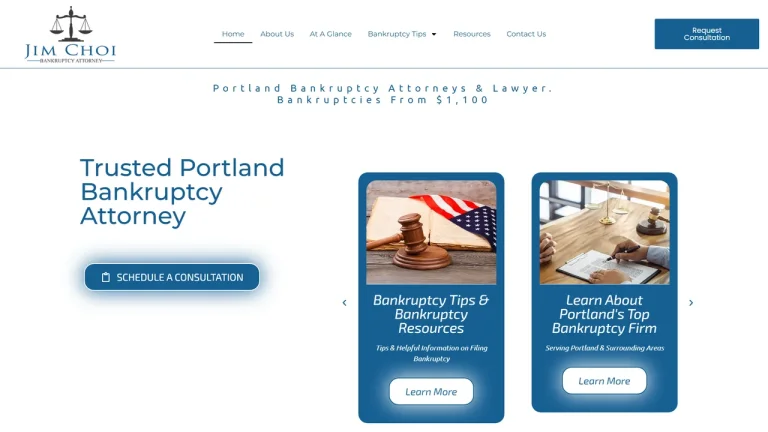
Jim Choi Bankruptcy Attorney - Portland - Portland, OR
Federal Bankruptcy Jurisdiction and Divisional Practice in Oregon
Bankruptcy proceedings in the State of Oregon are governed exclusively by Title 11 of the United States Code and fall under the federal judicial authority of the United States Bankruptcy Court for the District of Oregon. Operating as a unit of the United States District Court for the District of Oregon, the court oversees all personal, consumer, and business reorganizations across all thirty-six counties. Appellate jurisdiction over Oregon bankruptcy judgments is exercised by the United States Bankruptcy Appellate Panel of the Ninth Circuit (BAP) or the federal District Court, with ultimate appeals proceeding to the United States Court of Appeals for the Ninth Circuit.
To serve litigants across the state, the District of Oregon maintains two staffed divisional headquarters: the Portland Division, situated at the Mark O. Hatfield United States Courthouse, serving northwestern Oregon counties including Multnomah, Washington, Clackamas, Yamhill, Marion, and Columbia; and the Eugene Division, located at the Wayne L. Morse United States Courthouse, serving central, southern, and eastern counties including Lane, Jackson, Deschutes, Douglas, and Linn. Video dockets and scheduled Section 341 Meetings of Creditors are conducted throughout regional hubs like Medford, Bend, and Klamath Falls under the administration of the Office of the United States Trustee.
Upon filing a bankruptcy petition, debtors receive immediate legal protection through the automatic stay established under 11 U.S. Code § 362. The automatic stay immediately enjoins all pending state court collection litigation, residential foreclosures, creditor communications, and bank levies. Furthermore, the stay suspends continuous wage garnishments executed under Or. Rev. Stat. § 18.600, providing breathing room to structure an orderly discharge or chapter repayment plan.
Oregon Bankruptcy Attorney Fees & Typical Cost Structures
| Case Scenario | Fee Structure | Estimated Cost (USD) | Key Cost Determinants |
|---|---|---|---|
| Chapter 7 Consumer Liquidation (Uncontested) | Standard Flat Fee | $1,200 - $2,500 | Means Test calculation, exemption selection, non-exempt asset analysis, plus $338 statutory clerk filing fee |
| Chapter 13 Wage Earner Reorganization | Court-Approved Presumptive Fee | $3,500 - $5,000 | Standardized district no-look fee, curing mortgage arrears, plan duration (36-60 months), plus $313 filing fee |
| Complex Chapter 7 with Business Interests | Retainer + Hourly ($300 - $475/hr) | $3,000 - $7,000+ | Valuation of closely held LLC interests, personal guarantees on commercial debt, insider transaction reviews |
| Chapter 11 Subchapter V Small Business | Retainer + Hourly ($375 - $550/hr) | $10,000 - $25,000+ | Debtor-in-possession budgeting, Subchapter V trustee coordination, creditor ballot confirmation hearings |
Critical Legal Deadlines & Statutes in Oregon Bankruptcy
Debtors filing in Oregon must satisfy precise federal statutory timing requirements. Under 11 U.S. Code § 109(h), every individual consumer debtor must complete an approved credit counseling course from an authorized provider within the 180-day window immediately preceding the petition filing date.
Consumer eligibility for Chapter 7 relief is evaluated through the statutory Means Test under 11 U.S. Code § 707(b), comparing the debtor's six-month historical annualized income against the median income for a household of comparable size in Oregon. Filers with incomes exceeding the Oregon state median must calculate deductions to determine whether a presumption of abuse arises. Unlike many jurisdictions, Oregon debtors possess the unique legal right to choose between the federal bankruptcy exemption scheme under 11 U.S. Code § 522(d) or the Oregon state exemption system pursuant to Or. Rev. Stat. § 18.300. Oregon's state homestead exemption protects up to $40,000 of equity for an individual owner or $50,000 for married joint owners under Or. Rev. Stat. § 18.395. Creditors have 60 days following the first date set for the Section 341 meeting to contest the dischargeability of a specific debt pursuant to Fed. R. Bankr. P. 4007.
Small Claims Limits vs. Professional Bankruptcy Counsel
In Oregon, the Small Claims Department of the Circuit Court handles minor debt collection and breach of contract disputes with a jurisdictional limit of $10,000 under Or. Rev. Stat. § 55.011. While a debtor can defend an isolated small claims collection suit pro se, state court proceedings offer no broad debt relief. Winning or settling a small claims action leaves other creditors free to initiate separate lawsuits, encumber real property with judgment liens, or execute bank garnishments.
Conversely, federal bankruptcy is a comprehensive statutory restructuring of all personal liabilities. Attempting to file bankruptcy pro se carries significant peril. Self-represented debtors often miscalculate the Means Test, select the wrong exemption system-unintentionally exposing vehicles, tax refunds, or real estate to liquidation by the Chapter 7 Trustee-or face adversary proceedings for inadvertent omission of assets under 18 U.S. Code § 152. Retaining an attorney admitted to the Oregon State Bar and the federal District of Oregon ensures that assets are insulated, debt discharge is maximized, and Chapter 13 plans achieve judicial confirmation.
Red Flags & Debt Mill Warnings
- Non-attorney petition preparers advertising cheap filing services; federal law prohibits petition preparers from providing legal advice, calculating exemptions, or selecting bankruptcy chapters.
- Bankruptcy volume mills where clients never consult directly with a licensed attorney prior to the Section 341 Meeting of Creditors, leaving cases vulnerable to trustee audits.
- Attorneys who reflexively funnel all consumers into Chapter 13 repayment plans without evaluating whether Chapter 7 eligibility could be established through proper Means Test deductions.
- Failure of legal counsel to perform a detailed comparative exemption analysis between Oregon state exemptions and federal bankruptcy exemptions prior to filing.
Frequently Asked Questions
Can Oregon bankruptcy filers use federal exemptions?
Yes. Under Or. Rev. Stat. § 18.300, Oregon permits filers to select either the Oregon state statutory exemptions or the federal bankruptcy exemptions codified in 11 U.S. Code § 522(d), allowing debtors to select the schedule that best protects their specific assets.
What is the difference between Chapter 7 and Chapter 13 bankruptcy in Oregon?
Chapter 7 liquidates non-exempt property to discharge unsecured debts within four months, whereas Chapter 13 establishes a court-supervised three-to-five-year repayment plan allowing debtors to cure mortgage arrears and keep non-exempt property.
How does filing bankruptcy stop wage garnishments in Oregon?
The filing of a petition triggers the federal automatic stay under 11 U.S. Code § 362, immediately halting all state wage garnishments issued under Or. Rev. Stat. § 18.600 upon service of the bankruptcy case number to the garnishee.
What is the Means Test for Oregon bankruptcy filers?
The Means Test under 11 U.S. Code § 707(b) evaluates a debtor's average gross income over the past six months against the Oregon median income for their household size to determine whether they qualify for Chapter 7 liquidation.
Where are the federal bankruptcy courthouses located in Oregon?
The United States Bankruptcy Court for the District of Oregon maintains two fully staffed courthouses: the Portland Division at the Mark O. Hatfield Courthouse and the Eugene Division at the Wayne L. Morse Courthouse.