
Patent Attorneys in Portland, OR
Protecting intellectual property and proprietary inventions in Portland requires registered USPTO patent counsel. Experienced patent attorneys conduct comprehensive prior art searches, draft enforceable claims, and defend against patent infringement. Explore our directory below to connect with qualified Portland patent practitioners.
Raven Patents, LLC - Portland, OR

Immix Law / Portland - Portland, OR

Mersenne Law - Portland, OR

Kolitch Romano Dascenzo Gates, LLC - Portland, OR

London & Paris LLP - Portland, OR
Kolisch Hartwell PC - Portland, OR
Sierra IP Law, PC - Portland, OR
The Inventor's Friend Patent Law Firm - Portland, OR

Spencer K. Hunter, Patent Attorney - Portland, OR

Chernoff Vilhauer LLP - Portland, OR

John Rizvi, P.A. - The Idea Attorneys - Portland, OR
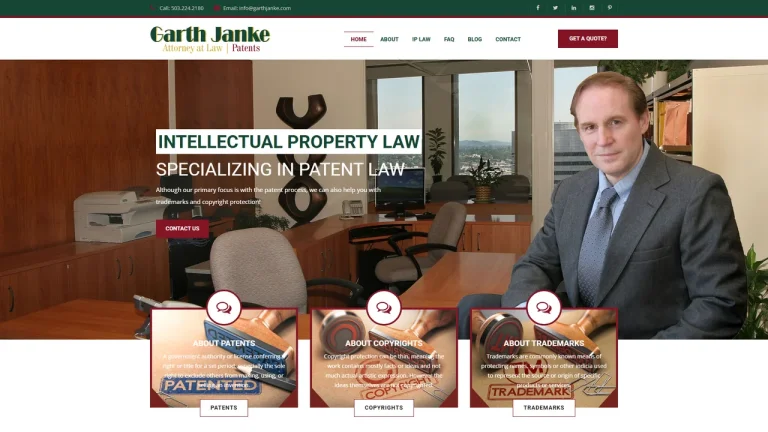
Garth Janke, LLC - Portland, OR
Mark S Hubert PC - Portland, OR
Bold Patents Law Firm - Portland, OR
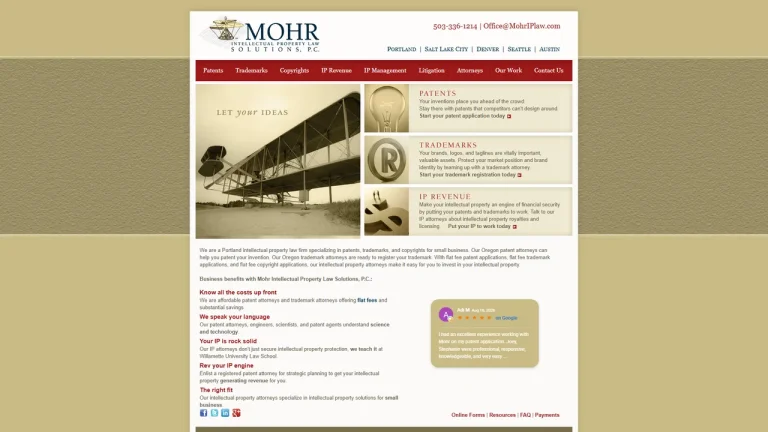
Mohr Intellectual Property Law Solutions, P.C. - Portland, OR

Klarquist Sparkman, LLP - Portland, OR

Stoel Rives LLP - Portland, OR

Summit Patents - Portland, OR

Baumgartner Patent Law - Portland, OR

James D. Givnan - Patent & Trademark Attorney - Portland, OR

Alleman Hall Creasman & Tuttle LLP - Portland, OR
Protecting Proprietary Inventions Across Portland and the Silicon Forest
Portland represents a primary technological center in the Pacific Northwest, anchoring Oregon's Silicon Forest that extends from downtown Portland and the Central Eastside to Beaverton and Hillsboro. Local innovation encompasses semiconductor devices, clean tech, electronic design software, sporting gear design, and biomedical engineering supported by research at Oregon Health & Science University (OHSU).
Patent prosecution is governed exclusively by federal law and administered through the United States Patent and Trademark Office (USPTO). Civil patent litigation, including patent infringement lawsuits, licensing controversies, and trade dress disputes, is heard by the United States District Court for the District of Oregon at the Mark O. Hatfield U.S. Courthouse on SW 3rd Avenue. Federal patent appeals are routed directly to the United States Court of Appeals for the Federal Circuit.
Engaging a Portland patent attorney registered with the USPTO ensures inventions are safeguarded under federal first-inventor-to-file standards. Legal counsel conducts rigorous patentability searches, prepares provisional and non-provisional applications, drafts defensible patent claims, and enforces intellectual property assets against commercial infringement.
Patent Prosecution and Litigation Fee Structures in Portland
| Case Scenario | Fee Structure | Estimated Cost (USD) | Key Cost Determinants |
|---|---|---|---|
| Prior Art Search & Patentability Opinion | Flat Fee | $1,500 - $3,500 | Technical complexity, prior art search breadth, foreign patent database review |
| Provisional Patent Application | Flat Fee | $2,500 - $6,000 | Depth of technical disclosure, informal claims inclusion, engineering schematics |
| Non-Provisional Utility Patent Application | Flat Fee / Phased | $7,500 - $16,000+ | Technology sector (software vs. mechanical), claim count, formal drawing requirements |
| Patent Infringement Litigation / PTAB | Hourly / Retainer ($450 - $850/hr) | $50,000 - $250,000+ | Inter Partes Review (IPR) filings, Markman claim construction, expert witness testimony |
Critical Legal Deadlines & Statutes in Oregon
Patent rights operate under strict federal statutory deadlines. Under the Leahy-Smith America Invents Act (AIA), codified at 35 U.S. Code § 102, the United States follows a first-inventor-to-file framework. While an inventor has a narrow 1-year grace period following their own public disclosure to file a patent application, immediate filing is critical to prevent forfeiture of rights.
When filing a provisional application under 35 U.S. Code § 111, the corresponding non-provisional utility patent application must be filed within exactly 12 months to claim priority benefits. Utility patents maintain a term of 20 years from the earliest effective non-provisional filing date under 35 U.S. Code § 154, subject to statutory maintenance fees payable at 3.5, 7.5, and 11.5 years under 35 U.S. Code § 41.
For infringement litigation, 35 U.S. Code § 286 establishes that no recovery of damages may be obtained for any infringement committed more than 6 years prior to the filing of the lawsuit. Additionally, trade secret claims asserted alongside patent disputes under Oregon law must be initiated within 3 years of discovering the misappropriation under Or. Rev. Stat. § 646.471.
Small Claims Limitations vs. Federal Patent Prosecution
The Small Claims Department of the Multnomah County Circuit Court is limited to monetary disputes up to $10,000 under Or. Rev. Stat. § 46.405. Small claims courts have zero legal jurisdiction over patent applications, patent validity, or infringement disputes. Under 28 U.S. Code § 1338, federal district courts hold exclusive jurisdiction over civil actions arising under federal patent statutes.
Representing inventors before the USPTO requires passing the USPTO registration examination and holding technical credentials in science or engineering. General attorneys not registered with the USPTO cannot legally prosecute patent applications. Filing without qualified patent counsel often leads to defective claims, inadequate enablement under 35 U.S. Code § 112, or permanent loss of international patent options under the Patent Cooperation Treaty.
Red Flags to Watch When Hiring a Patent Attorney in Portland
- Invention promotion companies and submission services that solicit inventors with marketing guarantees but lack USPTO-registered attorneys.
- Attorneys who lack registration with the USPTO Patent Bar (verify their active registration number on the official USPTO directory).
- Firms lacking technical and academic credentials relevant to your specific technological field (such as semiconductors, software, or biotechnology).
- Attorneys who guarantee that the USPTO will issue a patent, as patent examiners exercise wide statutory discretion during examination.
Frequently Asked Questions
What is the difference between a patent attorney and a general intellectual property lawyer?
A patent attorney possesses a degree in engineering or science, has passed the USPTO Patent Bar examination, and is registered to prosecute patent applications before the USPTO. A general IP lawyer can litigate trademark or copyright issues but cannot draft or file patent applications with the USPTO.
How does a provisional patent application protect my intellectual property?
A provisional patent application filed under 35 U.S. Code § 111 establishes an official priority filing date with the USPTO and allows you to label your product as patent pending. You must convert it into a non-provisional application within 12 months to maintain the priority date.
What happens if an invention is publicly disclosed before filing a patent application?
Under 35 U.S. Code § 102, the U.S. allows a 1-year grace period for disclosures made by the inventor. However, public disclosure immediately forfeits patent rights in most foreign jurisdictions, which enforce absolute novelty standards.
Can computer software algorithms be patented in the United States?
Software can be patented provided it satisfies subject matter eligibility under 35 U.S. Code § 101. The claims must demonstrate a practical technological improvement or solve a specific computing problem rather than claiming an abstract mathematical formula.
What is a Markman hearing in federal patent litigation?
A Markman hearing is a pre-trial proceeding in federal court where the judge determines the legal interpretation and scope of specific patent claim terms. The outcome of a Markman hearing frequently determines whether infringement exists or prompts settlement discussions.