
Wage & Hour Lawyers in Oregon
Recovering unpaid wages, overtime, or statutory penalties in Oregon requires seasoned legal counsel who understands complex state labor laws and administrative procedures. An experienced Oregon wage and hour attorney can enforce your statutory wage rights and often secure full compensation through settlement without protracted court litigation. Explore our directory below to locate verified wage and hour attorneys across Oregon and schedule a case evaluation.

Crispin Hannon LLC - Portland, OR

HKM Employment Attorneys LLP - Portland, OR

Harrang Long P.C. - Eugene, OR

Benjamin Rosenthal, Attorney at Law - Portland, OR

Ogletree Deakins - Portland, OR
Law Office of Jon Weiner, Salem, OR
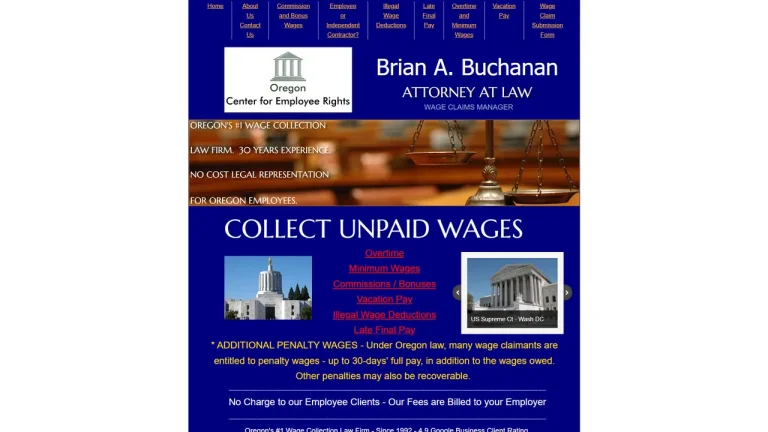
Brian A. Buchanan Oregon Center for Employee Rights - Salem, OR

Gleaves Swearingen LLP - Eugene, OR

The Law Office of Elizabeth J. Inayoshi, LLC - Hillsboro, OR

Oregon Law Center - Salem, OR

Buchanan Angeli Altschul & Sullivan LLP - Portland, OR
Kang Law Group - Salem, OR

Watkinson Laird Rubenstein, PC - Eugene, OR

Sudano Law Firm - Salem, OR

Oregon Employment Law - Portland, OR

Stevens & Legal - Hillsboro, OR

Matthew C. Ellis, PC - Portland, OR

Stutheit Kalin LLC - Portland, OR
Elizabeth Farrell - Portland, OR

Cambreleng & Marton, LLC - Portland, OR
Denecke Employment Law - Portland, OR
Erin E. Gould Attorney at Law - Eugene, OR
Law Office of Emily S. Hill, P.C. - Eugene, OR
Oregon Wage Regulations and Court Jurisdiction
Wage and hour protections in Oregon are among the most robust in the nation, codified primarily under Chapters 652 and 653 of the Oregon Revised Statutes. Administrative enforcement is managed by the Wage and Hour Division of the Oregon Bureau of Labor and Industries (BOLI), while formal civil litigation proceeds in the Oregon Circuit Courts. Major caseloads are handled across Multnomah County Circuit Court in Portland, Clackamas County Circuit Court in Oregon City, Washington County Circuit Court in Hillsboro, and Lane County Circuit Court in Eugene.
Oregon law regulates minimum wage rates by geographic tiers (standard, Portland metropolitan area, and non-urban counties) under Or. Rev. Stat. § 653.025. In addition, state statutes enforce strict rules regarding overtime pay after 40 hours in a workweek under Or. Rev. Stat. § 653.261, mandatory paid rest periods, unpaid 30-minute meal periods, unlawful payroll deductions, and independent contractor misclassifications. When employers withhold compensation, employees can recover back wages along with statutory penalty wages.
The attorneys in our directory are active members of the Oregon State Bar and admitted to practice before the Oregon Supreme Court in Salem. Retaining a local Oregon wage and hour lawyer provides a vital advantage, as state law contains powerful fee-shifting statutes that require non-compliant employers to pay the worker's reasonable legal fees upon prevailing in court.
Oregon Wage and Hour Legal Fee Structures and Penalty Calculations
| Case Scenario | Fee Structure | Estimated Cost (USD) | Key Cost Determinants |
|---|---|---|---|
| Late Final Paycheck & Statutory Penalty Claim | Contingency Fee | 33.3% - 40% of recovery ($0 upfront) | Number of days unpaid, regular hourly pay rate, 30-day penalty calculation under ORS 652.150. |
| Unpaid Overtime & Off-the-Clock Work | Contingency Fee | 33.3% of recovery | Timecard audit records, employer failure to keep hours, FLSA versus Oregon law liquidated damages. |
| Worker Misclassification (Contractor vs Employee) | Contingency / Class Action | 33.3% - 40% of award | Employer control test, unpaid payroll taxes, class member volume, statutory fee-shifting. |
| Systematic Meal & Rest Period Violations | Contingency Fee | 33.3% of recovery | Frequency of interrupted breaks, corporate automated time-clock policies, BOLI regulatory penalties. |
Critical Legal Deadlines & Statutes in Oregon
Oregon enforces rigorous deadlines for paying wages upon termination of employment. Under Or. Rev. Stat. § 652.140, if an employee is discharged, all earned wages are due and payable immediately, by the end of the next business day. If an employee quits with at least 48 hours of notice (excluding weekends and holidays), wages are due on the final day worked; if no notice is given, payment is due within five days or on the next regular payday, whichever occurs first.
If an employer willfully fails to pay wages within these statutory deadlines, Or. Rev. Stat. § 652.150 imposes a mandatory penalty wage: the employee's regular wages continue at eight hours per day for each day the wages remain unpaid, up to a maximum of thirty days. For filing formal legal claims, Or. Rev. Stat. § 12.080 provides a six-year statute of limitations for contract-based wage claims, while claims seeking statutory penalty wages under Or. Rev. Stat. § 12.110 must generally be filed within two years.
Small Claims Limitations vs. Circuit Court Wage Litigation
Under Or. Rev. Stat. § 46.405, small claims departments in Oregon Circuit Courts have a monetary ceiling of $10,000. Attorneys are generally not permitted to appear on behalf of clients in small claims proceedings without judicial consent. While an employee can bring a simple dispute for a few hundred dollars in small claims, doing so often forfeits substantial statutory penalties.
When calculating full back pay along with thirty days of statutory penalty wages under Or. Rev. Stat. § 652.150, claims routinely exceed the $10,000 small claims limit. Furthermore, under Or. Rev. Stat. § 652.200, employees who prevail in Circuit Court wage actions are entitled to mandatory attorney fees from the employer, provided proper pre-suit written demand was served. Representing oneself in small claims forfeits this statutory fee protection and deprives workers of formal discovery mechanisms to obtain employer payroll records.
Red Flags to Avoid When Hiring an Oregon Wage Lawyer
- Attorneys who charge upfront out-of-pocket fees to pursue valid wage claims instead of relying on Oregon's statutory fee-shifting provisions under Or. Rev. Stat. § 652.200.
- Practitioners who fail to calculate 30-day penalty wages under Or. Rev. Stat. § 652.150 when an employer has failed to issue a timely final paycheck.
- Lawyers who encourage settling solely for base unpaid wages without demanding statutory penalty wages and interest.
- Firms lacking familiarity with the multi-tiered regional minimum wage rates enforced by BOLI under Or. Rev. Stat. § 653.025.
Frequently Asked Questions
What is Oregon's 30-day penalty wage rule?
Under Or. Rev. Stat. § 652.150, if an employer willfully fails to pay an employee's final wages within statutory deadlines upon separation, the employer must pay a penalty equal to eight hours of regular pay for each day the wages remain unpaid, up to a statutory maximum of 30 days.
What are the meal and rest break requirements in Oregon?
Under BOLI rules authorized by Or. Rev. Stat. § 653.261, Oregon employers must provide a paid 10-minute rest break for every four hours worked (or major fraction thereof) and an unpaid, uninterrupted 30-minute meal break for shifts of six hours or longer.
Who pays attorney fees in an Oregon wage claim?
Pursuant to Or. Rev. Stat. § 652.200, if an employee prevails in a court action for the recovery of unpaid wages, the court must award reasonable attorney fees and costs to the employee, provided statutory pre-suit notice requirements are fulfilled.
Can an employer make unauthorized deductions from my paycheck in Oregon?
Under Or. Rev. Stat. § 652.610, an employer cannot make deductions from an employee's wages unless required by law, authorized in writing for the employee's benefit, or authorized by a collective bargaining agreement. Deductions for cash register shortages or company equipment damage are strictly illegal.
What is the statute of limitations for filing a wage claim in Oregon?
Under Or. Rev. Stat. § 12.080, claims for breach of employment contract or unpaid base wages have a six-year statute of limitations. However, claims seeking statutory penalty wages under Or. Rev. Stat. § 12.110 must be brought within two years.