
Medical Malpractice Lawyers in Pittsburgh
Consult leading Pittsburgh medical malpractice lawyers to investigate medical negligence, hold hospital networks accountable, and pursue fair compensation for your family. Seasoned Allegheny County practitioners manage complex evidentiary filings and work with certified specialists to reach fair settlements or pursue courtroom verdicts. Review our curated directory below to find an experienced advocate for your medical claim.

Pittsburgh Injury Lawyers P.C. - Pittsburgh, PA

Tarasi & Tarasi P.C. - Pittsburgh, PA

Del Sole Cavanaugh Stroyd LLC - Pittsburgh, PA

Gelman & Reisman Law Offices - Pittsburgh, PA

Tetlow Law, P.C. - Pittsburgh, PA
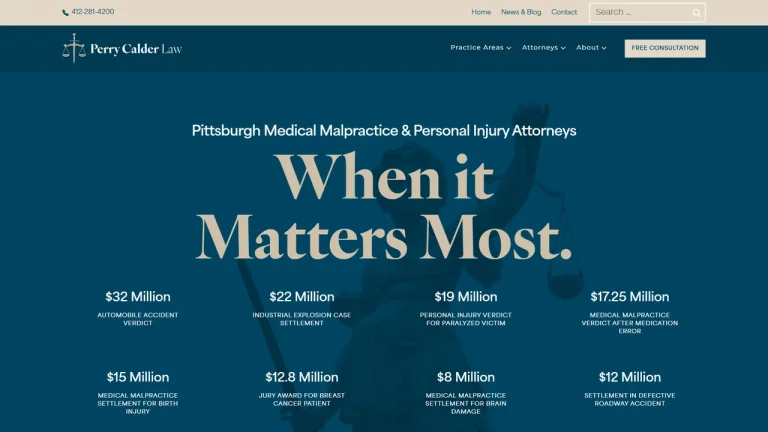
Perry Calder Law - Pittsburgh, PA

T. Brent McCune, Attorney at Law - Pittsburgh, PA

Galanter Tomosovich, LLC - Pittsburgh, PA

Ogg, Murphy & Perkosky, P.C. - Pittsburgh, PA

Wienand & Bagin - Pittsburgh, PA

Eddy, Townsend, Gravina & Bendik - Pittsburgh, PA

Dallas W. Hartman P.C., Attorneys at Law - Pittsburgh, PA

Quinn Logue LLC - Pittsburgh, PA

Brandon J. Broderick, Attorney at Law - Pittsburgh, PA

Munley Law Personal Injury Attorneys - Pittsburgh, PA

Swensen & Perer, P.C. - Pittsburgh, PA

TopDog Law Personal Injury Lawyers - Pittsburgh, PA

Jack Goodrich & Associates, P.C. - Pittsburgh, PA

Lupetin & Unatin, LLC - Pittsburgh, PA

Robert J. Amelio & Associates, LLC - Pittsburgh, PA

The Trial Law Firm, LLC - Pittsburgh, PA

Farrell Weaver & Okun - Pittsburgh, PA

Brandt, Milnes & Rea, P.C. | Fred C. Jug Jr. - Pittsburgh, PA

Carmody and Ging, Injury & Accident Lawyers - Pittsburgh, PA
Addressing Medical Negligence Across Pittsburgh Healthcare Systems
Pittsburgh represents a premier global medical hub, anchored by major healthcare systems including the University of Pittsburgh Medical Center (UPMC) network, UPMC Presbyterian, UPMC Shadyside, UPMC Magee-Womens Hospital, and the Allegheny Health Network (AHN) anchored by Allegheny General Hospital. While these facilities deliver advanced care, systemic understaffing, diagnostic oversight, medication miscalculations, and surgical errors can lead to devastating patient outcomes across Allegheny County.
Medical malpractice claims in Pittsburgh are filed in the Civil Division of the Allegheny County Court of Common Pleas inside the City-County Building on Grant Street. Due to the procedural intricacy of these actions, Allegheny County maintains specialized medical malpractice conciliation procedures and discovery guidelines overseen by dedicated judges to streamline pre-trial exchanges, evaluate liability, and encourage resolution.
Retaining local medical malpractice counsel is vital for navigating Pennsylvania evidentiary statutes and medical expert rules. Local attorneys collaborate with licensed medical practitioners to evaluate medical records, identify deviations from standard care, and present compelling claims to insurers and hospital legal departments, frequently achieving negotiated settlements before trial.
Medical Malpractice Retainer Structures and Litigation Costs in Pittsburgh
| Case Scenario | Fee Structure | Estimated Cost (USD) | Key Cost Determinants |
|---|---|---|---|
| Preliminary Merit Review & Medical Record Audit | Contingency / Firm Advanced | $0 Upfront ($2,500 - $8,000 Incurred Costs) | Volume of institutional records, diagnostic imaging audits, and independent specialist reviews. |
| Surgical Error or Anesthesia Complication Settlement | Contingency Fee (33.3% - 40%) | $0 Upfront ($250,000 - $1,200,000+ Recovered) | Demonstrated permanent impairment, future corrective surgeries, and loss of earning capacity. |
| Failure to Diagnose / Delayed Cancer Detection | Contingency Fee (33.3% - 40%) | $0 Upfront ($400,000 - $2,500,000+ Recovered) | Oncology staging progression, life expectancy reduction, and survival damages. |
| Catastrophic Birth Injury or Neonatal Brain Trauma | Contingency Fee (33.3% - 40%) | $0 Upfront ($1,500,000 - $8,000,000+ Recovered) | Lifetime care plans, neurological expert panels, and structured annuity configurations. |
Critical Legal Deadlines & Statutes in Pennsylvania
Under 42 Pa. C.S. § 5524(2), medical malpractice actions in Pennsylvania are subject to a strict two-year statute of limitations. This time limit begins when the patient knew, or through reasonable diligence should have known, that the injury was caused by medical negligence. In fatal malpractice actions, claims are asserted under the Pennsylvania Wrongful Death Act (42 Pa. C.S. § 8301) and Survival Act (42 Pa. C.S. § 8302), both strictly requiring initiation within two years of death.
Pennsylvania enforces rigorous procedural requirements designed to screen medical claims. Under Pa. R.C.P. No. 1042.3, the plaintiff attorney must file an official Certificate of Merit within 60 days of filing the complaint, certifying that an appropriate licensed medical professional has reviewed the matter and concluded there is a reasonable probability the care fell outside accepted standards. Furthermore, expert witness qualifications are governed by the Pennsylvania Medical Care Availability and Reduction of Error (MCARE) Act under 40 P.S. § 1303.512, requiring certifying experts to practice in the same subspecialty and possess identical board certifications as the defendant physician.
Small Claims Limits vs. Professional Representation in Allegheny County
Civil disputes under $12,000 fall within the jurisdiction of Pennsylvania Magisterial District Courts pursuant to 42 Pa. C.S. § 1515. However, litigating medical malpractice within small claims court is legally and practically unfeasible. Magisterial district courts do not provide the procedural framework necessary for mandatory Certificates of Merit, comprehensive pre-trial depositions, or medical peer reviews.
Hospital networks and physician risk retention groups never settle unrepresented claims without rigorous proof of deviation from standard care. Pro se filings in this field invariably face immediate judgment on the pleadings or dismissal for lack of a Certificate of Merit under Pa. R.C.P. No. 1042.7. Professional legal representation levels the playing field against well-funded hospital defense counsel, financing substantial expert costs and building evidence that complies with the Pennsylvania Rules of Evidence.
Red Flags & Hiring Considerations in Pittsburgh
- General Practitioners Lacking Medical Malpractice Experience: Medical liability is technically complex and heavily specialized. Choose an attorney who focuses primarily on clinical negligence and has proven trial experience in the Allegheny County Court of Common Pleas.
- Failure to Retain MCARE-Qualified Experts: If a law firm attempts to rely on a general family doctor to testify against a board-certified neurosurgeon, the testimony will be struck under 40 P.S. § 1303.512. Verify that counsel retains actively practicing specialists.
- Guarantees of Swift Out-of-Court Settlements: Pennsylvania hospital systems and medical malpractice insurers fiercely defend clinical actions. Legitimate lawyers never guarantee immediate settlements before analyzing the complete medical file.
- Demanding Upfront Retainer Payments for Merit Reviews: Credible medical malpractice firms operate exclusively on a contingency basis, fronting the substantial costs required to obtain medical records and retain independent physician reviews without risk to the client.
Frequently Asked Questions
What is a Certificate of Merit under Pennsylvania law?
Under Pa. R.C.P. No. 1042.3, a Certificate of Merit is a formal legal filing signed by the plaintiff attorney within 60 days of the complaint, verifying that a qualified medical expert has reviewed the case and found a reasonable probability that care fell below acceptable medical standards.
How long do I have to file a medical malpractice claim in Pittsburgh?
Under 42 Pa. C.S. § 5524(2), you generally have two years from the date you discovered, or reasonably should have discovered, the medical injury and its negligent cause to initiate legal action.
Where are malpractice cases tried in Allegheny County?
Medical malpractice lawsuits in Pittsburgh are handled by the Civil Division of the Allegheny County Court of Common Pleas, located inside the City-County Building at 414 Grant Street in Downtown Pittsburgh.
Can I sue both the treating doctor and the hospital network in Pittsburgh?
Yes. If the physician is an employee, the hospital can be held vicariously liable for the doctor's actions. Additionally, hospitals may be sued directly for corporate negligence if they failed to maintain adequate staffing, equipment, or credentialing standards.
How are medical malpractice attorney fees handled in Pennsylvania?
Attorneys handle medical malpractice claims on a contingency fee agreement, meaning you pay no out-of-pocket legal fees. Legal fees and litigation expenses are recovered only as a percentage of the financial recovery obtained through settlement or verdict.