
Patent Attorneys in Pittsburgh
Securing intellectual property protections in Pittsburgh demands skilled patent counsel admitted before the USPTO and familiar with regional innovation hubs. Experienced patent attorneys help innovators navigate novelty searches, draft resilient claims, and resolve infringement disputes outside of court whenever possible. Review our verified directory below to schedule a confidential consultation with a trusted local patent lawyer.
Spilman Thomas & Battle, PLLC - Pittsburgh, PA

Leech Tishman Fuscaldo & Lampl - Pittsburgh, PA
Eisner Law - Pittsburgh, PA
Dentons Cohen & Grigsby - Pittsburgh, PA

Dinsmore & Shohl LLP - Pittsburgh, PA
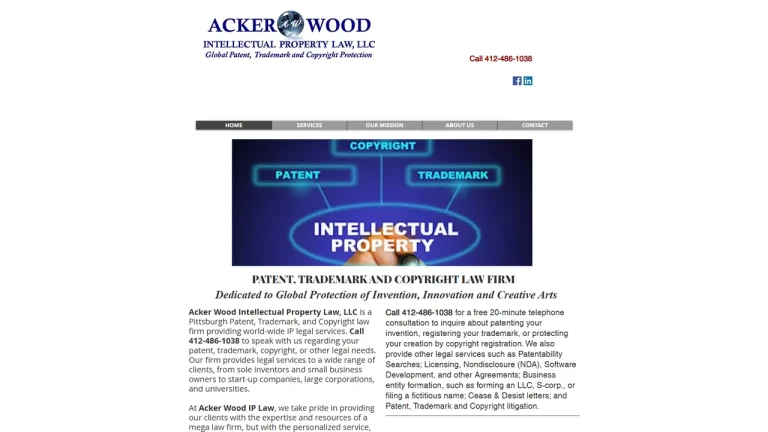
Acker Wood Intellectual Property Law, LLC - Pittsburgh, PA
Saul Ewing LLP - Pittsburgh, PA
Morgan, Lewis & Bockius LLP - Pittsburgh, PA
The Zegarelli Law Group - Pittsburgh, PA
Houston Harbaugh, P.C. - Pittsburgh, PA

Cohen & Grace, LLC - Pittsburgh, PA

Jackson Kelly PLLC - Pittsburgh, PA
Henry M. Sneath, Esq. - Pittsburgh, PA

Fox Rothschild LLP - Pittsburgh, PA

Behrend & Ernsberger, P.C. - Pittsburgh, PA
Burns White LLC - Pittsburgh, PA
Vorys, Sater, Seymour and Pease LLP - Pittsburgh, PA
The Webb Law Firm - Pittsburgh, PA
Frost Brown Todd - Pittsburgh, PA
Clark Hill PLC - Pittsburgh, PA

Buchanan Ingersoll & Rooney PC - Pittsburgh, PA

Sughrue Mion, PLLC - Pittsburgh, PA
Protecting High-Tech and Industrial Innovation Across Pittsburgh
Pittsburgh has established itself as an international center for robotics, artificial intelligence, life sciences, and advanced manufacturing, propelled by research institutions like Carnegie Mellon University and the University of Pittsburgh. Securing exclusive commercial rights across these technical sectors requires legal counsel with dual qualifications: admission to the Pennsylvania Bar and formal registration with the United States Patent and Trademark Office (USPTO).
From startup incubators along the Strip District's Robotics Row to research campuses in Oakland, Shadyside, and Bakery Square, patent attorneys prepare applications that withstand international scrutiny. Local patent counsel conducts prior art searches, drafts strategic independent and dependent claims, and navigates office action rejections issued by USPTO patent examiners.
When infringement disputes or validity challenges arise, litigation is conducted under the Local Patent Rules of the U.S. District Court for the Western District of Pennsylvania at the federal courthouse on Grant Street. Experienced litigators guide inventors through Markman claim construction hearings and administrative post-grant proceedings before the Patent Trial and Appeal Board (PTAB).
Typical Fee Structures for Pittsburgh Patent Legal Services
| Case Scenario | Fee Structure | Estimated Cost (USD) | Key Cost Determinants |
|---|---|---|---|
| Patentability Prior Art Search & Legal Opinion | Flat Fee | $1,200 - $3,000 | Depth of domestic and international database searching, technical discipline complexity, and competitive field density. |
| Provisional Patent Application Preparation | Flat Fee | $2,500 - $5,500 | Technical disclosure completeness, engineering diagram complexity, and provisional claim drafting scope. |
| Non-Provisional Utility Patent Prosecution | Flat Fee / Phased | $7,500 - $16,000+ | Number of claims, software/biotech classification, specification detail, and USPTO micro/small entity fees. |
| Federal Patent Infringement Litigation | Hourly Retainer | $25,000 - $100,000+ retainer ($450 - $850/hr) | Markman hearing complexity, forensic reverse engineering, expert witness reports, and discovery scope. |
Critical Legal Deadlines & Statutes in Pennsylvania
Patent rights are governed by strict statutory deadlines that, if missed, dedicate inventions permanently to the public domain. Under 35 U.S. Code § 102, the United States operates under a first-inventor-to-file system with a limited one-year grace period following public disclosure, commercial sale, or public use of an invention.
A provisional patent application filed under 35 U.S. Code § 111 establishes an initial priority date but expires automatically after 12 months. Failure to convert the provisional filing into a non-provisional application within this strict one-year period results in the permanent loss of the original priority filing date.
In formal infringement litigation, damages are governed by a six-year statutory lookback period under 35 U.S. Code § 286. During administrative patent prosecution, responses to USPTO Office Actions must be filed within three months under 37 C.F.R. § 1.136 to avoid extension penalties, and all applicants must comply with the duty of candor under 37 C.F.R. § 1.56.
Small Claims Limitations & Self-Filing vs. Registered Patent Counsel
Magisterial District Courts in Allegheny County exercise jurisdiction over minor disputes up to $12,000 under 42 Pa. C.S. § 1515, but they have zero subject-matter jurisdiction over patent disputes. Federal courts hold exclusive jurisdiction over all patent matters under 28 U.S. Code § 1338.
While individual inventors may theoretically prepare and file their own applications pro se, patent drafting involves rigid statutory requirements under 35 U.S. Code § 112. Pro se patent filings frequently suffer from claim drafting defects, unintentional disclaimers, or inadequate written description, leaving the invention vulnerable to competitor workarounds. Retaining an attorney registered under 37 C.F.R. § 11.7 ensures robust claim architecture and defensible intellectual property assets.
Red Flags to Avoid When Hiring a Pittsburgh Patent Attorney
- Invention promotion companies that promise guaranteed commercialization or licensing deals while charging excessive fees, often in violation of 35 U.S. Code § 297.
- General practice attorneys who are not formally registered with the USPTO and therefore cannot legally prosecute patent applications before patent examiners.
- Practitioners who recommend drafting a non-provisional application without first conducting a comprehensive prior art search.
- Attorneys lacking technical degrees or industry familiarity with your specific engineering, computer science, or biochemical domain.
Frequently Asked Questions
What is the difference between a patent attorney and a patent agent?
Both are licensed by the USPTO to write and prosecute patent applications. However, patent attorneys are also licensed by a state bar, enabling them to draft licensing contracts, provide legal opinions, and litigate in court.
What does a provisional patent application accomplish?
A provisional application secures an immediate filing date and allows the applicant to use the patent pending designation for up to 12 months before filing a formal non-provisional application.
Where are patent lawsuits filed in Pittsburgh?
Patent infringement actions in Pittsburgh are filed in the U.S. District Court for the Western District of Pennsylvania, governed by dedicated Local Patent Rules.
Does a patent protect my invention internationally?
No. A U.S. patent provides legal exclusivity only within the United States. International protection requires filings through foreign patent offices or the Patent Cooperation Treaty.
How long does the patent application process take?
The examination process generally takes between 18 and 36 months, depending on the technological classification and whether track-one prioritized examination is requested.