
Tax Lawyers in Pennsylvania
Retaining a skilled Pennsylvania tax lawyer protects your assets and provides strategic defense against state and federal tax audits, penalties, and tax liens. Dedicated counsel negotiates offers in compromise, penalty abatements, and administrative appeals before the Commonwealth Court and administrative boards. Explore our verified directory below to consult an experienced Pennsylvania tax attorney.

BakerHostetler - Philadelphia, PA

Defense Tax Partners - Tax Attorney, IRS Tax Relief & Audit Defense, Free Consultation - Pittsburgh, PA

Goldberg Katzman, P.C. - Harrisburg, PA

Rust Belt Business Law - Erie, PA

Zarwin Baum DeVito Kaplan Schaer Toddy, P.C. - Philadelphia, PA

Rubin & Rubin - Philadelphia, PA

McCarthy Weidler P.C. - Philadelphia, PA

Fleming Petenko Law - Philadelphia, PA

Jerome C. Wegley, Esq. - Erie, PA

Gilboy & Gilboy LLP - Philadelphia, PA

Cooper Levenson, P.A. - Harrisburg, PA

Braverman Kaskey Garber, P.C. - Philadelphia, PA
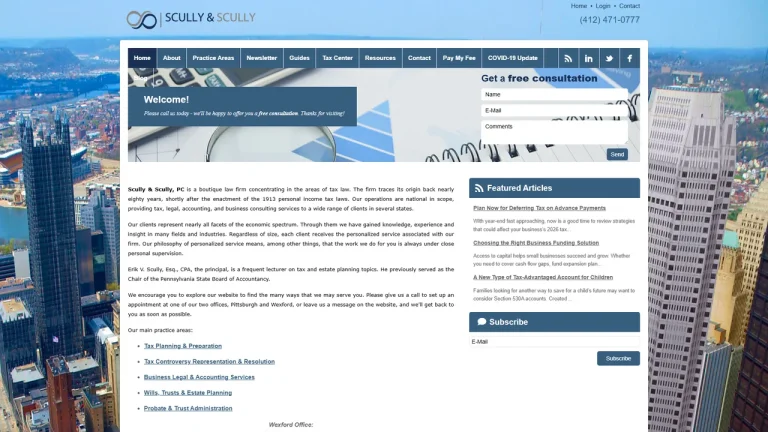
Scully & Scully, PC - Pittsburgh, PA
Blank Rome LLP - Philadelphia, PA

Offit Kurman - Harrisburg, PA

Vorys, Sater, Seymour and Pease LLP - Pittsburgh, PA

Philadelphia Volunteer Lawyers for the Arts - Philadelphia, PA

MacDonald, Illig, Jones & Britton LLP - Erie, PA

Defense Tax Partners - Tax Attorney, Tax Relief Settlement Service, Free Consultation - Pittsburgh, PA

McNees Wallace & Nurick LLC - Harrisburg, PA

Spilman Thomas & Battle, PLLC - Pittsburgh, PA

Morella & Associates, A Professional Corporation - Pittsburgh, PA
Buchanan Ingersoll & Rooney PC - Pittsburgh, PA

The Law Office of P. William Bercik - Pittsburgh, PA
Navigating the Pennsylvania and Federal Tax Jurisdictional Landscape
Resolving complex tax controversies in the Commonwealth of Pennsylvania requires handling multi-tiered state and federal jurisdictions. State tax enforcement is centralized under the Pennsylvania Department of Revenue (PA DOR) headquartered in Harrisburg. When disputes arise regarding Personal Income Tax, Corporate Net Income Tax, or Sales and Use Tax, taxpayers must navigate rigorous administrative appeal tracks before seeking judicial relief.
Administrative appeals are initially adjudicated by the Department of Revenue Board of Appeals, followed by an independent administrative review before the Pennsylvania Board of Finance and Revenue in Harrisburg. If administrative remedies fail, legal appeals move directly to the Commonwealth Court of Pennsylvania, a specialized appellate court exercising original jurisdiction over state tax determinations, with final appellate review conducted by the Supreme Court of Pennsylvania.
For federal matters, Pennsylvania tax attorneys represent individuals and corporate entities before the Internal Revenue Service (IRS), the United States Tax Court, and the federal district courts serving the Eastern, Middle, and Western districts of Pennsylvania. In municipal matters, practitioners interface with local agencies, such as the Philadelphia Department of Revenue for Business Income and Receipts Tax (BIRT) or regional tax collection committees enforcing local earned income taxes under Act 32.
Typical Legal Fee Structures for Pennsylvania Tax Controversies
| Case Scenario | Fee Structure | Estimated Cost (USD) | Key Cost Determinants |
|---|---|---|---|
| PA Department of Revenue Audit & Board of Appeals | Hourly Rate | $2,500 - $7,500 | Documentation volume, sales and use tax sample audits, trust fund recovery assessments. |
| Board of Finance and Revenue (BF&R) Formal Appeal | Hourly / Retainer | $3,500 - $10,000 | Statutory brief drafting, corporate tax apportionment formulas, formal oral argument. |
| IRS Offer in Compromise & Penalty Abatement | Flat Fee / Hourly | $2,500 - $6,500 | Asset equity calculations, doubt as to collectibility, reasonable cause justification for penalties. |
| Commonwealth Court Tax Litigation | Hourly Retainer | $10,000 - $30,000+ | Stipulation of facts development, expert witness depositions, constitutional uniformity challenges. |
Critical Legal Deadlines & Statutes in Pennsylvania
Strict statutory timeframes govern Pennsylvania tax disputes, and missing a deadline completely forfeits the right to contest an assessment. Under the Pennsylvania Tax Reform Code of 1971, a taxpayer must file a petition for reassessment with the PA DOR Board of Appeals within 60 days of the mailing date of the assessment notice pursuant to 72 P.S. § 9702.
If the Board of Appeals issues an adverse determination, the taxpayer has exactly 60 days from the mailing date of the decision to file a petition for review with the Pennsylvania Board of Finance and Revenue under 72 P.S. § 9704. Timely filing is jurisdictional; late submissions are dismissed without review.
To appeal a final determination of the Board of Finance and Revenue, a petition for review must be filed in the Commonwealth Court of Pennsylvania within thirty days under 42 Pa. C.S. § 763 and Pennsylvania Rule of Appellate Procedure 1571. Refund claims for overpaid personal income or corporate taxes must generally be filed within three years of payment pursuant to 72 P.S. § 10003.1.
For federal tax deficiencies, a taxpayer receiving an IRS Notice of Deficiency must file a petition with the United States Tax Court within 90 days of the notice mailing date under 26 U.S. Code § 6213. This 90-day statutory window cannot be extended by any court.
Self-Representation vs. Professional Legal Counsel in Tax Controversies
Taxpayers can often resolve minor mathematical corrections, missing W-2 notices, or standard payment plans under $12,000 directly with Department of Revenue customer representatives without formal legal counsel. Straightforward identity verification or standard filing corrections rarely require specialized representation.
However, when a dispute involves corporate business tax apportionments, sales tax audit sampling methodologies, personal officer liability under 72 P.S. § 7225, or formal proceedings in the Commonwealth Court, professional legal representation is indispensable. Commonwealth Court appeals involve de novo evidentiary review where procedural rules are strictly enforced. Experienced tax attorneys protect confidential records, preserve constitutional uniformity arguments, and negotiate complex administrative settlements.
Red Flags When Hiring a Pennsylvania Tax Attorney
- National call-center tax resolution firms that make unsubstantiated guarantees to settle your tax liability for pennies on the dollar before examining your records.
- Firms employing non-attorney representatives who cannot appear before the Commonwealth Court of Pennsylvania or the United States Tax Court.
- Failure to evaluate personal liability risks for corporate officers regarding unpaid Pennsylvania sales tax and employee wage withholding trust funds.
- Lack of transparency regarding billing structures, hourly rates for paralegals and partners, and anticipated state filing fees.
Frequently Asked Questions
How do I appeal an assessment from the Pennsylvania Department of Revenue?
You must file a formal petition for reassessment with the Department of Revenue Board of Appeals within 60 days of the mailing date of the assessment notice. If dissatisfied with that ruling, you have 60 days to appeal to the Board of Finance and Revenue.
What is the Commonwealth Court of Pennsylvania's role in tax disputes?
The Commonwealth Court of Pennsylvania has jurisdiction to review appeals from the Board of Finance and Revenue, conducting de novo review where new evidence and factual stipulations are presented.
Can corporate officers be held personally liable for a business's unpaid Pennsylvania taxes?
Yes. Under Pennsylvania law, officers and individuals responsible for collecting and remitting trust fund taxes, such as sales tax and employer payroll withholdings, can be assessed personal liability penalties.
Does Pennsylvania have an Offer in Compromise program for state taxes?
Yes. The Pennsylvania Department of Revenue maintains a formal Offer in Compromise program that allows qualifying taxpayers with genuine financial hardship or doubtful collectibility to settle state tax liabilities for less than the full amount.
What is the deadline to petition the US Tax Court after an IRS audit?
You have exactly 90 days from the date stamped on the IRS Statutory Notice of Deficiency to file a petition with the United States Tax Court. This statutory deadline is non-extendable.