
Business Litigation Lawyers in South Carolina
Engaging a South Carolina business litigation lawyer protects your corporate assets and safeguards commercial operations during high-stakes corporate disputes. Experienced trial counsel resolves complex shareholder, contract, and partnership conflicts through decisive litigation or mediation. Explore our statewide directory to connect with leading commercial litigation attorneys today.

Park Circle Law, LLC - North Charleston, SC
Goodwyn Law Firm, LLC - Columbia, SC

Finkel Law Firm LLC - North Charleston, SC

Senn Legal, LLC - Charleston, SC
Barnwell Whaley Patterson & Helms - Charleston, SC

Hood Law Firm, LLC - Charleston, SC

Ellis Roberts Law, LLC - Charleston, SC
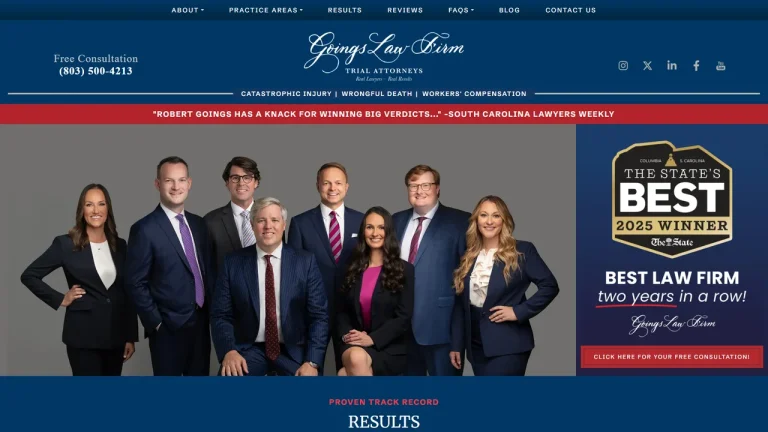
Christian E. Boesl - Goings Law Firm, LLC - Columbia, SC
Thad L. Myers, P.A. & Associates - Columbia, SC
Allen Legal - Charleston, SC
Willson Jones Carter & Baxley, P.A. - Columbia, SC
Rikard & Protopapas, LLC - Columbia, SC

Pierce, Sloan, Kennedy and Early LLC - Charleston, SC
Thrive IP - North Charleston, SC

Closser Law, PA - North Charleston, SC
Allen Law - Charleston, SC

Copeland, Stair Valz & Lovell, LLP - Charleston, SC
McGowan, Hood, Felder & Phillips, LLC - Columbia, SC

Rosen Hagood - Charleston, SC
Proffitt & Cox, LLP - Columbia, SC

Duffy & Young LLC - Charleston, SC

Rogers Townsend - Charleston, SC

Howser, Newman and Besley, LLC - Columbia, SC

South Carolina Commercial Litigation Venues and Judicial Procedures
Commercial litigation across South Carolina involves substantial financial interests and intricate corporate statutes. From manufacturing facilities in Greenville and Spartanburg to coastal commercial enterprises in Charleston and corporate institutions in Columbia, business disputes demand assertive representation within established judicial venues.
Business litigation primarily unfolds in the South Carolina Circuit Court, specifically the Court of Common Pleas. The Supreme Court of South Carolina established the Business Court Program-a specialized track designed to handle complex commercial cases, including corporate dissolutions, intellectual property conflicts, trade secret claims, and high-value breach of contract actions.
When lawsuits involve parties across different jurisdictions or federal questions, cases proceed in the United States District Court for the District of South Carolina, with division courthouses in Charleston, Columbia, Greenville, and Florence. Retaining trial counsel admitted to the South Carolina Bar and experienced in both state and federal procedural rules guarantees rigorous protection for corporate interests.
Fee Structures for South Carolina Commercial Litigation
| Case Scenario | Fee Structure | Estimated Cost (USD) | Key Cost Determinants |
|---|---|---|---|
| Pre-Suit Commercial Dispute & Demand Strategy | Hourly Rate | $300 - $600 / hr | Entity documentation, damage assessments, negotiation rounds |
| Temporary Restraining Orders & Injunctions | Hourly / Retainer | $7,500 - $25,000+ | Emergency motion preparation, evidentiary hearings, witness affidavits |
| Shareholder & Partnership Derivative Suits | Hourly / Hybrid | $20,000 - $80,000+ | Forensic accounting audits, entity valuation, partner counts |
| Full-Scale Business Court Trial | Hourly Rate | $35,000 - $150,000+ | Electronic discovery volume, expert witnesses, trial length, appeals |
Critical Legal Deadlines & Statutes in South Carolina
Strict adherence to statutory limitation periods is crucial when prosecuting or defending commercial claims in South Carolina. Failing to commence a lawsuit within statutory limits permanently bars legal recovery.
Under S.C. Code Ann. § 15-3-530, actions based on breach of contract, commercial torts, fraud, and breach of fiduciary duty must be brought within three years from the date the cause of action arose or was discovered.
Claims under the South Carolina Unfair Trade Practices Act (SCUTPA), codified at S.C. Code Ann. § 39-5-20, are subject to a strict three-year limitation period pursuant to S.C. Code Ann. § 39-5-140. Plaintiffs must prove that the unfair or deceptive act has an adverse impact on the public interest.
Litigation alleging the misappropriation of proprietary business assets must be brought within three years after the misappropriation was discovered or reasonably should have been discovered under S.C. Code Ann. § 39-8-50. Furthermore, judicial dissolution petitions initiated by oppressed minority shareholders proceed under the South Carolina Business Corporation Act pursuant to S.C. Code Ann. § 33-14-300.
Magistrate Small Claims vs. Circuit Court Business Litigation
The South Carolina Magistrate Court maintains a monetary limitation of $7,500 pursuant to S.C. Code Ann. § 22-3-10. Although a small sole proprietorship might pursue modest account collections before a magistrate, higher commercial disputes require formal litigation.
Magistrate Courts cannot grant injunctive relief, enter asset freezes, or resolve complex shareholder derivative actions. Moreover, corporations and limited liability companies cannot be represented pro se in the South Carolina Court of Common Pleas; state legal rules require business entities to appear through licensed attorneys.
Pursuing complex commercial claims in Circuit Court ensures access to broad discovery mechanisms, subpoena power, and specialized Business Court procedures. Experienced commercial litigators navigate these procedures to safeguard business valuations and corporate control.
Red Flags to Avoid When Selecting a Business Litigation Attorney
- Attorneys offering unrealistic guarantees of trial victories or specific financial recoveries, in direct contradiction of South Carolina Bar professional conduct standards.
- Litigators without documented experience appearing in the South Carolina Business Court program or the United States District Court for the District of South Carolina.
- Ambiguous fee agreements that fail to define handling costs for extensive electronic discovery (e-discovery), document preservation, and forensic accounting.
- Firms that disregard early alternative dispute resolution options despite South Carolina mandatory court-annexed mediation requirements.
Frequently Asked Questions
What qualifies a commercial dispute for the South Carolina Business Court?
The South Carolina Business Court program handles non-jury commercial disputes, complex contract claims, shareholder derivative actions, corporate mergers, and trade secret actions exceeding specified financial thresholds upon motion granted by the presiding business court judge.
Is mediation mandatory in South Carolina civil lawsuits?
Yes. Under the South Carolina Court-Annexed Alternative Dispute Resolution Rules, civil actions filed in the Court of Common Pleas are subject to mandatory mediation prior to trial in all forty-six South Carolina counties.
Can a corporate entity appear without a lawyer in South Carolina Circuit Court?
No. Under South Carolina law, business entities including corporations and limited liability companies must be represented by an attorney admitted to the South Carolina Bar in Circuit Court proceedings.
What is required to prove a South Carolina Unfair Trade Practices Act claim?
Under S.C. Code Ann. § 39-5-20, a claimant must demonstrate that the defendant engaged in an unfair or deceptive trade practice that caused actual monetary damages and had an adverse impact on the public interest.
What remedies exist for shareholder oppression in South Carolina?
Under S.C. Code Ann. § 33-14-300 and S.C. Code Ann. § 33-14-310, oppressed shareholders can petition the court for judicial dissolution of the corporation, a court-ordered buyout of shares at fair value, or the appointment of a receiver.