
Business Litigation Lawyers in Nashville
Hiring an experienced Nashville business litigation lawyer ensures your commercial interests and corporate assets are fiercely protected in Tennessee courts. Skilled trial attorneys resolve complex shareholder disputes, contract breaches, and commercial torts through strategic negotiation or courtroom trial. Explore our verified directory below to schedule a strategic case evaluation with trusted Davidson County business litigators.

Wicker Smith O'Hara McCoy & Ford, PA - Nashville, TN

Christy Tosh Crider (Baker Donelson) - Nashville, TN

Surber, Asher, Surber & Moushon PLLC - Nashville, TN
Music City Law, PLLC - Nashville, TN

Brewer, Krause, Brooks, Chastain and Meisner, PLLC - Nashville, TN
Ortale Kelley Law Firm, PLLC - Nashville, TN
Morgan & Akins, PLLC - Nashville, TN

Leach & Company, PLLC - Nashville, TN
Tune, Entrekin & White, P.C. - Nashville, TN
Groth, Makarenko, Kaiser & Eidex - Nashville, TN

Butler Snow LLP - Nashville, TN

Schulman Leroy and Bennett PC - Nashville, TN
Buchalter - Nashville, TN
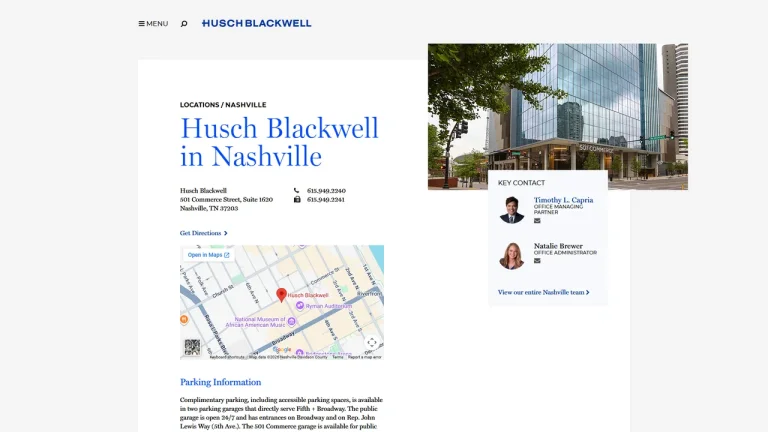
Husch Blackwell LLP - Nashville, TN

Meggan Bess Sullivan, PLLC - Nashville, TN

Hemp Law Group - Nashville, TN
John P. Branham, Attorney - Nashville, TN

Quantum Law & Consulting - Nashville, TN

Jack F. Stringham II - Nashville, TN
Lawless and Associates, P.C. - Nashville, TN
Northstar Litigation, P.C. - Nashville, TN
Miller & Martin PLLC - Nashville, TN
Howell and Fisher PLLC - Nashville, TN
Resolving Commercial Disputes in Nashville and Davidson County Courts
Commercial conflict can threaten an enterprise's operations, brand reputation, and financial solvency. In Nashville's booming economy, disputes arise frequently across key sectors, including corporate healthcare networks, real estate ventures, entertainment management, technology startups, and construction development throughout Downtown, The Gulch, SoBro, and West End.
Business disputes in Nashville are litigated within the 20th Judicial District of Tennessee. Most substantial commercial litigation is filed in the Davidson County Chancery Court at the Historic Metro Courthouse on Public Square. Davidson County hosts the specialized Tennessee Business Court Docket, a dedicated commercial forum with experienced chancellors tailored to handle complex business disputes, emergency temporary restraining orders, and corporate dissolutions efficiently.
Leading Nashville trial litigators advocate for clients located in Davidson County and across Middle Tennessee, including Brentwood, Franklin, Hendersonville, and Murfreesboro. Experienced counsel combines aggressive courtroom advocacy with out-of-court dispute resolution methods such as mediation and arbitration to protect corporate assets.
Nashville Business Litigation Fee Structures and Case Projections
Business litigation representation in Nashville is primarily billed at hourly rates, although hybrid fees or success-based arrangements may be available depending on the nature of the claim.
| Case Scenario | Fee Structure | Estimated Cost (USD) | Key Cost Determinants |
|---|---|---|---|
| Pre-Suit Dispute Assessment & Mediation | Hourly ($300 - $550/hr) | $3,500 - $10,000 | Document analysis, pre-suit demand letters, valuation review, and formal mediation sessions. |
| Chancery Court Injunction & TRO Proceeding | Hourly ($350 - $650/hr) | $10,000 - $35,000+ | Emergency evidentiary filings, expedited discovery, bond requirements, and restraining order hearings. |
| Full Commercial Trial (Contract Breach / Fraud) | Hourly / Hybrid Contingency | $25,000 - $100,000+ | Extensive electronic discovery (ESI), expert witness retentions, depositions, and jury trial duration. |
| Shareholder Derivative & Freeze-Out Action | Hourly ($350 - $600/hr) | $15,000 - $60,000+ | Forensic financial auditing, company valuation disputes, and fiduciary duty breach proofs. |
Critical Legal Deadlines & Statutes in Tennessee
Filing deadlines in Tennessee commercial litigation vary significantly by the legal cause of action. Claims based on breach of contract carry a 6-year statute of limitations under Tenn. Code Ann. § 28-3-109(a)(3). However, commercial torts, including tortious interference with business relationships and injury to personal property, must be brought within 3 years under Tenn. Code Ann. § 28-3-105.
Claims under the Tennessee Consumer Protection Act are governed by a 1-year statute of limitations from discovery, coupled with a strict 4-year statute of repose under Tenn. Code Ann. § 47-18-110. For corporate internal disputes, shareholder derivative lawsuits must comply with mandatory pre-suit demand rules under Tenn. Code Ann. § 48-17-401, requiring a 90-day waiting period following written demand unless the board rejects the demand earlier.
Parties pursuing commercial litigation in the Davidson County Business Court Docket must also comply with specialized local case management orders, requiring strict adherence to early disclosure timetables and mandatory mediation conferences.
General Sessions Civil Limits vs. Chancery Court Business Litigation
The Davidson County General Sessions Court provides a swift forum for civil matters capped at $25,000 under Tenn. Code Ann. § 16-15-501. For isolated, low-dollar vendor defaults, General Sessions provides a practical, low-cost collection mechanism without formal discovery.
However, true commercial litigation typically involves high financial stakes, equitable relief, non-monetary remedies, and multi-party discovery far exceeding General Sessions jurisdiction. Matters such as emergency injunctions, trade secret enforcement, partnership dissolutions, and complex fiduciary breaches require the Davidson County Chancery Court and its Business Court Docket. Seasoned commercial litigation counsel implements electronic document holds, conducts rigorous depositions, and structures effective courtroom presentations that protect corporate longevity.
Red Flags to Avoid When Selecting a Nashville Business Litigation Lawyer
When retaining legal counsel to handle high-stakes commercial disputes, avoid attorneys who exhibit these concerning practices:
- Attorneys who rush straight into protracted litigation without first exploring structured commercial mediation or early settlement options.
- Law firms lacking direct courtroom experience in the Davidson County Chancery Court or unfamiliar with the specialized rules of the Tennessee Business Court Docket.
- Firms that fail to provide transparent litigation budgeting or clear staffing plans for handling voluminous electronic discovery (ESI).
- Lawyers who guarantee trial victories or predict court rulings before thoroughly reviewing business records, emails, and transactional contracts.
Frequently Asked Questions
What is the Tennessee Business Court Docket in Davidson County?
The Tennessee Business Court Docket is a specialized commercial court pilot operating in the Davidson County Chancery Court, designed to handle complex business disputes with streamlined discovery, experienced chancellors, and accelerated resolution timelines.
What types of damages can a business recover in a commercial lawsuit?
Plaintiffs can recover compensatory damages, lost profits, and incidental costs. In cases involving willful fraud or gross malice, punitive damages may also be awarded under Tennessee statutory limits.
Can a member or shareholder be forced out of a Nashville company?
Expulsion depends on the terms of the company's operating agreement or corporate bylaws. In the absence of specific contractual provisions, a partner or member can only be removed through judicial dissociation in Chancery Court upon showing illegal conduct or material breach of duty.
Is mediation mandatory before a commercial trial in Davidson County?
Under Tennessee Supreme Court Rule 31, local judges and chancellors in Davidson County routinely order business disputes into mandatory mediation before setting a trial date, encouraging out-of-court resolution.
What constitutes tortious interference with a business contract in Tennessee?
Under Tennessee law, tortious interference requires proving the existence of a valid contract, the defendant's knowledge of that contract, an intentional procurement of its breach without justification, and resulting financial damages.