
Copyright Lawyers in Nashville
Retaining an experienced Nashville copyright lawyer protects your musical compositions, recordings, and literary creative assets under federal copyright law. A knowledgeable attorney negotiates publishing royalties, manages licensing agreements, and pursues infringement damages through skilled advocacy. Explore our directory below to consult top-rated copyright counsel serving Nashville's vibrant creative community.
Hendley & Goodwyn, LLP - Nashville, TN
Bradley Arant Boult Cummings LLP - Nashville, TN

Whiskey Ghost Entertainment - Nashville, TN
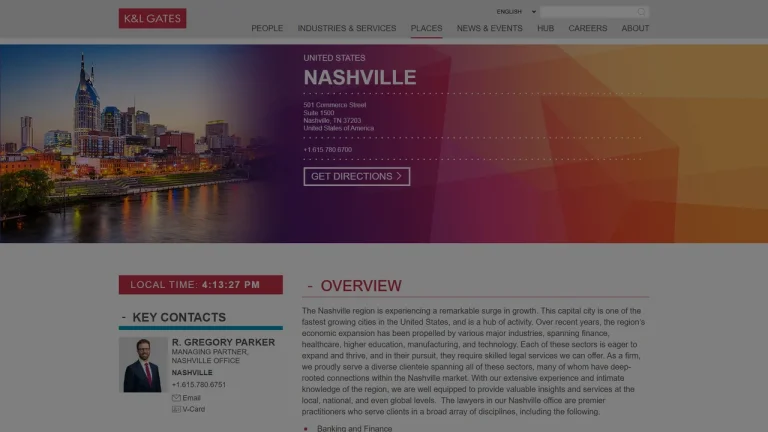
K&L Gates LLP - Nashville, TN
Hollowell Patent Group - Nashville, TN
Epstein Law Firm Nashville - Nashville, TN
Kaalberg Giesecke, PLLC - Nashville, TN
McInteer & O'Rear PLC - Nashville, TN
A.J. Bahou - Nashville, TN

John Rizvi, P.A. - The Idea Attorneys - Nashville, TN
Norman Gillis & Associates, Inc. - Nashville, TN
Trademark Soup - Nashville, TN
Robert L. Brewer - Bass, Berry & Sims PLC - Nashville, TN
Equitus Law (Equitus Law Alliance, PLLC) - Nashville, TN
Schelling IP Law, PLLC - Nashville, TN
Bass, Berry & Sims PLC - Nashville, TN
Reasonover Law Firm - Nashville, TN
Wolfe Legal Services, PLC - Nashville, TN
The Primacy Firm, PLLC - Nashville, TN
Novick Law PLLC - Nashville, TN
Baker Donelson - Nashville, TN
The Fruitful Firm - Nashville, TN

Greenspoon Marder LLP - Nashville, TN
Safeguarding Creative Works in Nashville's Entertainment Ecosystem
Nashville stands as Music City, an internationally renowned epicenter for music publishing, sound recordings, songwriting, audiovisual productions, and digital creative works. From historic publishing companies along Music Row to modern recording studios across Wedgewood-Houston, Berry Hill, and Downtown, original creative expressions represent the foundational commercial capital of Tennessee artists and entertainment enterprises.
Copyright protection is governed by the federal Copyright Act of 1976 and administered by the United States Copyright Office. Civil copyright litigation in Middle Tennessee is conducted primarily in the U.S. District Court for the Middle District of Tennessee at the Fred D. Thompson U.S. Courthouse, or through administrative procedures before the Copyright Claims Board (CCB). Disputes involving underlying publishing agreements, co-writer split sheets, and management contracts may also be heard in the Davidson County Chancery Court.
Engaging an experienced Nashville copyright attorney ensures proper registration, bulletproof chain-of-title documentation, and proactive enforcement against unauthorized digital sampling, synchronization, or unlicensed distribution. Skilled legal counsel helps creators navigate royalty audits, out-of-court settlement negotiations, and federal court proceedings to preserve their creative rights and revenue streams.
Copyright Legal Fee Structures & Retainers in Nashville
| Case Scenario | Fee Structure | Estimated Cost (USD) | Key Cost Determinants |
|---|---|---|---|
| U.S. Copyright Office Registration & Chain of Title Audit | Flat Fee | $450 - $1,250 | Number of individual works, eligibility for group registration (published vs. unpublished tracks), and complexity of co-authorship split sheets. |
| Music Publishing, Synchronization & Master Licensing Negotiation | Hourly or Flat Fee | $1,200 - $4,000 | Scope of license grant (worldwide, terrestrial, digital), exclusivity terms, reversion clauses, and upfront advance structuring. |
| Copyright Claims Board (CCB) Small Dispute Proceeding | Flat Fee / Hourly | $3,000 - $7,500 | Drafting of CCB claim or response, respondent opt-out evaluation, and streamlined paper discovery management. |
| Federal Copyright Infringement Litigation (Middle District of TN) | Hourly / Hybrid | $12,000 - $50,000+ | Forensic musicologist analysis, temporary restraining orders, formal depositions, and statutory damage determinations under Section 504. |
Critical Legal Deadlines & Statutes in Copyright Practice
Creators and entertainment companies in Nashville must observe rigid statutory deadlines to maintain legal remedies and avoid claim forfeiture under federal copyright jurisprudence:
Under 17 U.S. Code § 507(b), civil copyright infringement actions are subject to a strict three-year statute of limitations. A civil lawsuit must be filed within three years after the copyright owner discovered, or with reasonable diligence should have discovered, the infringing activity.
Registration timing fundamentally dictates available legal remedies. Under 17 U.S. Code § 411(a), a copyright owner cannot initiate an infringement lawsuit in federal court until the U.S. Copyright Office has formally acted upon the registration application. Furthermore, under 17 U.S. Code § 412, statutory damages and recovery of attorney fees under 17 U.S. Code § 504(c) and 17 U.S. Code § 505 are unavailable unless registration occurred prior to infringement, or within three months of the work's initial commercial publication.
In online copyright disputes governed by the Digital Millennium Copyright Act (DMCA), service providers must adhere to prompt timelines. Under 17 U.S. Code § 512(g), when a user submits a valid DMCA counter-notification, the service provider must restore the removed content within ten to fourteen business days unless the copyright owner files a formal federal court action within that period.
General Sessions vs. Federal Jurisdiction & Copyright Claims Board
The Davidson County General Sessions Court exercises jurisdiction over small monetary disputes with a ceiling of $25,000 under Tenn. Code Ann. § 16-15-501.
However, state courts in Tennessee have zero jurisdiction over copyright infringement actions. Pursuant to 28 U.S. Code § 1338(a), federal courts maintain exclusive jurisdiction over claims arising under federal copyright law. If an artist or publisher files a copyright infringement action in General Sessions Court, the case will be summarily dismissed for lack of subject matter jurisdiction.
For smaller copyright disputes up to $30,000, creators can utilize the Copyright Claims Board (CCB) established by Congress under 17 U.S. Code § 1501. The CCB provides a streamlined, cost-effective administrative alternative to federal court litigation. For disputes involving extensive catalog infringement, substantial financial losses, or injunctive relief, retaining a seasoned copyright litigation attorney in the U.S. District Court for the Middle District of Tennessee is essential.
Red Flags When Hiring a Copyright Attorney
- Failure to Verify Pre-Suit Registration: Litigators willing to file federal lawsuits without verifying whether a formal Copyright Office registration certificate has been issued under Section 411(a).
- Unrealistic Statutory Damages Promises: Promising six-figure statutory damages without verifying whether the work was registered before the infringement took place pursuant to Section 412.
- Lack of Entertainment Catalog Experience: Attorneys unfamiliar with the critical distinction between musical compositions (PA marks) and sound recordings (SR marks), leading to defective licensing agreements.
- Unclear Commission or Royalty Splits: Counsel requiring ongoing percentages of creative revenue streams rather than clear, transparent hourly rates or capped flat fees for transactional negotiations.
Frequently Asked Questions
Can I file a copyright infringement lawsuit before my registration is approved?
No. Under 17 U.S. Code § 411(a), as affirmed by the United States Supreme Court, you cannot file a copyright infringement lawsuit in federal court until the U.S. Copyright Office has formally granted or refused your registration.
What is the difference between a musical composition and a sound recording copyright?
A musical composition copyright protects the underlying music and lyrics written by songwriters and composers. A sound recording copyright protects the specific recorded audio performance captured by recording artists and record labels. These are distinct copyrights requiring separate registrations.
How does the Copyright Claims Board (CCB) benefit Nashville creators?
The CCB is a voluntary administrative tribunal under 17 U.S. Code § 1501 that hears copyright disputes with total claims capped at $30,000 ($15,000 per work). It offers an affordable alternative to full federal court litigation without formal in-person appearances.
What compensation can I recover in a federal copyright infringement lawsuit?
Plaintiffs can recover actual damages plus the infringer's additional profits. If the work was registered timely under 17 U.S. Code § 412, plaintiffs may elect statutory damages up to $150,000 per willful infringement, as well as attorney's fees under 17 U.S. Code § 505.
Can a copyright infringement lawsuit be resolved out of court in Nashville?
Yes. The vast majority of copyright disputes in Nashville are resolved out of court through structured settlement agreements, licensing accords, or co-writing credit allocations negotiated by copyright counsel before trial.