
Patent Attorneys in Nashville
Engaging an experienced Nashville patent attorney protects your proprietary inventions and secures priority under federal patent statutes. Registered patent counsel conducts rigorous prior art searches, drafts robust utility or design applications, and prosecutes filings before the USPTO. Explore our curated directory below to consult an accredited patent lawyer serving inventors and tech enterprises across Middle Tennessee.
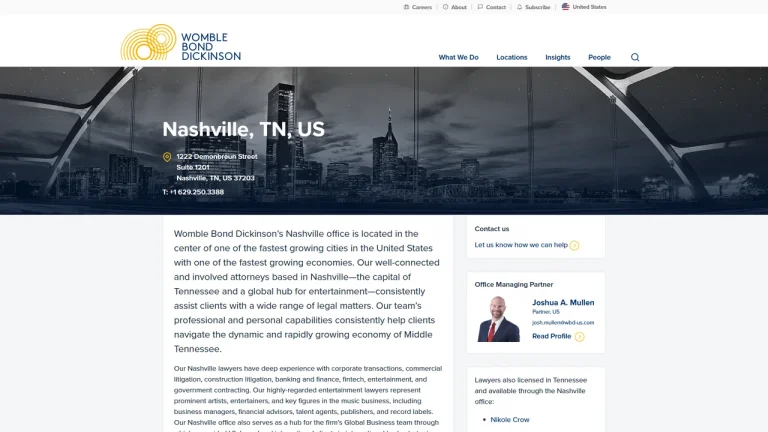
Womble Bond Dickinson (US) LLP - Nashville, TN
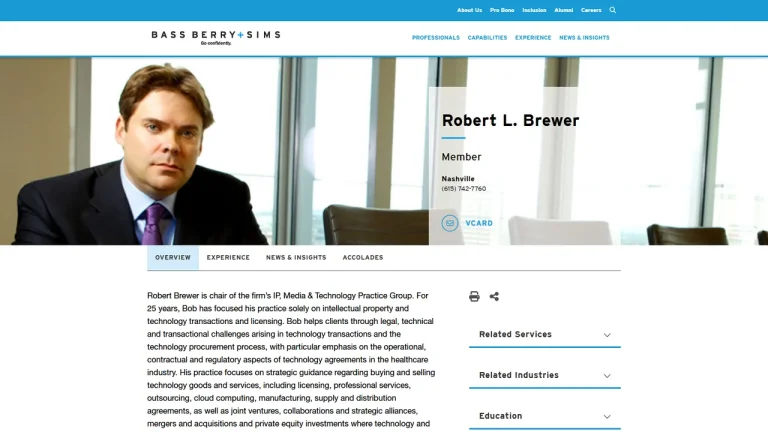
Robert L. Brewer - Bass, Berry & Sims PLC - Nashville, TN
Bold Patents Law Firm - Nashville, TN
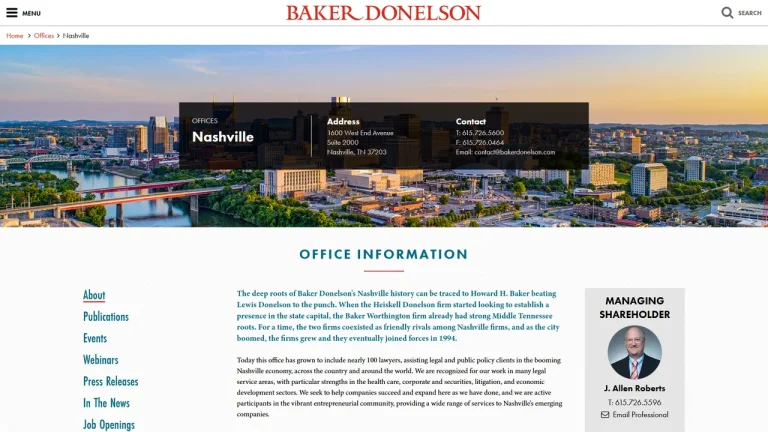
Baker Donelson - Nashville, TN

Waddey Acheson - Nashville, TN
Schelling IP Law, PLLC - Nashville, TN
Bradley Arant Boult Cummings LLP - Nashville, TN

John Rizvi, P.A. - The Idea Attorneys - Nashville, TN

Trammell Love Law Firm - Nashville, TN

Frost Brown Todd - Nashville, TN
Buchalter - Nashville, TN

Loeb & Loeb LLP - Nashville, TN
Bass, Berry & Sims PLC - Nashville, TN
Law Office of Randall Burton - Nashville, TN
Nelson Mullins Riley & Scarborough LLP - Nashville, TN
Rose IP Law PLLC - Nashville, TN
Rick Sanders Law - Nashville, TN
Pillsbury Winthrop Shaw Pittman LLP - Nashville, TN
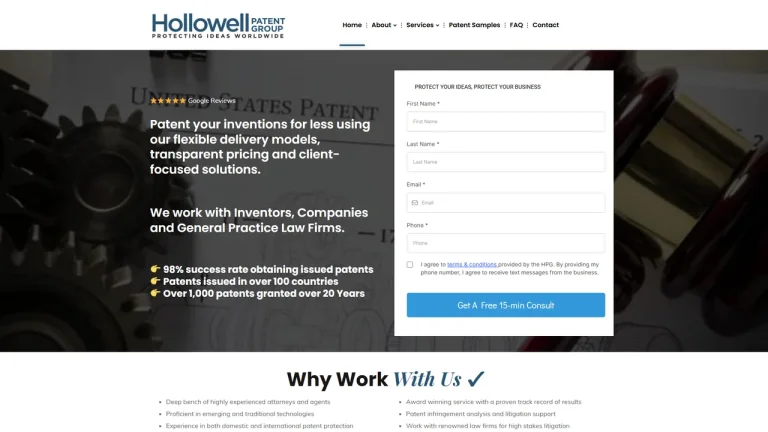
Hollowell Patent Group - Nashville, TN
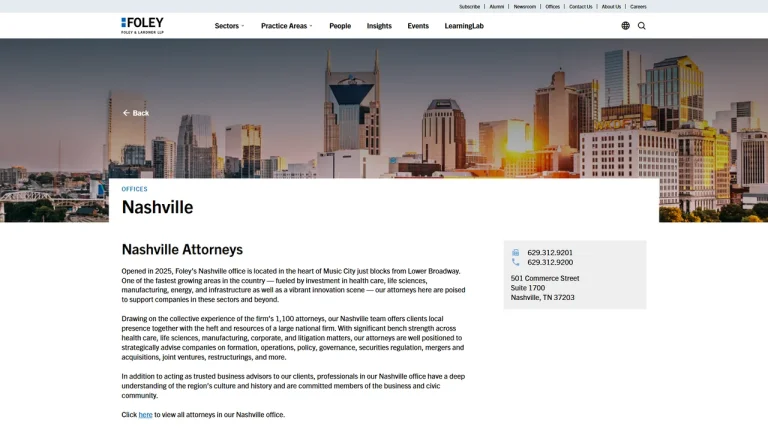
Foley & Lardner LLP - Nashville, TN
McDermott Will & Schulte LLP - Nashville, TN
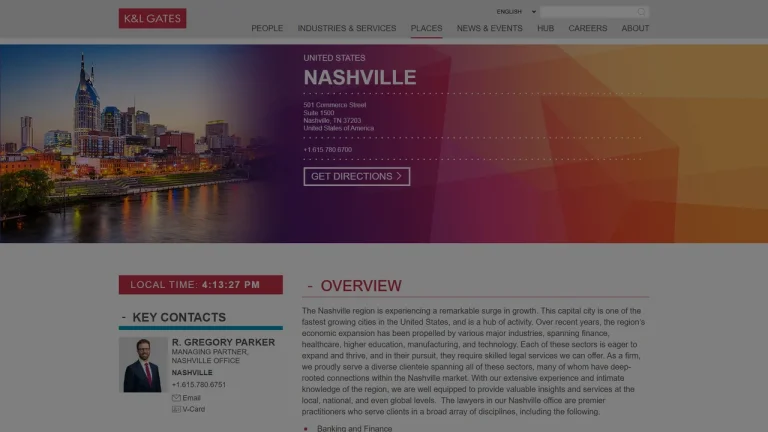
K&L Gates LLP - Nashville, TN
Stites and Harbison, PLLC - Nashville, TN
Protecting Innovations Through Nashville Patent Counsel
Nashville has rapidly emerged as a leading technology and healthcare innovation hub, fostering groundbreaking advancements in biotechnology, medical devices, health informatics, and advanced manufacturing. From research laboratories surrounding Vanderbilt University Medical Center to emerging startup incubators across Downtown, Midtown, and the Gulch, protecting novel intellectual property requires specialized legal expertise.
Patent law is governed by federal statutes and administered by the United States Patent and Trademark Office (USPTO). Practicing patent attorneys must hold admission to the Tennessee Bar and maintain registered status with the USPTO patent bar. When patent disputes escalate to litigation or invalidation challenges, cases are heard in the U.S. District Court for the Middle District of Tennessee, located at the Fred D. Thompson U.S. Courthouse on Church Street, or before the Patent Trial and Appeal Board (PTAB).
Retaining a knowledgeable Nashville patent attorney ensures your technological assets are comprehensively evaluated before public disclosure. An experienced patent lawyer conducts exhaustive patentability investigations, crafts precise patent claims, and navigates examiner rejections, positioning your business for commercial licensing, institutional funding, and long-term market exclusivity.
Patent Prosecution & Litigation Fee Structures in Nashville
| Case Scenario | Fee Structure | Estimated Cost (USD) | Key Cost Determinants |
|---|---|---|---|
| Comprehensive Prior Art Search & Patentability Opinion | Flat Fee | $1,500 - $3,500 | Technical complexity of the invention, scope of international patent database queries, and depth of non-obviousness legal analysis. |
| Provisional Patent Application Drafting & Filing | Flat Fee | $2,500 - $5,500 | Completeness of technical specifications, formal CAD drawings required, and scaffolding needed for subsequent utility conversion. |
| Non-Provisional Utility Patent Prosecution (USPTO) | Flat Fee / Retainer | $7,500 - $15,000+ | Number of independent and dependent claims, technical discipline (software, mechanical, biotech), and USPTO office action response cycles. |
| Patent Infringement Defense & PTAB Inter Partes Review | Hourly / Retainer | $15,000 - $75,000+ | Middle District of Tennessee litigation timetable, technical expert witness testimony, Markman claim construction hearings, and prior art discovery. |
Critical Legal Deadlines & Statutes in Patent Practice
Securing and maintaining patent rights requires unwavering adherence to strict federal statutory deadlines, where a single missed filing date results in forfeiture of rights:
Under the America Invents Act, codified at 35 U.S. Code § 102, the United States operates under a strict first-inventor-to-file framework. An inventor has a limited one-year grace period following an initial public disclosure, offer for sale, or commercial use to file a patent application. Failure to file within 365 days of disclosure forfeits patent eligibility permanently.
When filing an informal preliminary application, inventors must strictly observe 35 U.S. Code § 119(e). A non-provisional utility patent application must be filed within twelve months of the provisional filing date to retain the original priority date. This one-year conversion deadline cannot be extended under federal rules.
For granted utility patents, patentees must timely remit USPTO maintenance fees under 35 U.S. Code § 41(b) at 3.5 years, 7.5 years, and 11.5 years following the issue date. In patent infringement actions, 35 U.S. Code § 286 bars financial recovery for any infringement committed more than six years prior to the filing of the formal complaint.
State Small Claims Limitations vs. Federal Patent Jurisdiction
The Metropolitan Government of Nashville and Davidson County operates the Davidson County General Sessions Court, which exercises civil jurisdiction over controversies up to $25,000 under Tenn. Code Ann. § 16-15-501.
However, state courts-including the Davidson County General Sessions Court and the Davidson County Chancery Court-have zero subject-matter jurisdiction over patent disputes. Under 28 U.S. Code § 1338(a), federal courts maintain exclusive jurisdiction over any civil action arising under an Act of Congress relating to patents. Pro se inventors cannot litigate patent infringement, validity, or inventorship in Tennessee state tribunals.
While collateral contract disputes regarding patent licensing royalties or non-disclosure agreement violations may occasionally proceed in Davidson County Chancery Court under Tenn. Code Ann. § 47-25-1701, any challenge touching patent enforceability belongs entirely in federal court. Engaging registered patent counsel is indispensable for navigating complex federal civil procedure and USPTO administrative tribunals.
Red Flags When Hiring a Patent Attorney
- Lack of USPTO Registration: Practitioners who cannot furnish a valid USPTO registration number or who are not listed on the USPTO Office of Enrollment and Discipline roster.
- Guaranteed Patent Grants: Unethical assertions promising guaranteed patent issuance, which violates ethical standards given the independent discretion of USPTO patent examiners.
- Invention Promotion Mill Affiliations: Solicitors or firms associated with unaccredited invention promotion companies that push costly, low-value novelty filings with no commercial utility.
- Vague Fee Agreements: Retainer agreements that fail to distinguish between attorney legal fees, USPTO filing fees, professional draftsman illustration costs, and subsequent office action responses.
Frequently Asked Questions
Does a patent lawyer need specific credentials to file applications in Nashville?
Yes. In addition to admission to the Tennessee Bar, a patent attorney must hold an accredited scientific or engineering degree and pass the USPTO Patent Bar examination, earning official registration to prosecute applications before the USPTO.
What is the difference between a provisional and non-provisional patent application?
A provisional application acts as an informal placeholder that secures an early priority date for twelve months without formal claims or examination. A non-provisional application requires exhaustive formal claims and drawings, initiating official examination by the USPTO for patent issuance.
Can a patent infringement lawsuit be heard in Davidson County Chancery Court?
No. Under 28 U.S. Code § 1338(a), federal courts possess exclusive jurisdiction over patent cases. Patent infringement claims in Middle Tennessee must be filed in the U.S. District Court for the Middle District of Tennessee in Nashville.
How does the one-year disclosure grace period work under federal patent law?
Under 35 U.S. Code § 102, an inventor has up to one year after their own public disclosure, commercial sale, or publication to file a U.S. patent application. Once this 12-month window expires, the invention enters the public domain and cannot be patented.
How long does it take for the USPTO to grant a utility patent?
Obtaining a utility patent generally requires eighteen to thirty-six months from the initial filing date. Timelines depend on the USPTO examining art unit, application backlog, and the number of office actions required to resolve examiner rejections.