
Tax Lawyers in Nashville
Seeking trusted Nashville tax lawyers? Connect with experienced Davidson County tax attorneys to handle Tennessee state audits, corporate tax structuring, and federal disputes. Retaining seasoned legal counsel protects your assets, ensures compliance with complex state revenue statutes, and resolves liabilities through administrative appeals. Explore our directory below to schedule an initial consultation with vetted local professionals.
Tax Relief Law Center - Nashville, TN

Baker, Campbell & Parsons - Nashville, TN

Burkhalter and Associates, PC - Nashville, TN

Harry McNutt, Tax Attorney - Nashville, TN

Keller Turner Andrews and Ghanem, PLLC - Nashville, TN
BW Tax Partners - Nashville, TN

Sullivan F. Marsden, PC - Nashville, TN
Richard A. Demonbreun - Nashville, TN

Defense Tax Partners - Nashville, TN
Siegel & Callahan - Nashville, TN
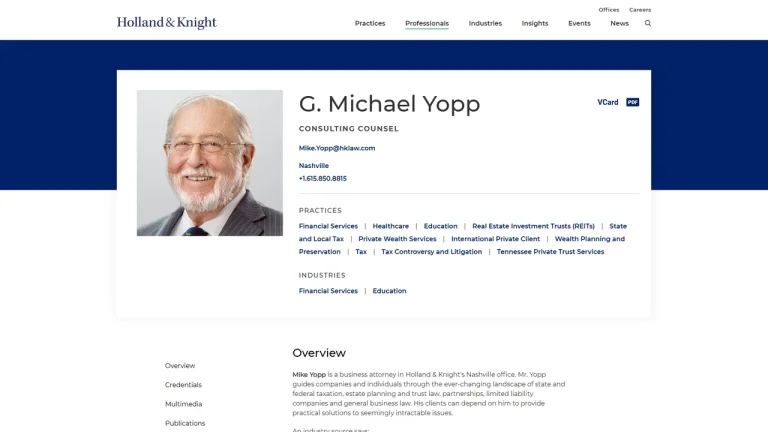
G. Michael Yopp (Holland & Knight) - Nashville, TN

Frazier Law - Nashville, TN

Dodson Parker Behm & Capparella - Nashville, TN

L. Kevin Levine, PLLC - Nashville, TN

Butler Snow LLP - Nashville, TN
The Law Office of Lance R. Drury - Nashville, TN

Bass, Berry & Sims PLC - Nashville, TN
The Levy Group - Nashville, TN

Joseph W. Gibbs - Nashville, TN
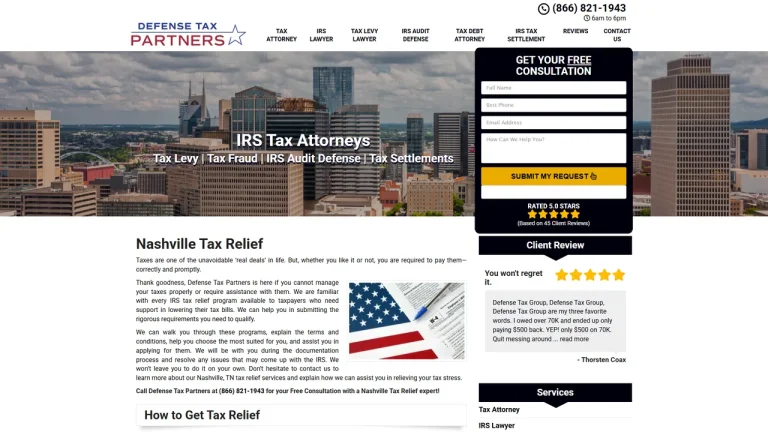
Defense Tax Partners | Tax Relief Attorneys - Nashville, TN

James B. Bristol - Nashville, TN
Wood Stabell Law Group, PLLC - Nashville, TN

Barnes & Thornburg LLP - Nashville, TN

Navigating State and Federal Tax Controversies in Nashville
Nashville serves as Tennessee's economic and legislative capital, housing major corporate headquarters, healthcare conglomerates, and thriving entertainment enterprises across Downtown, Midtown, and the Music Row corridor. Managing high-stakes state and federal tax liabilities in this competitive market requires deep legal proficiency in Tennessee statutory revenue codes and federal procedural guidelines.
State tax enforcement in Tennessee is uniquely centered in Davidson County. The Tennessee Department of Revenue (TDOR) maintains its headquarters at the Andrew Jackson State Office Building on Deaderick Street in Nashville. Crucially, under Tennessee law, any formal lawsuit to challenge a state tax assessment or seek a refund must be filed directly in the Davidson County Chancery Court at the Historic Metro Courthouse on Public Square, making Nashville the central battleground for state tax controversy.
For federal matters, tax disputes involve local administrative channels and the federal judiciary. Federal audits and examinations are handled through regional channels or the IRS Taxpayer Assistance Center on Broadway in Nashville. When litigation becomes necessary, proceedings move to the United States Tax Court, which holds periodic trial sessions at the Fred D. Thompson U.S. Courthouse on Church Street. A dedicated Nashville tax lawyer provides vital counsel during state Franchise and Excise (F&E) audits, corporate sales tax disputes, and complex administrative appeals.
Nashville Tax Attorney Fee Models & Representation Costs
| Case Scenario | Fee Structure | Estimated Cost (USD) | Key Cost Determinants |
|---|---|---|---|
| Tennessee F&E or Sales Tax Audit Defense | Hourly ($300 - $550/hr) | $2,500 - $7,500 | Transaction record volume, auditor positions, economic nexus documentation |
| TDOR Informal Conference & Administrative Appeal | Flat Fee or Hourly | $3,000 - $8,000 | Statutory deadline compliance, legal brief drafting, nexus disputes under state law |
| Chancery Court State Tax Litigation | Retainer / Hourly | $10,000 - $35,000+ | Discovery complexity, expert accounting witnesses, disputed assessment values |
| Corporate Entity Tax Structuring & Advisory | Flat Fee | $2,000 - $5,000 | Multi-entity pass-through structures, local business tax classifications, asset transfers |
Critical Legal Deadlines & Statutes in Tennessee
Tennessee state tax disputes are governed by strict statutory timeframes that do not allow for procedural delays. Under Tenn. Code Ann. § 67-1-1801, an aggrieved taxpayer who receives a final proposed assessment from the Tennessee Department of Revenue has precisely thirty days to request an informal conference with the department. If the taxpayer intends to bypass the conference or appeal the final determination directly to court, a formal lawsuit must be filed in the Davidson County Chancery Court within ninety days of the date the assessment becomes final.
Corporate taxation in Tennessee centers on the Franchise and Excise Tax statutes codified under Tenn. Code Ann. § 67-4-2001. Businesses must carefully account for net earnings, capital investment, and gross receipts apportionment. Municipal and county business levies are governed under the Tennessee Business Tax Act pursuant to Tenn. Code Ann. § 67-4-701, which requires precise classification of operating locations across Nashville and surrounding municipalities.
On the federal level, when the IRS issues a formal Statutory Notice of Deficiency, taxpayers are bound by 26 U.S. Code § 6213, which establishes an unyielding ninety-day deadline to file a petition in the U.S. Tax Court. In corporate tax default situations, the government may pursue corporate officers individually under 26 U.S. Code § 6672 for trust fund recovery liabilities, making prompt administrative intervention crucial to protect personal bank accounts and assets.
Administrative Resolution vs. Davidson County Chancery Court Litigation
Routine local business license inquiries or minor municipal tax questions can sometimes be clarified directly with the Davidson County County Clerk or Metro Nashville Department of Finance without entering formal litigation. Under Tenn. Code Ann. § 16-15-501, the Davidson County General Sessions Court handles general civil matters under $25,000, but it lacks jurisdiction to adjudicate state revenue disputes or challenge Department of Revenue tax liens.
State tax disputes in Tennessee are subject to exclusive statutory remedies under Tenn. Code Ann. § 67-1-1801, which places original subject-matter jurisdiction solely in the Davidson County Chancery Court. Navigating Chancery Court requires sophisticated legal representation to prepare discovery requests, challenge audit sampling techniques, and argue statutory interpretations of corporate nexus before a Chancellor. An experienced Nashville tax attorney ensures you exhaust all mandatory administrative remedies with the Department of Revenue while preserving your right to litigate if informal appeals do not produce a fair outcome.
Red Flags to Avoid When Hiring a Nashville Tax Attorney
Selecting the right tax counsel requires careful evaluation of their specific litigation credentials and local standing. Be vigilant against these red flags:
- Non-attorney CPAs or tax preparers claiming they can litigate state tax assessment appeals in Davidson County Chancery Court without a Tennessee law license.
- Lawyers who do not regularly practice before the Tennessee Department of Revenue or lack familiarity with the state's unique Franchise and Excise Tax rules.
- Unrealistic promises of guaranteed penalty abatements or audit dismissals before conducting a thorough review of the auditor's workpapers.
- Firms advising corporate officers to ignore state sales tax delinquency notices, risking personal liability under Tenn. Code Ann. § 67-1-1438.
Frequently Asked Questions
Where must I file a lawsuit to challenge a Tennessee state tax assessment?
Under Tenn. Code Ann. § 67-1-1801, all lawsuits challenging state tax assessments issued by the Tennessee Department of Revenue must be filed in the Davidson County Chancery Court in Nashville. This court holds exclusive statewide jurisdiction over state tax dispute litigation.
How long do I have to appeal a proposed assessment from the Tennessee Department of Revenue?
Taxpayers generally have thirty days from the notice date to request an informal conference with the Department of Revenue. If the assessment becomes final, you have ninety days to file a formal legal action in the Davidson County Chancery Court under Tenn. Code Ann. § 67-1-1801.
What is the difference between a tax lawyer and a CPA?
While CPAs excel at financial accounting and return preparation, only a licensed attorney can provide attorney-client privilege and represent you in court litigation, such as the Davidson County Chancery Court or the United States Tax Court. Legal counsel is essential when facing complex audits, fraud investigations, or courtroom disputes.
Can corporate officers be held personally liable for unpaid business taxes in Tennessee?
Yes. Under state law, officers and managers who have control over filing returns and remitting collected sales and trust taxes can be held personally liable for unpaid amounts if the corporation fails to pay. A tax attorney works to challenge officer assessments and negotiate resolutions before personal assets are targeted.
How does the United States Tax Court operate in Nashville?
The U.S. Tax Court is a federal court that travels nationwide to hear tax controversies before the taxpayer is required to pay the contested tax. Trial sessions in Nashville are held periodically at the Fred D. Thompson U.S. Courthouse on Church Street, where taxpayers are represented by licensed tax attorneys.