
Patent Attorneys in Tennessee
Hiring a registered patent attorney in Tennessee ensures your proprietary inventions and technical assets are protected under federal patent statutes. Experienced patent counsel conducts prior art searches and navigates complex USPTO application examinations to build enforceable patent portfolios. Explore our statewide directory below to connect with a qualified Tennessee patent attorney for your technical review.
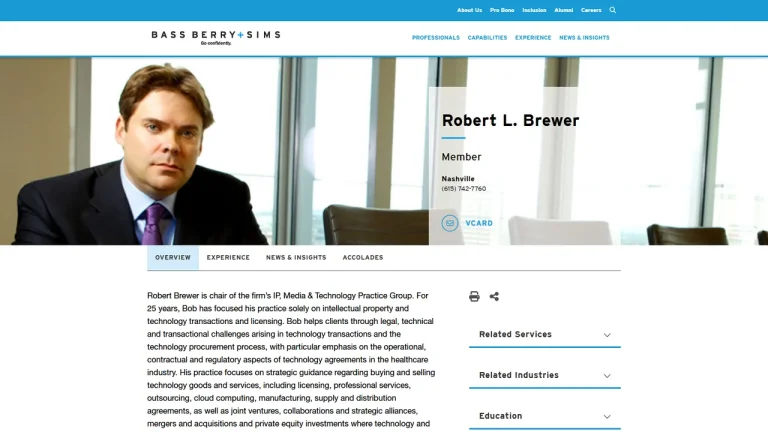
Robert L. Brewer - Bass, Berry & Sims PLC - Nashville, TN
John Rizvi P.A. - The Idea Attorneys - Memphis, TN

Loeb & Loeb LLP - Nashville, TN
Bold Patents Law Firm - Nashville, TN
K&L Gates LLP - Nashville, TN
Novick Law PLLC - Nashville, TN
Stites and Harbison PLLC - Memphis, TN

Trammell Love Law Firm - Nashville, TN
Schelling IP Law, PLLC - Nashville, TN

Bradley Arant Boult Cummings LLP - Nashville, TN

Barnes & Thornburg LLP - Nashville, TN

Waddey Acheson - Nashville, TN
Stites and Harbison, PLLC - Nashville, TN

Law Office of Van R Irion - Knoxville, TN

Pitts Lake, LLC - Knoxville, TN

McDermott Will & Schulte LLP - Nashville, TN
Mark (Andy) Pitchford - Nashville, TN

Nelson Mullins Riley & Scarborough LLP - Nashville, TN

Kline Preston Law Group - Nashville, TN
John Rizvi, P.A. - The Idea Attorneys - Nashville, TN
Foley & Lardner LLP - Nashville, TN

Patterson Intellectual Property Law PC - Nashville, TN

Butler Snow LLP - Memphis, TN
Tennessee Patent Jurisdictions & Technical Innovation Centers
Patent prosecution and litigation across Tennessee are anchored in the state vibrant research corridors, spanning medical device innovations in Memphis, biotechnology and healthcare software across Nashville, automotive manufacturing hubs in Middle Tennessee, and advanced materials generated near Oak Ridge National Laboratory in East Tennessee.
Patent applications are submitted exclusively to the United States Patent and Trademark Office (USPTO) under federal oversight. However, patent attorneys practicing in the state must be registered with the USPTO Patent Bar under 37 C.F.R. § 11.7 while maintaining active licensure with the Tennessee Board of Professional Responsibility and the Tennessee Bar Association.
When patent infringement disputes arise, exclusive federal subject matter jurisdiction lies within the U.S. District Courts under 28 U.S.C. § 1338(a). Patent lawsuits are litigated before the U.S. District Court for the Middle District of Tennessee in Nashville, the Western District in Memphis, and the Eastern District in Knoxville and Chattanooga, with administrative invalidity challenges heard before the Patent Trial and Appeal Board (PTAB).
Fee Structures for Tennessee Patent Prosecution & Counseling
| Case Scenario | Fee Structure | Estimated Cost (USD) | Key Cost Determinants |
|---|---|---|---|
| Provisional Patent Application | Flat Fee | $2,500 - $5,000 | Technical disclosure depth, engineering drawings complexity, inventor readiness. |
| Non-Provisional Utility Patent Filing | Flat Fee / Hourly | $7,500 - $15,000 | Independent claim scope, software architecture or chemical formulation complexity, USPTO fees. |
| USPTO Office Action Response & Prosecution | Hourly Rate | $2,000 - $5,000 per response | Prior art rejections under Section 102/103, claim amendment strategy, examiner interviews. |
| Federal Patent Infringement Litigation | Hourly Rate with Retainer | $50,000 - $250,000+ | Markman claim construction hearings, technical expert testimony, discovery scope in federal court. |
Critical Legal Deadlines & Statutes in Tennessee
Patent rights operate under an unforgiving temporal clock governed by federal statutes. Under the Leahy-Smith America Invents Act codified at 35 U.S.C. § 102, the United States operates under a strict first-inventor-to-file system. Inventors possess a narrow one-year grace period from the date of first public disclosure, commercial sale, or public use to file a patent application before their invention is permanently dedicated to the public domain.
When filing a provisional patent application under 35 U.S.C. § 111(b), inventors must file a corresponding non-provisional application within precisely twelve months to claim priority to the provisional filing date. In patent infringement litigation, damages recovery is limited under 35 U.S.C. § 286, which bars recovery for any infringement committed more than six years prior to the filing of the complaint. Proprietary technical trade secrets not patented are protected under the Tennessee Uniform Trade Secrets Act, Tenn. Code Ann. § 47-25-1701, which enforces a three-year statute of limitations under Tenn. Code Ann. § 47-25-1707.
General Sessions Limits vs. Federal Patent Jurisdiction
The Tennessee General Sessions Court maintains civil jurisdiction capped at $25,000 pursuant to Tenn. Code Ann. § 16-15-501(d)(1). However, General Sessions Courts, along with Tennessee Circuit and Chancery Courts, are completely prohibited from hearing patent validity, inventorship, or infringement disputes. Under 28 U.S.C. § 1338(a), federal courts possess exclusive jurisdiction over patent claims.
Attempting to prepare and prosecute a patent application pro se before the USPTO regularly leads to fatal defects, including broad prior art anticipation rejections, inadvertently disclosed trade secrets, or overly narrow claim drafting that competitors can easily circumvent. Retaining an attorney admitted to the USPTO Patent Bar ensures your invention descriptions satisfy enablement standards and build robust defensive moats in federal district court or before the PTAB.
Red Flags to Avoid When Hiring Patent Counsel
- Unregistered Invention Promotion Companies: Steer clear of non-attorney marketing outfits that charge thousands of dollars for generic feasibility reports and cannot represent you before the USPTO.
- Lack of USPTO Registration Number: Verify that your attorney holds an active registration number with the USPTO Office of Enrollment and Discipline under 37 C.F.R. § 11.7.
- Guarantees of Patent Issuance: Ethical practitioners never guarantee that a patent will issue, as patent grant decisions lie entirely within USPTO examiner discretion.
- Superficial Prior Art Searches: Avoid firms that bypass exhaustive worldwide patent database searches before drafting expensive non-provisional utility applications.
Frequently Asked Questions
What is the difference between a patent attorney and a patent agent?
Both patent attorneys and patent agents are licensed to practice before the USPTO under 37 C.F.R. § 11.7. However, only patent attorneys have a law degree, are admitted to a state bar like Tennessee, and can represent clients in court or draft licensing contracts.
How long does a utility patent protect an invention?
Under federal law (35 U.S.C. § 154), a utility patent generally grants protection for twenty years from the earliest effective non-provisional filing date, subject to payment of periodic maintenance fees.
What is the benefit of filing a provisional patent application?
A provisional application under 35 U.S.C. § 111(b) establishes an official early priority filing date with lower initial costs, granting inventors a twelve-month window to refine their technology and assess market viability before filing a non-provisional application.
Can a patent infringement lawsuit be filed in Tennessee state court?
No. Under 28 U.S.C. § 1338(a), federal district courts possess exclusive subject-matter jurisdiction over patent infringement cases; state courts cannot hear these matters.
How does the first-inventor-to-file rule affect patenting in Tennessee?
Under 35 U.S.C. § 102, patent priority is awarded to the first party to file an application with the USPTO rather than the first person to conceive the idea, making immediate filing crucial.