
Wage & Hour Lawyers in Tennessee
Retaining an experienced Tennessee wage and hour attorney safeguards your earned income and holds employers accountable for unpaid overtime and wage violations. Qualified legal counsel frequently recovers unpaid compensation through structured administrative negotiations and federal court filings without prolonged litigation. Explore our verified directory below to schedule a case evaluation with a trusted Tennessee employment lawyer.

Ross E. Webster - Attorney at Law - Memphis, TN

The Ebbert Law Firm - Knoxville, TN
Yezbak Law Offices - Nashville, TN
James A. Crumlin, Jr., Attorney - Bone McAllester Norton - Nashville, TN

Moore Law PC - Nashville, TN

Bahou Law, PLLC - Nashville, TN

Law Office of James W. Friauf - Knoxville, TN

Beth E. Vessel - Nashville, TN

Frank Steiner Law, PC - Nashville, TN

Wimberly Lawson Wright Daves & Jones PLLC - Knoxville, TN

EmployLegal - Nashville, TN
Wimberly Lawson Wright Daves & Jones, PLLC - Nashville, TN

R. Scott Jackson, Jr. Attorney at Law - Nashville, TN
Employment and Commerce Law Group - Nashville, TN
Cotney - Attorneys & Consultants - Nashville, TN

The Cassell Firm - Nashville, TN

Your Company's Employment Lawyer (The Crone Law Firm) - Memphis, TN

Watson Law Group PLLC - Nashville, TN
Sanford Heisler Sharp McKnight - Nashville, TN

Donati Law, PLLC Memphis - Memphis, TN
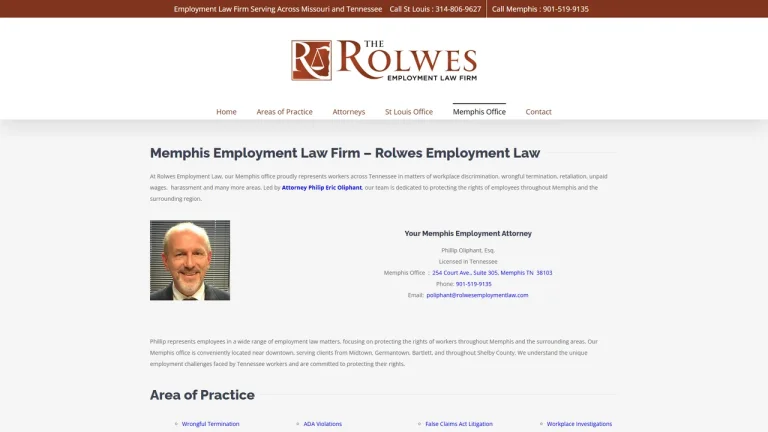
Philip Oliphant, Esq. - Memphis, TN

The Zinser Law Firm, P.C. - Nashville, TN

Lyell Law Firm - Nashville, TN

Enforcing Workplace Pay Protections Across Tennessee Courts
Workplace compensation disputes disrupt financial stability and undermine worker dignity. In Tennessee, employees confront unique legal dynamics because the state does not maintain a standalone state minimum wage or statutory overtime requirement. Instead, workers rely on the federal Fair Labor Standards Act (FLSA) in conjunction with state protections under the Tennessee Wage Regulation Act to pursue unpaid earnings, improper paycheck withholdings, and employee misclassification.
Wage and hour claims are adjudicated across federal and state judicial systems in Tennessee. Collective actions and statutory overtime claims are primarily filed in the United States District Courts for the Western, Middle, and Eastern Districts of Tennessee, located in legal centers such as Memphis, Nashville, Knoxville, and Chattanooga. In addition, state-level wage withholding disputes and breach of contract actions proceed through local Chancery Courts and Circuit Courts, with regulatory oversight provided by the Tennessee Department of Labor and Workforce Development (TDLWD).
Retaining an experienced Tennessee wage and hour lawyer ensures an aggressive investigation of employer payroll records, digital timecard entries, and electronic badge swipes. Skilled attorneys represent hourly workers, salaried staff, and independent contractors in recovering back wages, statutory liquidated damages, and mandatory attorney fees from non-compliant employers.
Tennessee Wage & Hour Legal Fee & Recovery Framework
| Case Scenario | Fee Structure | Estimated Cost (USD) | Key Cost Determinants |
|---|---|---|---|
| Individual Overtime or Off-the-Clock Claim | Contingency / Statutory Fee-Shift | 33.3% - 40% of recovery ($0 upfront) | Electronic timecard logs, supervisor emails, proof of employer willful violation |
| Independent Contractor Misclassification | Contingency / Fee-Shift | 33.3% - 40% of recovery ($0 upfront) | Degree of behavioral and financial control, 1099 tax documentation, job duty audits |
| Collective Action / Multi-Employee Wage Theft | Contingency (Court-Approved) | Court-approved fee percentage | Size of affected workforce class, preliminary conditional certification, corporate payroll audit |
| Executive Unpaid Bonus & Contract Dispute | Hourly Retainer / Hybrid | $4,000 - $12,500 | Employment contract terms, performance metric proofs, Chancery Court motion practice |
Critical Legal Deadlines & Statutes in Tennessee
Wage and hour actions in Tennessee are bound by strict statutory deadlines. Under the Fair Labor Standards Act, codified at 29 U.S. Code § 255, a standard lawsuit for unpaid minimum wage or overtime compensation must be commenced within two years of the violation. However, if counsel proves that the employer committed a willful violation, the statute of limitations extends to three years, significantly increasing potential back-pay recovery.
Successful claimants are entitled to recover 100% liquidated damages equal to the unpaid wages, along with reasonable attorney fees and costs pursuant to 29 U.S. Code § 216. Under the Tennessee Wage Regulation Act, codified at Tenn. Code Ann. § 50-2-101, private employers must inform employees of their wage rates and pay all accumulated wages in regular semi-monthly or monthly installments. Unlawful deductions or failures to disburse final paychecks are regulated under Tenn. Code Ann. § 50-2-103.
For common-law claims based on written employment contracts, commission agreements, or executive incentive packages, Tennessee enforces a six-year statute of limitations under Tenn. Code Ann. § 28-3-109. Acting swiftly ensures that electronic timekeeping logs and server backups are preserved before corporate document retention policies destroy vital evidence.
General Sessions Court Limits vs. Federal Wage Representation
Tennessee General Sessions Courts exercise civil jurisdiction up to $25,000 pursuant to Tenn. Code Ann. § 16-15-501. While an employee might consider filing an unrepresented warrant in General Sessions Court for an isolated unpaid final paycheck under $25,000, self-representation is ill-suited for complex wage disputes. General Sessions courts lack the procedural mechanisms necessary to compel extensive corporate payroll discovery, enforce multi-employee class actions, or calculate complex fluctuating workweek overtime.
Furthermore, the FLSA contains a mandatory statutory fee-shifting mandate requiring non-compliant employers to pay the employee legal fees upon prevailing. Attempting to navigate wage litigation without counsel risks forfeiting mandatory liquidated damages and running afoul of strict procedural rules. Retaining an experienced Tennessee wage lawyer levels the playing field against corporate defense firms without requiring upfront legal costs from the employee.
Red Flags When Retaining Tennessee Wage & Hour Counsel
- Attorneys demanding significant upfront hourly retainers for clear statutory wage violations that qualify for fee-shifting or contingency arrangements.
- Law firms lacking experience filing collective action certification motions in Tennessee federal district courts.
- Lawyers who overlook investigating whether an employer violation was willful to access the three-year statute of limitations.
- Practitioners advising clients to sign informal private settlement waivers without securing court approval or Department of Labor validation.
Frequently Asked Questions
What is the minimum wage and overtime rate in Tennessee?
Because Tennessee does not set an independent state minimum wage, it adopts the federal standard of $7.25 per hour. Overtime must be paid at one and one-half times the regular hourly rate for all hours worked over forty in a workweek.
Can an employer in Tennessee dock my pay as a disciplinary penalty?
Under Tennessee law, employers cannot deduct amounts from an employee paycheck without written authorization, unless mandated by court order or tax law. Unauthorized deductions that reduce pay below minimum wage violate federal law.
What are liquidated damages under federal wage law?
Liquidated damages represent an additional amount equal to the unpaid wages owed to the employee, effectively doubling the recovery unless the employer proves it acted in good faith with reasonable grounds.
How does Tennessee treat independent contractor misclassification?
Labeling a worker as an independent contractor on a 1099 form does not exempt an employer from overtime laws. If the company controls the worker hours, tools, and daily activities, they may be legally entitled to full employee overtime protections.
When must a terminated employee receive their final paycheck in Tennessee?
Under Tennessee law, an employer must disburse all earned wages to a separated worker by the next regular payday or within twenty-one days following the date of separation, whichever occurs later.