
Patent Attorneys in Austin
Retaining an Austin patent attorney protects your proprietary technology, secures patent grants, and maximizes enterprise valuation in Silicon Hills. Registered USPTO patent lawyers draft resilient claims, conduct freedom-to-operate analyses, and litigate infringement in the Western District of Texas. Explore our directory below to consult an accomplished Austin patent attorney today.

Law Office of Sean Christian Connolly - Austin, TX
Grell & Watson, Patent Attorney, Trademark Copyright Lawyer - Austin, TX

Willi Law Firm, P.C. - Austin, TX

Pirkey Barber PLLC - Austin, TX

Amsel IP Law PLLC - Austin, TX

Pierson Intellectual Property - Austin, TX

Parker Highlander, PLLC - Austin, TX

Leavitt Eldredge Law Firm - Austin, TX

Sprinkle IP Law Group - Austin, TX
Castro and Baker - Austin, TX

Dunham LLP - Austin, TX
Matthew J. Booth PC - Austin, TX

Law Offices of Gregory D. Jordan - Austin, TX
HULSEY P.C. - Austin, TX

AEON Law - Patent, Trademark, and Copyright Attorneys - Austin, TX
Bold Patents Law Firm - Austin, TX
DiNovo Price LLP - Austin, TX

Buche & Associates, PC - Austin, TX
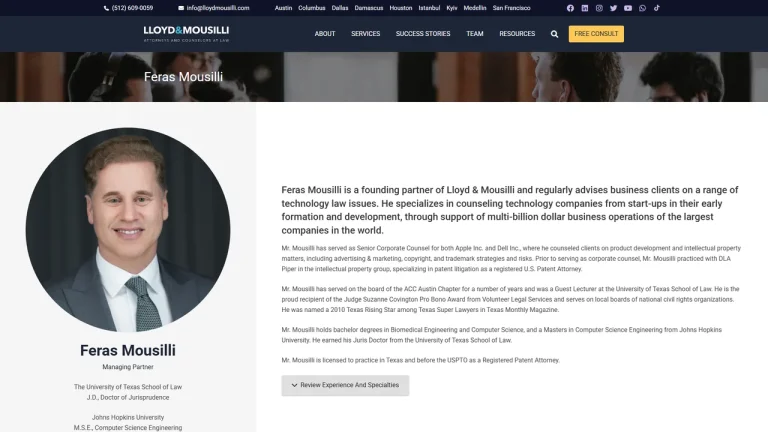
Lloyd & Mousilli - Austin, TX
Berkeley Law & Technology Group - Austin, TX
Outlier Patent Attorneys, PLLC - Austin, TX
John Rizvi, P.A. - The Idea Attorneys - Austin, TX

Protecting High-Tech Inventions Across Austin & Central Texas
Patent prosecution and intellectual property litigation in Austin are anchored within federal jurisdiction, with patent trials adjudicated before the United States District Court for the Western District of Texas, Austin Division, located at 501 West 5th Street in Downtown Austin. Formal patent prosecution and appeals are conducted directly before the United States Patent and Trademark Office (USPTO).
Austin's Silicon Hills technology corridor-spanning The Domain, Downtown Austin, East Austin, and research clusters around the University of Texas at Austin-represents a global hub for semiconductor design, enterprise software, artificial intelligence, medical devices, and clean energy. In this high-stakes ecosystem, securing robust utility and design patents is essential to insulate innovations from infringement and protect venture capital funding.
Working with an Austin patent attorney registered with the USPTO patent bar ensures that technical disclosures are translated into enforceable patent claims. Experienced local counsel conducts thorough freedom-to-operate (FTO) studies, navigates inter partes review (IPR) proceedings, and manages patent enforcement dockets in the Western District of Texas.
Legal Fee Structures for Austin Patent Prosecution & Litigation
| Case Scenario | Fee Structure | Estimated Cost (USD) | Key Cost Determinants |
|---|---|---|---|
| Provisional Patent Application | Flat Fee | $2,500 - $5,500 | Technical specification depth, number of engineering drawings, USPTO filing fees. |
| Non-Provisional Utility Patent Application | Flat Fee or Hourly | $7,500 - $16,000 | Independent and dependent claim scope, prior art density, software architecture complexity. |
| Freedom-to-Operate (FTO) & Prior Art Search | Flat Fee or Retainer | $3,500 - $9,000 | Competitive patent landscape, claim charting depth, non-infringement opinion drafting. |
| Federal Patent Infringement Lawsuit | Hourly Billing with Retainer | $50,000 - $250,000+ | Markman claim construction hearing, expert witness fees, discovery volume, trial duration. |
Critical Legal Deadlines & Statutes for Patents
Patent rights in the United States operate under the first-inventor-to-file system established by the America Invents Act, codified at 35 U.S. Code § 102. Inventors must file a patent application before disclosing the invention publicly or offering it for commercial sale, subject to a narrow one-year grace period under 35 U.S. Code § 102(b). Failing to file within one year of public disclosure permanently surrenders all patent rights.
If you file a provisional patent application under 35 U.S. Code § 111, you have a strict, non-extendable 12-month deadline to file a non-provisional utility patent application to claim the provisional priority date. In patent litigation, patent damages are limited to the six years preceding the filing of the infringement complaint pursuant to 35 U.S. Code § 286. Furthermore, patent eligibility for software and computer-implemented inventions must satisfy strict subject-matter eligibility standards under 35 U.S. Code § 101.
Pro Se Patent Filing vs. Retaining a Registered Patent Attorney
While local Texas Justice of the Peace courts handle small contract claims up to $20,000 under Tex. Gov't Code § 27.031, federal courts possess exclusive jurisdiction over patent matters pursuant to 28 U.S. Code § 1338(a). Navigating patent drafting or prosecution without a registered patent attorney carries an exceptionally high failure rate.
Inventors attempting to file pro se frequently draft overly narrow claims that competitors can design around, or inadvertently disclose proprietary concepts without claiming them, dedicating the technology to the public domain. A registered patent attorney possesses the technical training and legal credentialing to craft expansive claim sets, overcome USPTO examiner rejections, and protect your commercial exclusivity.
Red Flags When Hiring an Austin Patent Attorney
- Attorneys who are not registered to practice before the USPTO (verify their USPTO registration number under 37 C.F.R. § 11.7).
- Invention promotion companies that promise commercialization or venture capital backing instead of providing legal patent prosecution.
- Guaranteeing that a patent will be granted by the USPTO without first performing a prior art clearance search.
- Attorneys lacking technical experience in your specific industry, such as hiring a mechanical patent lawyer for advanced machine learning algorithms.
Frequently Asked Questions
What is the difference between a patent attorney and an IP attorney?
A patent attorney must hold an accredited technical degree (such as engineering or computer science) and pass the federal USPTO Patent Bar examination, allowing them to draft and prosecute patent applications. General IP attorneys handle trademarks, copyrights, and trade secrets but cannot prosecute patents before the USPTO.
How long does it take to obtain a utility patent in Austin?
Obtaining a utility patent from the USPTO typically takes between 18 months and three years, depending on the technological field, examination backlog, and whether you apply for prioritized examination under the Track One program.
What happens if I publicly disclose my invention before filing?
Under 35 U.S. Code § 102(b), the United States provides a one-year grace period for the inventor's own disclosures. However, most foreign jurisdictions require absolute novelty, meaning public disclosure before filing destroys foreign patent rights immediately.
Which court handles patent infringement lawsuits in Austin?
Patent infringement lawsuits in Austin are filed and litigated in the United States District Court for the Western District of Texas, Austin Division, located at 501 West 5th Street.
Can software and artificial intelligence be patented?
Yes, provided the software solves a specific technological problem or provides a technical improvement to computer functionality rather than merely claiming an abstract mathematical concept under 35 U.S. Code § 101.