
Wills, Estate Planning & Probate Lawyers in Austin
Retaining an experienced Austin estate planning and probate lawyer protects family wealth, secures assets, and streamlines Texas probate administration. Skilled local attorneys draft customized revocable trusts, establish independent administrations, and resolve will contests in Travis County probate courts. Explore our directory below to consult an Austin estate planning attorney today.

Streit Law - Austin, TX

Austin Legal Access - Austin, TX

StoneMyers Law PLLC - Austin, TX

Slater Pugh, Ltd. LLP - Austin, TX

Law Office of Robert E. Black - Austin, TX

Gray Becker, P.C. - Austin, TX

The Law Offices of Shann M. Chaudhry, ESQ - Austin, TX

The Kelly Legal Group PLLC - Austin, TX

Baker Law Group, PLLC - Austin, TX

Hailey-Petty Law Firm, PLLC - Austin, TX

Nickerson Law Group - Austin, TX

Bollier Ciccone Stinson LLP - Austin, TX

Texas Legal Services Center - Austin, TX

The Garrett Law Firm, PLLC - Austin, TX
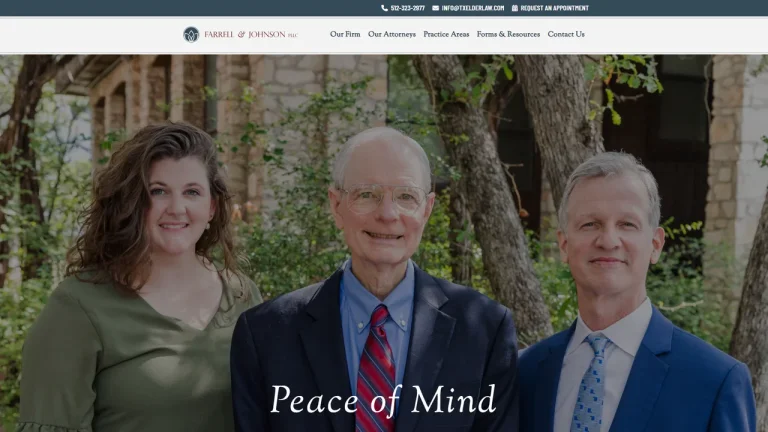
Farrell and Johnson PLLC - Austin, TX

Blazier, Christensen, Browder & Virr, P.C. - Austin, TX

Smith & Bledsoe Family Law - Austin, TX

Silberman Law Firm, PLLC - Austin, TX

Jason S. English Law, PLLC - Austin, TX

Leighton, Michaux, Adkinson & Brown, PLLC - Austin, TX

The Haney Law Firm - Austin, TX

Hardie Alcozer - Austin, TX

Jorgeson Pittman LLP - Austin, TX

Navigating Estate Planning & Probate in Travis County Courts
Estate planning, trust administration, and probate proceedings in Austin are centered within the Travis County Probate Courts, comprising Probate Court No. 1 and Probate Court No. 2. These specialized courts convene inside the Travis County Civil and Family Courts Facility, located at 1700 Guadalupe Street in Downtown Austin. They maintain exclusive subject-matter jurisdiction over decedent estates, testamentary trusts, guardianships, and fiduciary disputes throughout Travis County.
Austin's rapid growth has generated distinct wealth preservation priorities. From technology entrepreneurs with complex equity packages and startup founders in Silicon Hills to multi-generational landowners in Westlake Hills, Tarrytown, and Oak Hill, individuals face unique estate challenges. Comprehensive estate plans must properly coordinate high-value homestead properties, private corporate stock, intellectual property rights, blended family dynamics, and digital assets.
Working with an Austin estate planning and probate lawyer allows families to take advantage of Texas's streamlined independent administration process. Local counsel designs legally resilient wills, trusts, and advance directives while ensuring complete procedural compliance with the Texas Estates Code during court hearings.
Legal Fee Structures for Austin Estate Planning & Probate
| Case Scenario | Fee Structure | Estimated Cost (USD) | Key Cost Determinants |
|---|---|---|---|
| Standard Estate Plan (Will, POA, Healthcare Directives) | Flat Fee | $1,500 - $3,500 | Marital status, specific bequests, guardianship designations, tax planning scope. |
| Revocable Living Trust Portfolio (Probate Avoidance) | Flat Fee | $2,500 - $6,000 | Real estate deed funding, business equity transfers, multi-generational trust terms. |
| Uncontested Probate (Independent Administration) | Flat Fee or Hourly Retainer | $2,000 - $5,000 | Self-proving will validity, creditor notice requirements, inventory preparation. |
| Contested Estate Litigation / Will Contest | Hourly Billing with Retainer | $7,500 - $25,000+ | Undue influence claims, testamentary capacity challenges, deposition scope, trial length. |
Critical Legal Deadlines & Statutes in Texas
Estate administration in Austin is governed by strict statutory timelines. Under Tex. Estates Code § 256.003, a will must be submitted for probate within four years from the date of the testator's death. If an executor fails to probate the will within this four-year window, the estate is typically treated as intestate under Tex. Estates Code § 201.001, or must overcome rigorous burdens to be admitted as a muniment of title under Tex. Estates Code § 257.001.
Texas simplifies probate when a valid will designates an independent executor pursuant to Tex. Estates Code § 401.001, which frees the executor from burdensome court supervision. To be immediately admissible without courtroom witness testimony, the will must incorporate a proper self-proving affidavit executed under Tex. Estates Code § 251.104. Executors must also issue mandatory notice to general creditors in a local Travis County publication within one month of receiving letters testamentary pursuant to Tex. Estates Code § 308.051.
DIY Estate Planning vs. Retaining a Travis County Probate Attorney
While Travis County Justice of the Peace courts manage small civil debts up to $20,000 under Tex. Gov't Code § 27.031, JP courts possess zero legal authority over wills or probate. All estate actions must proceed before Travis County statutory probate judges. Attempting to draft a will or administer an estate without an attorney frequently leads to protracted litigation.
Generic online wills often omit the exact statutory language required to trigger independent administration. Without this language, the estate falls into dependent administration, requiring court approval for every administrative expense, asset sale, and creditor payment, which quickly consumes thousands of dollars in estate funds. An Austin probate lawyer ensures your instruments meet strict Texas statutory standards and streamlines probate through the Travis County courts.
Red Flags When Hiring an Austin Estate Planning & Probate Lawyer
- Recommending complex revocable living trusts to clients with modest assets who could easily utilize Texas's affordable independent probate process.
- Drafting trust instruments without providing deed preparation or asset transfer instructions to properly fund the trust entity.
- Lack of courtroom experience before Travis County Probate Court No. 1 and Probate Court No. 2 at 1700 Guadalupe Street.
- Unclear retainer agreements that fail to distinguish attorney legal fees from court clerk filing fees and publication expenses.
Frequently Asked Questions
How long do I have to probate a will in Austin, Texas?
Under Tex. Estates Code § 256.003, a will must be offered for probate within four years of the decedent's death. Failing to file within four years may result in the estate passing under Texas intestate succession laws.
What is an independent administration in Texas probate?
Independent administration, authorized under Tex. Estates Code § 401.001, allows an executor to manage the estate, settle debts, and distribute assets without obtaining continuous court approval for every transaction, significantly reducing probate costs and delays.
Which court handles probate cases in Austin?
Probate matters in Austin are filed and heard in Travis County Probate Court No. 1 and Probate Court No. 2, located at the Travis County Civil and Family Courts Facility at 1700 Guadalupe Street.
What is probate as a Muniment of Title?
Under Tex. Estates Code § 257.001, probating a will as a muniment of title is a simplified procedure used when the decedent left a valid will and owed no debts other than real property liens, transferring property titles without appointing a formal executor.
Do I need a living trust to avoid probate in Austin?
Not necessarily. Because Texas provides an efficient, low-cost independent probate process, many individuals do not require a living trust unless they own out-of-state real estate, have complex blended families, or require immediate asset privacy.