
Business & Real Estate Lawyers in Utah
Retaining a skilled Utah business and real estate attorney protects your commercial investments, corporate governance, and land acquisitions across the state. Dedicated legal counsel resolves contract breaches, title conflicts, and leasing disputes through strategic negotiation, avoiding costly courtroom battles. Explore our directory below to schedule a consultation with an established Utah commercial lawyer.

Neves Law Practice, PLLC - Provo, UT
Hanks & Peterson Law PLLC - Salt Lake City, UT

Barker Law Office - Salt Lake City, UT

Dewsnup King Olsen Worel Havas - Salt Lake City, UT
Kirton McConkie - Salt Lake City, UT

The Franchise & Business Law Group - Salt Lake City, UT

Spencer Fane Snow Christensen & Martineau - Salt Lake City, UT
Henriksen and Henriksen - Salt Lake City, UT
Ballard Spahr LLP - Salt Lake City, UT
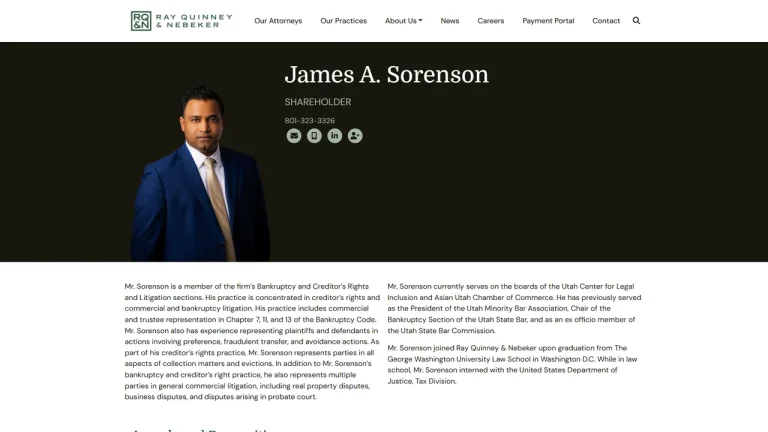
James A. Sorenson, Attorney at Ray Quinney & Nebeker - Salt Lake City, UT

Jess Couser Family Law - Salt Lake City, UT

Kimball Anderson Law Firm - Salt Lake City, UT

Maschoff Brennan | Intellectual Property Law Firm - Salt Lake City, UT
The Bankruptcy Center | Skoubye Nielson & Johansen, LLC - Salt Lake City, UT

Diaz and Larsen - Salt Lake City, UT

Dallin Call IP Law, LLC - West Jordan, UT

Utah Legal Services - Provo, UT
Foley & Lardner LLP - Salt Lake City, UT

Lewis Hansen Law Firm - Salt Lake City, UT
Nelson Christensen Hollingworth & Williams - Salt Lake City, UT
James Dodge Russell & Stephens, P.C. Salt Lake City, UT

Jacobsen Law Firm, PLLC - Salt Lake City, UT

Crippen and Cline LC - Salt Lake City, UT

Navigating Utah Business Transactions and Real Estate Jurisdictions
Utah boasts an expanding commercial ecosystem driven by tech innovation throughout Silicon Slopes and rapid commercial and residential development across the Wasatch Front and Southern Utah. From startup formations in Salt Lake City and Lehi to commercial leases, industrial acquisitions, and water rights transfers in Utah, Davis, Weber, and Washington counties, enterprises require meticulous legal structuring. Understanding state-specific business entity statutes and real property recording requirements is vital for managing commercial risk.
Commercial litigation and property disputes are adjudicated in the Utah State Courts system within state District Courts, organized into eight judicial districts. Primary commercial hubs include the Third Judicial District Court in Salt Lake City, the Fourth Judicial District Court in Provo, the Second Judicial District Court in Ogden, and the Fifth Judicial District Court in St. George. Corporate filings, entity annual renewals, and commercial registrations are administered through the Utah Department of Commerce Division of Corporations and Commercial Code, while electronic court filings move through the state Green Filing portal.
Engaging an established Utah business and real estate lawyer ensures thorough due diligence. Qualified counsel prepares customized limited liability company operating agreements, resolves mechanic's lien filings via the Utah State Construction Registry (SCR), negotiates purchase and sale contracts, and protects corporate assets during partnership dissolutions or commercial leasing disputes.
Utah Business & Real Estate Legal Fee & Representation Schedule
| Case Scenario | Fee Structure | Estimated Cost (USD) | Key Cost Determinants |
|---|---|---|---|
| Utah LLC Formation & Operating Agreement | Flat Fee | $1,250 - $2,750 | Manager-managed vs. member-managed structure, buyout provisions, Department of Commerce filing fees |
| Commercial Lease & Real Estate Purchase Agreement | Flat Fee / Hourly | $2,000 - $5,000 | Title commitment review, environmental survey evaluations, zoning variances, earnest money terms |
| Mechanic's Lien & Construction Dispute (SCR) | Flat Fee / Retainer | $1,500 - $4,500 | State Construction Registry preliminary notice audit, pre-lien notices, lien perfection litigation |
| Commercial Contract Breach & Real Estate Litigation | Hourly Retainer | $7,500 - $25,000+ | District Court trial settings, preliminary injunction hearings, electronic discovery, depositions |
Critical Legal Deadlines & Statutes in Utah
Commercial transactions and real estate matters in Utah are governed by strict statutory deadlines. Under Utah Code § 78B-2-309, the statute of limitations for an action founded upon a written contract is six years. Conversely, actions founded upon oral or unwritten agreements must be commenced within four years pursuant to Utah Code § 78B-2-307.
Real estate transactions must comply with the Utah Statute of Frauds under Utah Code § 25-5-1, which renders transfers of real property or long-term leases unenforceable unless documented in writing. Contractors, subcontractors, and suppliers must navigate the Utah State Construction Registry under Utah Code § 38-1a-501, requiring a preliminary notice to be filed on the SCR within twenty days after commencing work. Failure to timely file this preliminary notice impairs the ability to assert a statutory mechanic's lien. Pursuant to Utah Code § 38-1a-502, an action to enforce a mechanic's lien must be filed in District Court within 180 days after filing the notice of lien.
Entity governance is controlled by the Utah Revised Uniform Limited Liability Company Act under Utah Code § 48-3a-101. For commercial loans secured by real property, non-judicial trust deed foreclosures are governed by Utah Code § 57-1-24, which mandates a three-month reinstatement period following the recording of a notice of default before the trustee may publish a notice of sale.
Justice Court Small Claims vs. District Court Commercial Action
In Utah, small claims disputes are adjudicated in municipal or county Justice Courts, which maintain a statutory monetary limit of $20,000 under Utah Code § 78A-8-102. While an independent contractor or small vendor can file a pro se claim in Justice Court to collect an unpaid invoice up to $20,000, small claims courts have zero jurisdiction to grant equitable relief, issue injunctions, quiet title, or enforce mechanic's liens.
All substantive commercial lawsuits, corporate governance contests, and real property actions belong exclusively in Utah District Courts. Attempting to manage real estate conveyances without counsel creates severe exposure: omitting title searches can result in unrecorded easements or clouding title, while defective mechanic's lien filings forfeit statutory payment security. An experienced Utah business and real estate attorney ensures compliance with local recording requirements, conducts thorough contract reviews, and aggressively protects commercial capital.
Red Flags When Retaining Utah Business & Real Estate Counsel
- Attorneys offering boilerplate LLC agreements that fail to address Utah-specific manager deadlock mechanisms or buyout formulas.
- Lawyers who do not verify preliminary notice filings on the Utah State Construction Registry before preparing mechanic's liens.
- Firms that fail to examine commercial title commitments for municipal water right severances, mineral reservations, or utility easements.
- Practitioners who fail to provide a written fee agreement outlining transactional flat rates and hourly litigation fees.
Frequently Asked Questions
What is the Utah State Construction Registry (SCR)?
The SCR is an online statewide database where contractors, subcontractors, and suppliers must file preliminary notices within twenty days of starting work to preserve their statutory mechanic's lien rights under Utah law.
How does non-judicial trust deed foreclosure work in Utah?
Under Utah law, a lender can foreclose through a trustee without going to court. The trustee records a notice of default, providing the borrower a statutory three-month period to cure the default before issuing a public notice of sale.
What is the statute of limitations for breach of contract in Utah?
Under the Utah Code, lawsuits based on a written contract must be filed within six years from the date of breach. Claims based on oral or unwritten agreements must be initiated within four years.
Why are water rights critical in Utah real estate transactions?
Water rights in Utah are considered real property and can be severed from the land. A standard deed transfer does not automatically convey water rights unless specifically identified and filed with the Utah Division of Water Rights.
What are the key advantages of forming an LLC in Utah?
Forming an LLC in Utah provides owners with personal asset protection against company debts, pass-through taxation benefits, and flexible operational structures under the Utah Revised Uniform Limited Liability Company Act.