
Employment & Labor Lawyers in Utah
Connect with top-rated Utah employment and labor lawyers to resolve workplace discrimination, enforce wage rights, and dispute unlawful non-compete agreements. Retaining experienced local counsel ensures your statutory rights are asserted before the Utah Labor Commission and facilitates favorable out-of-court settlements. Explore our verified statewide directory below to consult an accomplished Utah workplace attorney.
McKay, Burton & Thurman, P.C. - Salt Lake City, UT

Clyde Snow & Sessions, P.C. - Salt Lake City, UT
Mabey Wright & James PLLC - Salt Lake City, UT

Florence M. Vincent - Salt Lake City, UT
Ray Quinney & Nebeker - Salt Lake City, UT

Neves Law Practice, PLLC - Provo, UT

Dentons Durham Jones Pinegar Salt Lake City, UT
Law on Call - West Jordan, UT
Provo Employment Attorney - UT
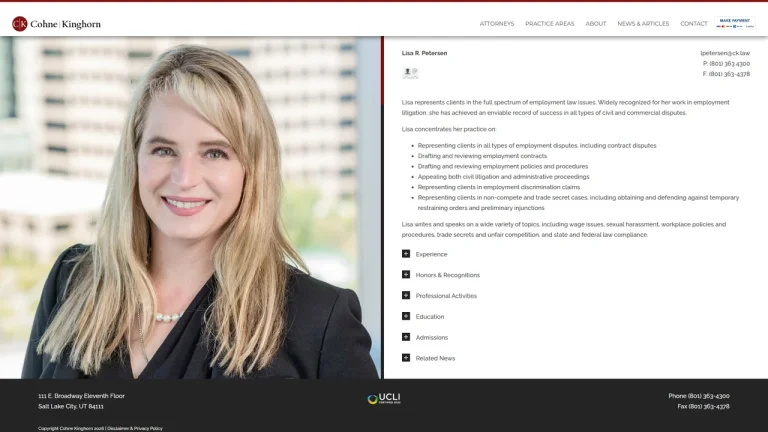
Petersen Lisa R - Salt Lake City, UT
Teter & Vu LLC - Salt Lake City, UT
Crook Legal Group PLLC - Salt Lake City, UT

Parr Brown Gee and Loveless - Salt Lake City, UT
Scholnick Thorne Holland - Salt Lake City, UT

Andrus Law Firm, LLC - Salt Lake City, UT
Darren K. Nelson - Commercial Litigation Attorney - Salt Lake City, UT
Fabian VanCott Salt Lake City, UT

Snell & Wilmer - Salt Lake City, UT
Cheylynn Hayman, Employment Attorney - Salt Lake City, UT
Hollingsworth Law Office, LLC - Salt Lake City, UT
Ballard Spahr LLP - Salt Lake City, UT
Larsen & Rico, PLLC Salt Lake City, UT
Ray Quinney & Nebeker - Provo, UT
The Utah Workplace Legal Framework and District Court Jurisdiction
Employment relations in Utah operate under the common-law presumption of at-will employment, meaning an employer may generally terminate an employment relationship at any time, for any lawful reason or no reason at all. However, this employer discretion is bounded by explicit state and federal statutory protections. The Utah Labor Code prohibits unlawful discrimination, protects wage and hour entitlements, and regulates post-employment restrictive covenants. When disputes arise across the Wasatch Front-from the tech corridor of Silicon Slopes in Utah County to commercial enterprises in Salt Lake, Davis, and Weber counties-knowledgeable counsel is essential.
Employment disputes frequently require administrative exhaustion before the Utah Antidiscrimination and Labor Division (UALD), an operating division of the Utah Labor Commission headquartered in Salt Lake City. The UALD investigates allegations of discriminatory employment practices, hostile work environments, and retaliatory discharges under work-share arrangements with federal authorities. Attorneys licensed by the Utah State Bar provide critical representation during mandatory intake interviews, formal mediation conferences, and administrative evidentiary hearings.
When workplace claims cannot be resolved through administrative conciliation or settlement negotiations, proceedings advance to Utah District Courts across eight judicial districts, such as the Third Judicial District in Salt Lake County or the Fourth Judicial District in Provo. Experienced local counsel evaluates executive severance packages, disputes overbroad non-compete restrictions, and litigates wrongful termination claims to protect employee livelihoods and corporate compliance.
Common Utah Employment Law Legal Fee Structures
| Case Scenario | Fee Structure | Estimated Cost (USD) | Key Cost Determinants |
|---|---|---|---|
| Wage & Overtime Claim (Utah Payment of Wages Act / FLSA) | Contingency (33% - 40%) or Hybrid | $0 Upfront (Contingency) | Administrative UALD wage claim vs. District Court action, timesheet audit volume, independent contractor misclassification, and statutory liquidated damages. |
| Non-Compete Review & Severance Negotiation | Flat Fee or Hourly ($275 - $475/hr) | $1,200 - $3,500 | Enforceability under the Utah Post-Employment Restrictions Act, trade secret covenants, executive compensation terms, and release scope. |
| Workplace Discrimination & Retaliation Lawsuit (UALD/Title VII) | Contingency or Hourly Retainer | $7,500 - $30,000+ (or Contingency) | Exhaustion of UALD administrative procedures, deposition volume, summary judgment briefing, and District Court jury trial duration. |
| Employer Defense & Workplace Policy Compliance Audit | Hourly Retainer ($275 - $500/hr) | $3,500 - $12,000 | Employee handbook overhaul, restrictive covenant drafting under Utah Code § 34-51-201, mandatory training protocols, and defending UALD complaints. |
Critical Legal Deadlines & Statutes in Utah Employment Law
Navigating employment claims in Utah requires strict adherence to statutory limitation periods. Under the Utah Antidiscrimination Act, codified at Utah Code § 34A-5-101 et seq., an employee alleging discrimination based on race, color, sex, pregnancy, religion, national origin, age, disability, sexual orientation, or gender identity must file a formal charge with the UALD within 180 days of the alleged discriminatory act pursuant to Utah Code § 34A-5-107. Failing to file within this 180-day window permanently bars state statutory discrimination remedies.
Utah maintains explicit statutory limits on restrictive employment covenants. Under the Utah Post-Employment Restrictions Act, codified at Utah Code § 34-51-101 et seq., any post-employment non-compete agreement entered into on or after May 10, 2016, that exceeds a duration of one year from the date of the employee's separation is void under Utah Code § 34-51-201. Furthermore, under Utah Code § 34-51-301, an employer that attempts to enforce an unlawful non-compete covenant is statutorily liable for the employee's reasonable attorney fees, court costs, and actual damages.
Wage claims are governed by the Utah Payment of Wages Act under Utah Code § 34-28-1 et seq. An employee seeking unpaid wages, earned bonuses, or sales commissions must file an administrative wage claim with the Utah Labor Commission within one year after the date the wages were due pursuant to Utah Code § 34-28-9. Common-law breach of written employment contracts must be commenced within six years under Utah Code § 78B-2-309, while actions upon oral agreements carry a four-year limitation period under Utah Code § 78B-2-307.
Small Claims Limits vs. District Court Employment Litigation in Utah
Utah Justice Courts and dedicated small claims divisions maintain jurisdiction over civil controversies seeking money damages up to $20,000 pursuant to Utah Code § 78A-8-102. An individual employee can utilize the small claims process or submit an administrative wage claim to the Utah Labor Commission to recover unpaid final paychecks or isolated expense reimbursements under $20,000 without mandatory legal counsel.
However, small claims courts possess zero authority to issue equitable relief, order workplace reinstatement, or resolve complex discrimination and whistleblower claims. Substantive employment actions-such as sexual harassment litigation, trade secret disputes, and non-compete enforcement-must be filed in Utah District Courts. Attempting to litigate these claims pro se is hazardous; navigating the Utah Rules of Civil Procedure, responding to summary judgment motions, and meeting strict evidentiary standards requires an experienced Utah employment lawyer to level the playing field against corporate defense firms.
Red Flags When Hiring a Utah Employment Lawyer
- Missing the 180-Day UALD Filing Deadline: An attorney who fails to file an administrative discrimination charge with the UALD within 180 days under § 34A-5-107 forfeits your state remedies completely.
- Overlooking the One-Year Non-Compete Limitation: Counsel who fails to evaluate the strict one-year statutory cap under the Utah Post-Employment Restrictions Act (§ 34-51-201) risks misadvising employees and employers alike.
- Promising Guaranteed Wins in At-Will Situations: Utah adheres firmly to at-will employment; attorneys who guarantee outcomes without establishing an explicit statutory or public policy violation are setting false expectations.
- Upfront Retainers for Administrative Wage Claims: Beware of practitioners charging high, non-refundable retainers for basic wage claims without first advising on the cost-effective administrative wage claim process through the Utah Labor Commission.
Frequently Asked Questions
Is Utah an at-will employment state?
Yes. Utah is an at-will employment state, meaning an employer may terminate an employee for any legal reason or no reason. However, terminations that violate statutory anti-discrimination laws under Utah Code § 34A-5-106, breach an employment contract, or violate clear public policy are unlawful.
What is the deadline to file a discrimination complaint in Utah?
Under Utah Code § 34A-5-107, you must file a formal Charge of Discrimination with the Utah Antidiscrimination and Labor Division (UALD) within 180 calendar days from the date the discriminatory conduct took place.
Are non-compete agreements enforceable under Utah law?
Non-compete agreements entered into on or after May 10, 2016, are enforceable only if their duration does not exceed one year from the date of employment separation under Utah Code § 34-51-201. Any covenant exceeding one year is void as a matter of law.
Can an employee recover legal fees if an employer enforces an invalid non-compete in Utah?
Yes. Pursuant to Utah Code § 34-51-301, if an employer attempts to enforce a post-employment restrictive covenant that is determined to be unenforceable, the employer is legally liable for the employee's court costs, arbitration fees, and reasonable attorney fees.
How do I file an unpaid wage claim in Utah?
Under Utah Code § 34-28-9, an employee may file a wage claim with the Utah Labor Commission within one year from the date wages were due, or pursue small claims court action if the amount is $20,000 or less.