
Harassment Lawyers in Utah
Facing unlawful harassment in Utah requires immediate and decisive legal protection under state statutes. Retaining an experienced Utah attorney helps secure civil stalking injunctions, address hostile workplace environments, and resolve disputes discreetly before escalation. Explore our directory below to schedule a case review with trusted local legal professionals.

Andrus Law Firm, LLC - Salt Lake City, UT
Hollingsworth Law Office, LLC - Salt Lake City, UT
Larsen & Rico, PLLC Salt Lake City, UT

Provo Employment Attorney - UT
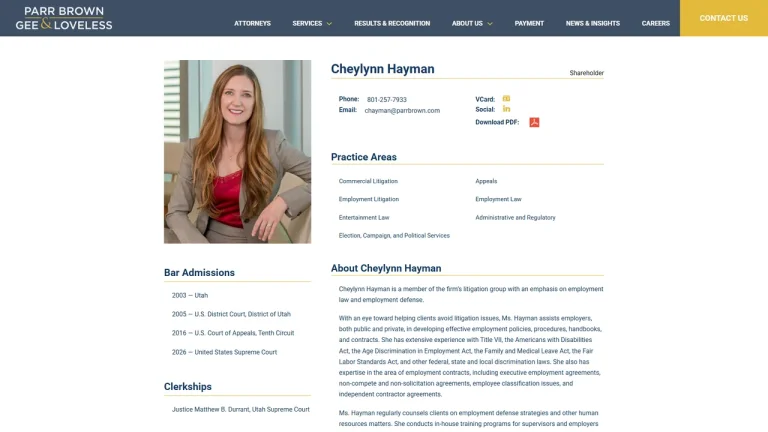
Cheylynn Hayman, Employment Attorney - Salt Lake City, UT
Littler Mendelson P.C. - Salt Lake City, UT
Scholnick Thorne Holland - Salt Lake City, UT

Navigating Harassment Claims Across Utah Courts
Harassment disputes in Utah encompass diverse legal challenges, ranging from repeated digital harassment and stalking to aggressive hostile work environments. When personal safety or professional reputations are threatened, engaging an attorney licensed by the Utah State Bar is essential to asserting statutory protections under state law. Local practitioners understand the procedural nuances required to present persuasive evidence before district court judges throughout the Wasatch Front and surrounding jurisdictions.
Civil harassment matters are formally heard in Utah District Courts, which maintain general jurisdiction over protective actions. Depending on where the parties reside or where conduct occurred, cases are filed within specific judicial districts, such as the 3rd Judicial District at the Matheson Courthouse in Salt Lake City, the 4th Judicial District in Provo, or the 2nd Judicial District in Ogden. Each court enforces distinct local rules regarding the submission of electronic exhibits, witness declarations, and emergency motion hearings.
Workplace harassment claims introduce a separate procedural layer requiring administrative coordination before filing a civil lawsuit. In Utah, private workplace harassment and retaliation matters fall under the oversight of the Utah Antidiscrimination and Labor Division (UALD), situated in Salt Lake City. A dedicated Utah harassment attorney guides victims and defendants through administrative investigations, mediation proceedings, and district court litigation to safeguard legal rights.
Typical Harassment Legal Fees & Representation Frameworks in Utah
| Case Scenario | Fee Structure | Estimated Cost (USD) | Key Cost Determinants |
|---|---|---|---|
| Ex Parte Civil Stalking Injunction | Flat Fee or Hourly Retainer | $1,500 - $3,500 | Evidence volume, emergency drafting urgency, and initial ex parte hearing appearances. |
| Contested Injunction Evidentiary Hearing | Hourly Rate ($275 - $450/hr) | $3,500 - $8,500 | Witness preparation, cross-examination subpoenas, and multiple district court appearances. |
| Workplace Harassment & Hostile Environment | Contingency (33% - 40%) or Hybrid | $0 upfront or $5,000 - $12,500 retainer | UALD administrative exhaustion, lost wage calculations, and settlement negotiation scope. |
| Civil Tort Litigation (Intentional Infliction) | Hourly Retainer or Contingency | $7,500 - $25,000+ | Digital forensic preservation, medical or psychological evaluations, and jury trial preparation. |
Critical Legal Deadlines & Statutes in Utah
Strict statutory timelines govern harassment and stalking litigation across Utah. For workplace harassment claims involving unlawful discrimination, victims must file a formal charge with the Utah Antidiscrimination and Labor Division within 180 calendar days of the discriminatory action pursuant to Utah Code § 34A-5-107. Failing to meet this strict administrative deadline forever bars the claimant from pursuing remedies under state employment statutes.
In civil protective matters, petitioners seeking relief must demonstrate a course of conduct under Utah Code § 76-5-106.5, which requires proof of two or more acts directed at a specific person that would cause a reasonable person to suffer emotional distress or fear for safety. Once a district court judge grants an ex parte civil stalking injunction under Utah Code § 78B-7-701, the respondent has exactly 14 calendar days from service to file a written request for an evidentiary hearing. If no hearing is requested, the injunction automatically remains active for three years or permanently as ordered.
For independent civil actions seeking monetary compensation for emotional distress, the statute of limitations is set at four years under Utah Code § 78B-2-307. However, if the harassment involves written libel or verbal slander, claimants must initiate court filings within a condensed one-year limitation period under Utah Code § 78B-2-302.
Small Claims Limits vs. Professional Representation
Utah Justice Courts handle small claims matters up to a statutory ceiling of $20,000 under Utah Code § 78A-8-102. While small claims courts in municipalities across the Wasatch Front provide a streamlined, low-cost venue for recovering liquidated financial damages, their jurisdiction is strictly limited to monetary compensation.
Justice Court judges have no legal power to grant equitable remedies, issue civil stalking injunctions, or order a harasser to cease electronic contact. When physical safety, personal privacy, or workplace standing is at stake, petitioners must seek relief in Utah District Court. Furthermore, small claims procedures lack formal discovery mechanisms like depositions and electronic subpoenas. Securing telephone records, social media metadata, or employment personnel files requires district court litigation guided by an experienced Utah attorney.
Red Flags & Hiring Safeguards for Harassment Counsel
When selecting legal representation for a harassment or stalking matter in Utah, evaluate prospective firms against essential professional safeguards:
- Guarantees of Criminal Charges: Private civil lawyers cannot file criminal indictments or promise jail time; charging authority belongs solely to Utah county attorneys and municipal prosecutors.
- Missing the 180-Day UALD Deadline: Law firms handling employment harassment must immediately preserve administrative rights before the Utah Labor Commission rather than prematurely filing in court.
- Inadequate Digital Forensics: Cyber harassment and online stalking require counsel proficient in authenticating digital evidence under Utah evidentiary standards, including IP tracing and message preservation.
- Vague Injunction Retainer Terms: Ensure the retainer agreement specifies whether the fee covers both the initial emergency petition and subsequent contested evidentiary hearings.
Frequently Asked Questions
What constitutes stalking or harassment under Utah law?
Under Utah Code § 76-5-106.5, stalking is defined as intentionally engaging in a course of conduct involving two or more separate acts directed at a specific individual-such as following, monitoring, communicating, or surveilling-that would cause a reasonable person emotional distress or fear of harm.
Can I get a protective order against a non-family member in Utah?
Yes. Utah provides Civil Stalking Injunctions under Utah Code § 78B-7-701 specifically to protect individuals from neighbors, coworkers, acquaintances, or strangers where no domestic or cohabitant relationship exists.
How long does a Utah civil stalking injunction remain valid?
Once served, a civil stalking injunction in Utah remains legally enforceable for up to three years from the date of service, and permanent injunctive provisions may be ordered by the presiding district court judge.
What is the deadline to report workplace harassment to Utah state regulators?
An employee must formally file a complaint with the Utah Antidiscrimination and Labor Division (UALD) within 180 calendar days of the harassing or discriminatory incident under Utah Code § 34A-5-107.
Can I sue for monetary damages resulting from harassment in Utah?
Yes. Victims may file a civil tort lawsuit in Utah District Court claiming intentional infliction of emotional distress under Utah Code § 78B-2-307 to recover therapy costs, lost income, and general compensatory damages.