
IRS Dispute Lawyers in Utah
Resolving an IRS tax dispute in Utah requires strategic intervention to halt wage garnishments, bank levies, and aggressive enforcement actions under federal deadlines. Experienced tax controversy attorneys protect your financial stability by negotiating offers in compromise or formal appeals before litigation escalates. Explore our verified directory below to consult an experienced Utah tax lawyer today.

Knudsen Law Firm, PLLC - Salt Lake City, UT
Expert Tax Law - Salt Lake City, UT
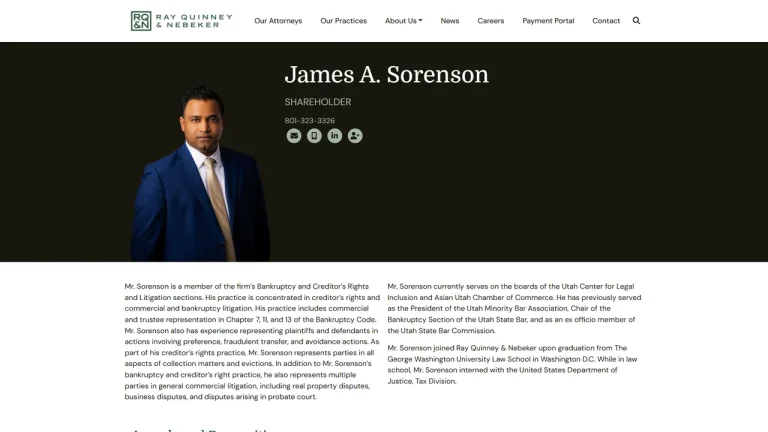
James A. Sorenson, Attorney at Ray Quinney & Nebeker - Salt Lake City, UT

Hendricks & Owens, PLLC - Provo, UT
Common Law PC - Salt Lake City, UT

Law Offices of Andrew Clawson - Salt Lake City, UT
Utah Bankruptcy, Inc. - Salt Lake City, UT

Jory L. Trease - Salt Lake City, UT

Blue Bee Bankruptcy Law Salt Lake City, UT

Defense Tax Partners - Salt Lake City, UT

Gilland Law Firm - Salt Lake City, UT
David G Harlow, Attorney-at-Law - Provo, UT
Law Office of Paul Benson in Salt Lake City Salt Lake City, UT

Navigating Federal Tax Controversies & Audits Across Utah
Facing the Internal Revenue Service (IRS) or navigating parallel tax audits with the Utah State Tax Commission places individual taxpayers and businesses under intense financial scrutiny. Federal tax controversies involve rigid procedural rules, complex forensic accounting, and high-stakes administrative deadlines. Retaining an experienced Utah IRS dispute lawyer ensures that your constitutional protections and statutory taxpayer rights are aggressively defended from the moment you receive an examination letter or notice of intent to levy.
Tax disputes in the Beehive State regularly span both federal and state jurisdictions. While federal tax issues originate through the IRS Independent Office of Appeals and proceed to the United States Tax Court-which periodically holds trial calendars in Salt Lake City-unresolved state tax liabilities are concurrently adjudicated through the Utah State Tax Commission in Salt Lake City under administrative procedures outlined in the Utah Administrative Code. Furthermore, complex tax litigation and criminal tax defense matters fall under the jurisdiction of the United States District Court for the District of Utah, situated in the Frank E. Moss and Orrin G. Hatch United States Courthouses.
Whether your case involves disputed payroll tax liabilities for a growing enterprise in the Silicon Slopes tech corridor, unfiled personal returns across Salt Lake County, or asset-protection challenges in Utah County, Weber County, or Washington County, qualified local counsel understands how to interface directly with local IRS Revenue Officers and state auditors. A licensed attorney provides attorney-client privilege-a vital safeguard that accountants and non-attorney tax preparation representatives cannot guarantee during criminal or fraud investigations.
Estimated Costs & Retainer Structures for IRS Dispute Attorneys in Utah
The legal fees associated with resolving IRS controversies depend on the procedural stage of the case, the total tax liability at stake, and the volume of forensic documentation required. Below is a realistic fee overview for tax controversy services in Utah.
| Case Scenario | Fee Structure | Estimated Cost (USD) | Key Cost Determinants |
|---|---|---|---|
| IRS Audit Representation (Individual or Small Business) | Hourly Retainer or Flat Fee | $2,500 - $7,500 | Scope of examination (correspondence vs. field audit), condition of financial books, and Schedule C or pass-through entity complexity. |
| Collection Defense, Wage Garnishment & Levy Release | Flat Fee / Initial Retainer | $3,000 - $6,500 | Imminence of asset seizure, filing of Collection Due Process (CDP) requests, and negotiation of installment agreements. |
| Offer in Compromise (OIC) & Penalty Abatement | Staged Flat Fee | $4,000 - $10,500 | Forensic asset valuation, calculation of Reasonable Collection Potential (RCP), and compliance across multi-year unfiled returns. |
| U.S. Tax Court Petition & Formal Litigation | Hourly Retainer ($350 - $650/hr) | $8,500 - $25,000+ | Trial preparation, expert witness testimony, extensive discovery motions, and potential criminal tax fraud exposure. |
Critical Legal Deadlines & Statutes in Utah
In federal and Utah tax matters, missing a statutory filing date can permanently extinguish your right to challenge assessed taxes or prevent aggressive administrative seizures. Once the IRS issues a formal notice, the clock begins ticking under stringent federal statutes.
If you receive a statutory Notice of Deficiency (often referred to as a 90-day letter), you have exactly 90 calendar days from the mailing date to petition the court under 26 U.S. Code § 6213(a). This deadline is strictly jurisdictional; missing it by a single day deprives the United States Tax Court of authority to hear your dispute prior to payment.
When faced with enforced collections, such as a Final Notice of Intent to Levy, taxpayers possess precisely 30 days under 26 U.S. Code § 6330 to request a Collection Due Process (CDP) hearing using IRS Form 12153, which legally halts collection activity while your appeal is adjudicated. General federal audit assessments are bounded by a three-year statute of limitations under 26 U.S. Code § 6501(a), while the IRS possesses ten years to collect assessed liabilities under 26 U.S. Code § 6502(a). At the state level, taxpayers seeking redetermination of a Utah tax deficiency must file an administrative appeal within 30 days under Utah Code § 59-1-501.
Small Claims Limitations vs. Professional Tax Court Representation
Under Utah law, small claims courts possess a monetary jurisdictional ceiling of $15,000 as codified in Utah Code § 78A-8-102. While small claims divisions throughout justice courts in Salt Lake County, Utah County, and Davis County provide an accessible venue for localized debt claims and minor consumer disputes, they have zero jurisdiction over federal or state tax liabilities.
Neither the IRS nor the Utah State Tax Commission can be sued in Utah small claims court to reduce an assessment, remove a tax lien, or contest an audit finding. Federal sovereign immunity and statutory jurisdictional mandates require all federal tax controversies to proceed either through administrative review with the IRS Independent Office of Appeals, litigation in the United States Tax Court, or a refund action filed in the United States District Court for the District of Utah or the United States Court of Federal Claims under 28 U.S. Code § 1346(a)(1).
Attempting to handle tax controversies pro se or relying on general legal counsel unfamiliar with federal tax procedure puts your financial future at risk. A dedicated tax controversy lawyer evaluates Collection Statute Expiration Dates (CSED), calculates accurate Reasonable Collection Potential (RCP), and negotiates legally binding settlements that protect real property, retirement accounts, and operating business assets.
Red Flags When Hiring a Utah Tax Controversy Attorney
Taxpayers under IRS distress are uniquely vulnerable to predatory marketing schemes. Protect yourself and your business by vetting legal counsel against these common industry red flags:
- Guaranteed 'pennies on the dollar' settlements: Unscrupulous tax relief mills promise massive debt reductions before analyzing your IRS master file, transcripts, or financial statements. No ethical attorney can guarantee an Offer in Compromise acceptance prior to a full financial investigation.
- Lack of United States Tax Court admission: Inexperienced representatives or non-lawyer negotiation services cannot enter an appearance in federal court. Verify that your attorney is licensed with the Utah State Bar and formally admitted to practice before the United States Tax Court.
- Pressure to pay large non-refundable retainers up front: Beware of out-of-state call centers that demand thousands of dollars before assigning a licensed attorney to your file. Reputable Utah practitioners provide transparent, itemized engagement agreements with clearly defined scope of representation.
- Failure to request and review IRS wage and income transcripts: Competent legal defense begins with an exhaustive forensic review of official IRS transcripts and collection expiration dates rather than speculative negotiation.
Frequently Asked Questions
Can the IRS seize my bank accounts or real property in Utah?
Yes. If tax assessments remain unresolved, the IRS has the statutory power to issue administrative levies on bank accounts, garnish wages, and record Notices of Federal Tax Liens against real property in county recorder offices across Utah. However, taxpayers must first receive formal notice, providing a strict 30-day window to invoke Collection Due Process rights to halt seizures.
What happens if I miss the 90-day deadline on an IRS Notice of Deficiency?
Missing the 90-day statutory window forfeits your legal right to petition the United States Tax Court without paying the tax first. Once that deadline expires, the IRS will formally assess the proposed tax, penalties, and interest, initiating collection actions unless you pay the liability in full and seek an administrative refund claim.
Can a Utah tax attorney resolve both IRS and Utah State Tax Commission debts?
Yes. Experienced Utah tax lawyers handle concurrent federal and state tax controversies. Because the Utah State Tax Commission frequently mirrors IRS audit adjustments, local counsel can coordinate responses to prevent dual tax liens and align state installment plans with federal settlement terms.
What is the difference between an Enrolled Agent, a CPA, and a tax attorney?
While Enrolled Agents and CPAs are qualified for tax preparation and routine administrative correspondence, only licensed tax attorneys possess full attorney-client privilege, formal trial training, and the authority to litigate disputes in the United States Tax Court, federal district courts, and appellate circuits.
Does filing an Offer in Compromise automatically stop IRS collection actions?
Yes, in most circumstances. When a processable Offer in Compromise is submitted and under formal evaluation by the IRS, statutory levies and enforcement actions are generally suspended. However, interest and penalties continue to accrue, and the collection statute of limitations is tolled during the review period.