
Employment & Labor Lawyers in Salt Lake City
Retaining an experienced Salt Lake City employment and labor attorney protects your workplace rights and enforces employer compliance under Utah labor statutes. Dedicated legal counsel helps resolve wrongful terminations, wage and hour disputes, and restrictive covenant disagreements through pre-suit mediation and administrative representation. Explore our verified directory below to consult with top-rated employment lawyers in Salt Lake County today.
McKay, Burton & Thurman, P.C. - Salt Lake City, UT

Spencer Fane Snow Christensen & Martineau - Salt Lake City, UT
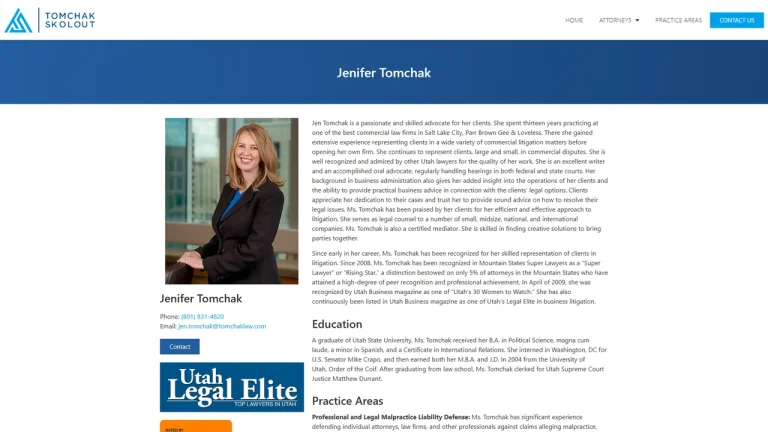
Jenifer L. Tomchak - Employment Litigation Attorney - Salt Lake City, UT

Darren K. Nelson - Commercial Litigation Attorney - Salt Lake City, UT
Snell & Wilmer - Salt Lake City, UT
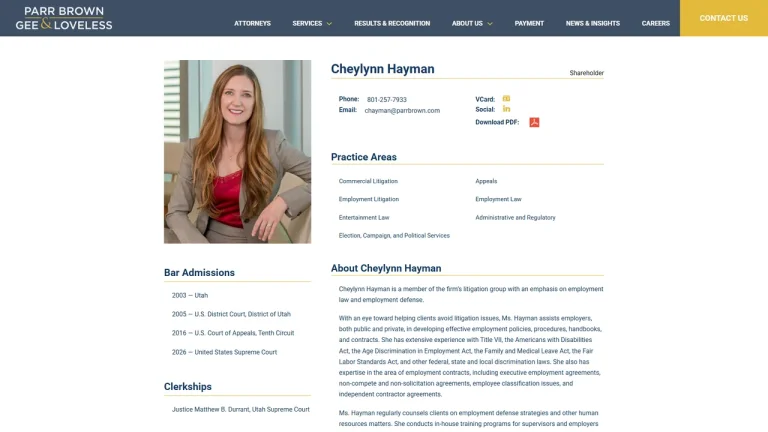
Cheylynn Hayman, Employment Attorney - Salt Lake City, UT
Littler Mendelson P.C. - Salt Lake City, UT

Clyde Snow & Sessions, P.C. - Salt Lake City, UT
Mabey Wright & James PLLC - Salt Lake City, UT
Dorsey and Whitney LLP - Salt Lake City, UT

Florence M. Vincent - Salt Lake City, UT
Ray Quinney & Nebeker - Salt Lake City, UT
Petersen Lisa R - Salt Lake City, UT

Dentons Durham Jones Pinegar Salt Lake City, UT
Crook Legal Group PLLC - Salt Lake City, UT

Parr Brown Gee and Loveless - Salt Lake City, UT
Ballard Spahr LLP - Salt Lake City, UT
Scholnick Thorne Holland - Salt Lake City, UT
Hollingsworth Law Office, LLC - Salt Lake City, UT
Dyer Law Group PLLC - Salt Lake City, UT

Andrus Law Firm, LLC - Salt Lake City, UT
Larsen & Rico, PLLC Salt Lake City, UT
Kirton McConkie - Salt Lake City, UT
Workplace Rights and Labor Law Advocacy in Salt Lake City
Salt Lake City serves as the primary commercial, technological, and corporate center of the Intermountain West. With prominent corporate employers located in Downtown Salt Lake City, expanding tech and software enterprises spanning toward the Silicon Slopes corridor, and expansive logistics and distribution facilities near the Salt Lake City International Airport, the local workforce is vast and diverse. While Utah is an 'at-will' employment state, employers must strictly comply with state and federal statutory protections safeguarding employees against discrimination, retaliation, and unlawful wage theft.
Navigating employment claims in Salt Lake County requires strict adherence to administrative exhaustion procedures. Workplace discrimination, sexual harassment, and retaliation complaints originating in Salt Lake City must first be submitted to the Utah Antidiscrimination and Labor Division (UALD), located on East 300 South in Downtown Salt Lake City, or cross-filed with the U.S. Equal Employment Opportunity Commission (EEOC) Salt Lake City Area Office. If agency mediation fails to resolve the controversy, lawsuits are litigated in the 3rd Judicial District Court at the Scott M. Matheson Courthouse or filed in the U.S. District Court for the District of Utah at the Orrin G. Hatch United States Courthouse.
A Salt Lake City employment lawyer provides decisive guidance for both employees and growing commercial enterprises. Local counsel reviews non-compete agreements to ensure compliance with Utah's strict post-employment restriction limits, recovers unpaid commissions and overtime under state wage statutes, and represents professionals in complex severance negotiations and trial litigation.
Estimated Legal Fees for Employment & Labor Matters in Salt Lake City
| Case Scenario | Fee Structure | Estimated Cost (USD) | Key Cost Determinants |
|---|---|---|---|
| Executive Severance & Non-Compete Review | Flat Fee / Hourly | $750 - $2,000 | Utah 1-year statutory non-compete limits, equity vesting, non-solicitation language. |
| UALD / EEOC Discrimination Charge & Conciliation | Contingency or Hourly | $300 - $475/hr or 33.3% of settlement | Charge dual-filing drafting, position statement rebuttals, agency mediation. |
| Unpaid Wages & Overtime Wage Claim (FLSA / Utah Act) | Contingency Fee | 33.3% - 40% of recovery ($0 upfront) | Payroll records audit, employee misclassification, statutory liquidated damages. |
| Wrongful Termination & Retaliation Jury Trial | Contingency Fee | 40% of total recovery | Corporate witness depositions, electronic discovery volume, expert economic analysis. |
Critical Legal Deadlines & Statutes in Utah
Employees pursuing claims in Utah must adhere to rigid statutory deadlines. Under the Utah Antidiscrimination Act, codified at Utah Code § 34A-5-106, employers with 15 or more employees are prohibited from discriminating on the basis of race, color, sex, pregnancy, religion, national origin, age, disability, sexual orientation, or gender identity. To preserve these protections, Utah Code § 34A-5-107 requires the aggrieved employee to file a formal Request for Agency Action with the UALD within 180 calendar days of the alleged discriminatory event. If cross-filed under federal Title VII provisions (42 U.S. Code § 2000e-2), the federal filing window extends to 300 days.
For unpaid wage disputes, the Utah Payment of Wages Act imposes rapid compliance rules. Under Utah Code § 34-28-5, when an employer discharges an employee, all earned wages become due and payable within 24 hours of separation. Administrative wage claims filed with the Utah Labor Commission must be brought within 1 year of the wage violation pursuant to Utah Code § 34-28-9. Furthermore, Utah strictly restricts post-employment restrictive covenants: under the Utah Post-Employment Restrictions Act, Utah Code § 34-51-201, any non-compete covenant entered into on or after May 10, 2016, that exceeds a duration of 1 year from the date of employment termination is void and unenforceable as a matter of law.
Small Claims Limits vs. Retaining Legal Counsel in Salt Lake County
Pursuant to Utah Code § 78A-8-102, Utah Justice Courts maintain small claims jurisdiction for recovery of money up to $20,000. For an employee seeking straightforward unpaid final compensation, unreimbursed travel expenses, or a modest bonus below $20,000, filing a self-represented claim in the Salt Lake City Justice Court or through the Utah Online Dispute Resolution (ODR) program offers a quick, accessible forum.
However, statutory employment discrimination, sexual harassment, and complex retaliation claims cannot be filed in small claims court. Justice Courts lack subject-matter jurisdiction to hear claims under the Utah Antidiscrimination Act or federal civil rights statutes, nor can they award emotional distress damages, enforce punitive sanctions, or issue equitable injunctions. Furthermore, resolving disputes involving non-compete enforcement, trade secret litigation, or federal Fair Labor Standards Act (FLSA) collective claims under 29 U.S. Code § 206 requires formal litigation in the 3rd Judicial District Court or the U.S. District Court, where representation by an experienced employment litigator is indispensable.
Red Flags When Hiring a Salt Lake City Employment Lawyer
- Missing the 180-Day UALD Filing Deadline: Any lawyer who fails to submit your administrative discrimination claim within 180 days of the adverse action permanently forfeits your state remedies under Utah Code § 34A-5-107.
- Ignorance of Utah's 1-Year Non-Compete Cap: Avoid counsel who attempts to draft or defend post-employment restrictive covenants that exceed the strict 1-year statutory limitation set forth in Utah Code § 34-51-201.
- Demanding Large Non-Refundable Upfront Retainers: For strong wage theft, FMLA retaliation, or statutory discrimination claims, qualified employment attorneys typically operate on contingency or hybrid structures rather than charging burdensome upfront fees.
- Lack of Local Administrative Experience: Ensure your attorney has direct experience handling conciliations and evidentiary hearings before the Utah Labor Commission on East 300 South in Salt Lake City.
Frequently Asked Questions
What is the deadline to file a workplace discrimination claim in Salt Lake City?
Under Utah Code § 34A-5-107, you must file a formal charge with the Utah Antidiscrimination and Labor Division (UALD) within 180 calendar days of the discriminatory action. If dual-filing under federal law with the EEOC, the deadline is 300 days.
Are non-compete agreements legally enforceable in Utah?
Yes, but with strict statutory limits. Under the Utah Post-Employment Restrictions Act, Utah Code § 34-51-201, any non-compete agreement entered into on or after May 10, 2016, cannot exceed a period of 1 year from the date of separation; any agreement exceeding 1 year is entirely void.
When must a Salt Lake City employer pay an employee after termination?
Under the Utah Payment of Wages Act, Utah Code § 34-28-5, when an employee is discharged or fired, all earned wages must be paid within 24 hours of separation. If an employee resigns voluntarily, wages are due on the next regularly scheduled payday.
Does Utah state law protect LGBTQ+ workers from employment discrimination?
Yes. The Utah Antidiscrimination Act explicitly includes sexual orientation and gender identity as protected classifications under Utah Code § 34A-5-106, prohibiting employers with 15 or more workers from taking adverse actions based on these grounds.
What remedies can an employee recover in a Utah wrongful termination lawsuit?
Prevailing employees can recover back pay (lost wages and benefits), front pay, compensatory damages for emotional pain, statutory penalties, court costs, and reasonable attorney fees, as well as job reinstatement where appropriate.