
Harassment Lawyers in Salt Lake City
Retaining an assertive Salt Lake City harassment lawyer provides immediate legal protection against hostile work environments, quid pro quo demands, and unlawful retaliation. Experienced local employment advocates hold negligent employers accountable across state and federal courts in Salt Lake County. Explore our verified directory below to schedule a confidential case evaluation with a trusted attorney today.

Andrus Law Firm, LLC - Salt Lake City, UT
Littler Mendelson P.C. - Salt Lake City, UT
Larsen & Rico, PLLC Salt Lake City, UT
Scholnick Thorne Holland - Salt Lake City, UT
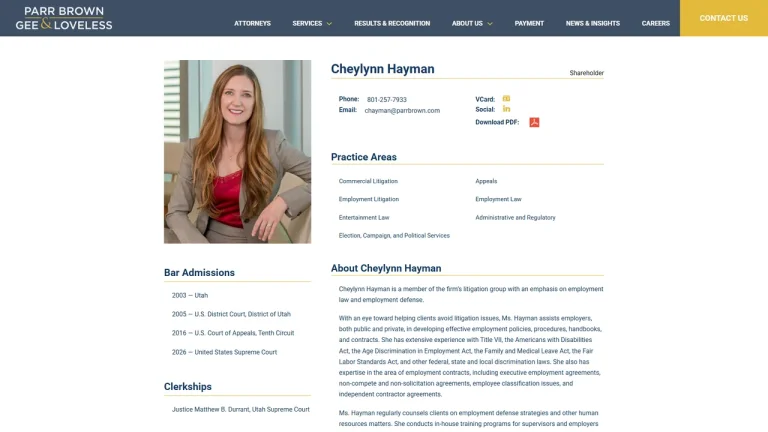
Cheylynn Hayman, Employment Attorney - Salt Lake City, UT
Workplace Harassment Protections & Salt Lake County Jurisdiction
Experiencing persistent harassment in the workplace disrupts professional careers and undermines personal well-being. In Salt Lake City, workplace harassment disputes arise across diverse employment environments, including corporate offices in Downtown Salt Lake City, biomedical research labs in Research Park, hospitality venues near the Salt Palace Convention Center, and retail or service sectors in Sugar House. Regardless of the work setting, Utah and federal laws prohibit unwelcome conduct that creates an intimidating, hostile, or offensive working environment.
Workplace harassment claims originating in Salt Lake City are subject to mandatory administrative procedures before they can proceed to formal court litigation. Aggrieved workers must file a formal charge with the Utah Antidiscrimination and Labor Division (UALD), located on the third floor of the Heber M. Wells Building at 160 East 300 South in Salt Lake City, or with the Equal Employment Opportunity Commission (EEOC). If the administrative investigation fails to resolve the matter or a right-to-sue notice is issued, lawsuits are litigated in the Third Judicial District Court at the Matheson Courthouse (450 South State Street) or removed to federal court at the Orrin G. Hatch United States Courthouse (351 South West Temple Street).
Working with a local Salt Lake City workplace harassment attorney ensures your case is built on admissible documentation from the earliest stages. An experienced advocate guides employees through internal corporate grievance procedures, gathers corroborating digital records (emails, text messages, chat logs), and defends against employer retaliation. Local counsel understands how judges in Utah's Third District evaluate severe or pervasive standards and aggressively pursues financial compensation for lost wages, emotional distress, and punitive damages.
Salt Lake City Harassment Representation Tiers & Cost Frameworks
| Case Scenario | Fee Structure | Estimated Cost (USD) | Key Cost Determinants |
|---|---|---|---|
| UALD / EEOC Harassment Charge & Conciliation | Hourly Retainer / Hybrid Contingency | $2,500 - $6,000 | Charge drafting, agency investigator interviews, witness affidavit submissions, conciliation conferences |
| Hostile Work Environment Lawsuit (District Court) | Contingency Fee (Formal Litigation) | 33.3% - 40% of recovery | Proof of severe or pervasive conduct, supervisor versus co-worker harassment, Faragher-Ellerth defense rebuttal |
| Quid Pro Quo Sexual Harassment Litigation | Contingency Fee (Trial / Settlement) | 40% of gross proceeds | Documented tangible employment actions (denied promotion, firing), digital correspondence evidence |
| Pre-Suit Separation & Harassment Severance Negotiation | Flat Fee / Hourly | $1,750 - $4,500 | Strength of documentation, employer corporate reputation exposure, mutual non-disparagement covenants |
Critical Legal Deadlines & Utah Harassment Statutes
Workplace harassment claims are governed under the Utah Antidiscrimination Act codified at Utah Code § 34A-5-106 and Title VII of the Civil Rights Act of 1964 under 42 U.S. Code § 2000e-2. Under both statutes, actionable harassment includes unwelcome conduct based on sex (including sexual harassment, pregnancy, and sexual orientation), race, color, religion, national origin, age, or disability that is severe or pervasive enough to create an abusive work environment.
Strict administrative deadlines dictate the viability of harassment claims. Under Utah Code § 34A-5-107, an employee must submit a formal charge of discrimination to the Utah Antidiscrimination and Labor Division (UALD) within 180 calendar days of the last discriminatory or harassing incident. While federal law provides up to 300 days to file with the EEOC under 42 U.S. Code § 2000e-5, missing the 180-day deadline completely bars claims under Utah state law. Furthermore, anti-retaliation provisions under Utah Code § 34A-5-106(1)(e) and 42 U.S. Code § 2000e-3 protect workers who file a complaint or participate in an investigation from adverse employer action.
Once the UALD or EEOC concludes its proceedings and issues a Right to Sue letter, the filing clock begins immediately. Plaintiffs have exactly 90 days from receipt of a federal EEOC notice to file a lawsuit in the United States District Court for the District of Utah. Missing this 90-day jurisdictional window results in the complete dismissal of your claims.
Small Claims Inadequacy vs. District Court Harassment Litigation
Although Utah small claims courts maintain a monetary jurisdictional limit of $20,000 under Utah Code § 78A-8-102, they are entirely inappropriate for resolving workplace harassment claims. Small claims courts have no authority to order workplace injunctions, compel human resource retraining, or adjudicate claims under the Utah Antidiscrimination Act or Title VII. Filing in small claims court without prior administrative exhaustion leads to immediate dismissal with prejudice.
Harassment litigation in the Third Judicial District Court or federal court requires overcoming sophisticated corporate defenses, such as the Faragher-Ellerth affirmative defense, where employers claim they exercised reasonable care to prevent and correct harassment and the employee unreasonably failed to take advantage of internal reporting channels. An experienced Salt Lake City harassment attorney establishes why reporting was futile or details how internal reporting was ignored, deposing human resource directors, issuing subpoenas for electronic communications, and leveraging statutory attorney fee recovery provisions to hold employers accountable.
Red Flags When Hiring a Salt Lake City Harassment Lawyer
- Attorneys who advise you to immediately resign from your position before reporting the conduct in writing to HR, which severely weakens constructive discharge claims.
- Firms failing to track the strict 180-day administrative filing deadline with the UALD under Utah Code § 34A-5-107.
- Lawyers demanding upfront investigation retainers for standard contingency-based sexual or racial harassment claims.
- Practitioners who lack experience litigating employment matters in the United States District Court for the District of Utah.
Frequently Asked Questions
What is the legal standard for a hostile work environment in Utah?
Under Utah Code § 34A-5-106 and federal law, a hostile work environment exists when unwelcome conduct based on a protected characteristic is so severe or pervasive that it alters the terms and conditions of employment, creating an abusive working environment from both an objective and subjective perspective.
What constitutes quid pro quo sexual harassment?
Quid pro quo harassment occurs when an employment benefit-such as a raise, promotion, favorable shift, or continued employment-is explicitly or implicitly conditioned upon the employee submitting to unwelcome sexual advances or conduct by a supervisor or manager.
Do I have to report harassment to my company before hiring an attorney?
While consulting an attorney immediately is recommended to understand your rights, you generally must report the harassment through your employer's internal reporting procedures. This prevents the employer from using the Faragher-Ellerth defense, which claims they were unaware of the misconduct.
What is constructive discharge in a Salt Lake City harassment case?
Constructive discharge occurs when an employer creates or allows workplace harassment so intolerable that a reasonable person in the employee's position would feel compelled to resign. Under Utah law, a successful constructive discharge claim allows the worker to seek damages as if they had been fired.
Can an employer be held liable for co-worker harassment in Utah?
Yes. An employer can be held legally responsible for co-worker harassment if management or human resources knew or reasonably should have known about the unlawful conduct and failed to take immediate and effective corrective action to stop the harassment.