
IRS Dispute Lawyers in Salt Lake City
Resolve serious IRS tax controversies with top Salt Lake City IRS dispute lawyers. Dedicated Utah attorneys stop levies, garnishments, and defend audits through strategic negotiation under the Internal Revenue Code. Browse our verified directory below to consult an experienced federal tax advocate in Salt Lake County and safeguard your financial future.

Moskowitz LLP - Salt Lake City, UT

Jory L. Trease - Salt Lake City, UT
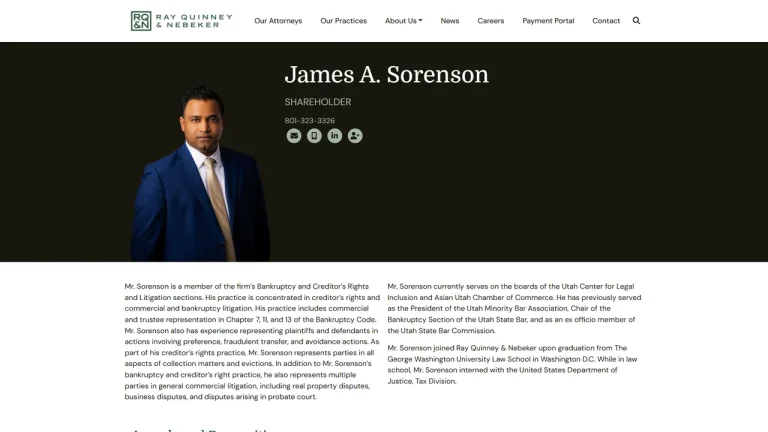
James A. Sorenson, Attorney at Ray Quinney & Nebeker - Salt Lake City, UT
Expert Tax Law - Salt Lake City, UT

Blue Bee Bankruptcy Law Salt Lake City, UT
Utah Bankruptcy, Inc. - Salt Lake City, UT
Defense Tax Partners - Salt Lake City, UT
Common Law PC - Salt Lake City, UT

Law Offices of Andrew Clawson - Salt Lake City, UT
Knudsen Law Firm, PLLC - Salt Lake City, UT
Law Office of Paul Benson in Salt Lake City Salt Lake City, UT

Defending Against IRS Enforcement in Salt Lake City and Utah
Receiving a formal audit notice, final intent to levy, or federal tax lien from the Internal Revenue Service creates immediate financial distress for individuals and business owners in Salt Lake City. Federal tax controversies involve aggressive enforcement tools, including bank account freezes, accounts receivable seizures, and wage garnishments that disrupt daily operations across the Wasatch Front.
IRS dispute resolution in Salt Lake City takes place through structured federal administrative and judicial channels. Local matters are handled through the IRS Taxpayer Assistance Center on South 200 East, while formal appeals and collection due process conferences proceed before the IRS Independent Office of Appeals. When disputes cannot be resolved administratively, litigation is initiated before the United States Tax Court or the United States District Court for the District of Utah at the Orrin G. Hatch United States Courthouse on West Temple Street.
Retaining a trial-ready Salt Lake City IRS dispute lawyer establishes an immediate shield between you and IRS revenue officers. Local counsel halts ongoing administrative collections, evaluates financial eligibility for formal debt compromises, challenges improper tax assessments, and provides zealous courtroom representation.
Legal Fee Structures for Salt Lake City IRS Dispute Resolution
| Case Scenario | Fee Structure | Estimated Cost (USD) | Key Cost Determinants |
|---|---|---|---|
| IRS Audit Defense & Examination Representation | Hourly Retainer ($350-$650/hr) | $3,500 - $7,500 | Number of tax years under audit, banking record completeness, deduction substantiation |
| Collection Due Process (CDP) Hearing & Levy Release | Flat Fee or Hourly | $2,500 - $5,500 | Urgency of bank levy release, CDP notice timeline compliance, financial disclosure scope |
| Offer in Compromise (OIC) Negotiation | Staged Flat Fee | $4,000 - $8,500 | Reasonable collection potential, equity in Utah real estate, business asset valuation |
| United States Tax Court Litigation | Staged Litigation Retainer | $7,500 - $25,000+ | 90-day petition deadline, stipulation of facts complexity, expert accounting testimony |
Critical Legal Deadlines & Statutes in Utah
Federal tax disputes in Utah are governed strictly by the Internal Revenue Code and federal administrative procedure. When the IRS completes an audit examination and proposes adjustments, the agency issues a Statutory Notice of Deficiency. Under 26 U.S. Code § 6213(a), a taxpayer has exactly 90 days from the date of the notice to file a formal petition with the United States Tax Court. This 90-day deadline is jurisdictional and cannot be extended under any circumstances.
When confronting aggressive collection actions, taxpayers possess formal due process rights. Under 26 U.S. Code § 6330 for levies and 26 U.S. Code § 6320 for federal tax lien filings, taxpayers have exactly 30 days from the date of the final notice to request a Collection Due Process hearing via Form 12153, which legally stays ongoing administrative seizures.
Tax debt settlement through an Offer in Compromise is authorized pursuant to 26 U.S. Code § 7122, based upon doubt as to collectability or liability. Corporate officers in Salt Lake City facing company payroll withholding delinquencies must be aware of personal liability assessments under 26 U.S. Code § 6672, known as the Trust Fund Recovery Penalty. For collection actions, the IRS is bound by the Collection Statute Expiration Date under 26 U.S. Code § 6502(a), which restricts collection to ten years from the formal tax assessment date.
Small Claims Limitations vs. Federal Tax Court Representation
In Salt Lake County, small claims matters are limited to $20,000 under Utah Code § 78A-8-102 in local Justice Courts. However, Justice Courts have no legal authority to intervene in federal IRS tax controversies or halt federal collection actions.
Federal tax law is an exclusive domain governed by Title 26 of the United States Code. Attempting to deal directly with aggressive IRS revenue officers or answering audit inquiries without counsel often results in inadvertent admissions, improper asset disclosures, and loss of critical appeal rights.
Enlisting a qualified Salt Lake City IRS dispute attorney ensures that statutory administrative remedies are exhausted, Collection Due Process appeals are timely preserved, and formal petitions are filed in the U.S. Tax Court or the U.S. District Court for the District of Utah to protect your business assets, wages, and bank accounts from seizure.
Red Flags When Hiring a Salt Lake City IRS Dispute Attorney
- National telemarketing tax mills: Beware of out-of-state call centers advertising aggressively on television that demand large upfront fees without reviewing your IRS transcripts or financial standing.
- Guarantees to eliminate 100% of tax penalties or principal: The IRS grants Offers in Compromise strictly according to reasonable collection potential under 26 U.S. Code § 7122; legitimate attorneys never guarantee acceptance.
- Missing the 90-day Tax Court window: Any representative who allows the 90-day Notice of Deficiency window under 26 U.S. Code § 6213(a) to lapse forfeits your ability to contest the tax without paying it first.
- Lack of attorney-client privilege: Non-attorney tax preparers cannot provide the legal protection of attorney-client privilege, which is indispensable if an audit turns into a criminal investigation.
Frequently Asked Questions
What is the deadline to respond to an IRS Notice of Deficiency?
Under 26 U.S. Code § 6213(a), you have exactly 90 days from the mailing date of the Notice of Deficiency to file a petition with the United States Tax Court. Missing this strict deadline forfeits your right to contest the proposed tax before paying it.
What is a Collection Due Process hearing, and how does it stop an IRS levy?
A Collection Due Process hearing under 26 U.S. Code § 6330 is an administrative appeal requested within 30 days of receiving a final notice of intent to levy. Filing Form 12153 legally freezes IRS collection actions while an independent appeals officer reviews alternatives.
Can an IRS dispute lawyer help with unpaid payroll taxes in Utah?
Yes. When a company fails to remit employee withholding taxes, the IRS can assess the Trust Fund Recovery Penalty against responsible individuals under 26 U.S. Code § 6672. A lawyer can defend against willful nonpayment allegations and protect personal assets.
How long does the IRS have to collect unpaid taxes under federal law?
Under 26 U.S. Code § 6502(a), the IRS has a ten-year Collection Statute Expiration Date from the date of assessment to collect unpaid federal taxes. After ten years, the tax liability expires and can no longer be legally collected.
Where are federal tax court trials held for Salt Lake City taxpayers?
United States Tax Court trial sessions for Utah taxpayers are held in Salt Lake City, typically taking place in federal courtrooms inside the Orrin G. Hatch United States Courthouse on West Temple Street.