
Wage & Hour Lawyers in Salt Lake City
Retaining an experienced Salt Lake City wage and hour lawyer protects your earnings against unlawful tip skimming, unpaid overtime, and misclassification. Dedicated local counsel aggressively enforces the Utah Payment of Wages Act and federal labor standards in Salt Lake County courts. Browse our directory below to consult a knowledgeable wage dispute attorney today.

Florence M. Vincent - Salt Lake City, UT
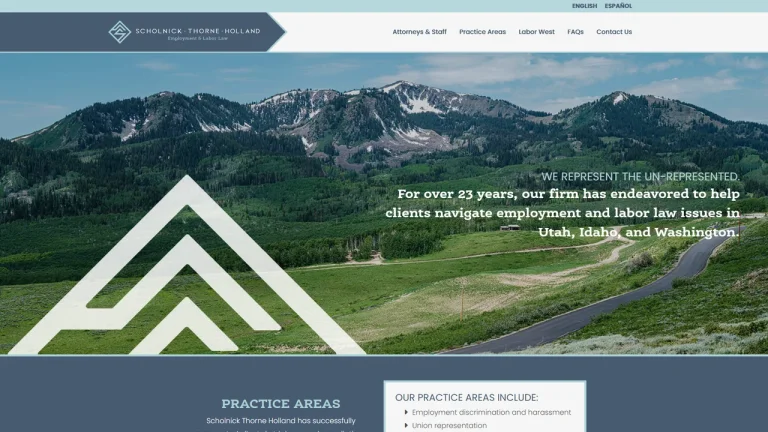
Scholnick Thorne Holland - Salt Lake City, UT
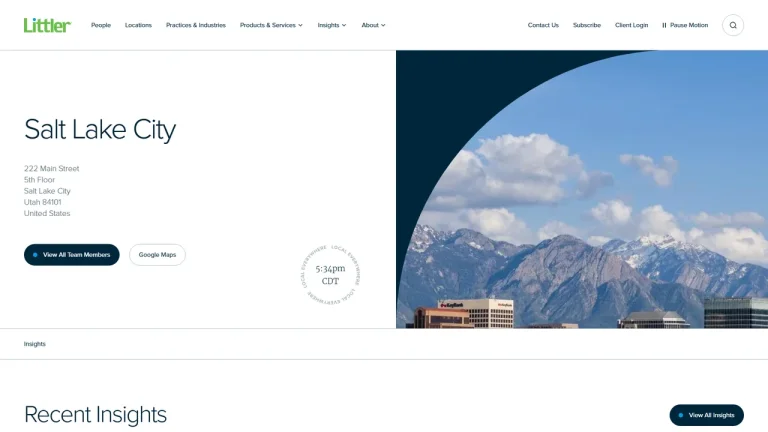
Littler Mendelson P.C. - Salt Lake City, UT
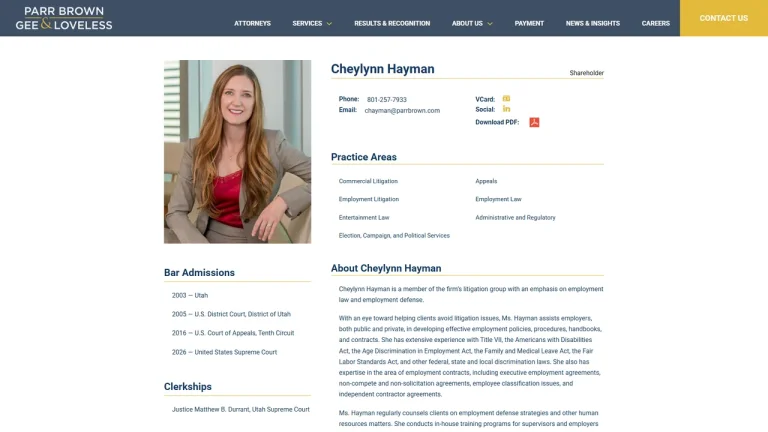
Cheylynn Hayman, Employment Attorney - Salt Lake City, UT
Salt Lake County Wage Jurisdiction & Utah Labor Standards
Recovering unpaid wages and enforcing workplace pay standards in Salt Lake City requires navigating a comprehensive set of state statutes and federal wage regulations. Workers across Salt Lake County-ranging from restaurant and hospitality staff in Sugar House and Downtown Salt Lake City to construction crews along Interstate 15, logistics workers near the international airport, and tech professionals in Silicon Slopes-frequently encounter wage violations such as unpaid overtime, off-the-clock work, illegal paycheck deductions, and misclassification as independent contractors.
Wage and hour controversies originating in Salt Lake City are resolved through two primary legal avenues. For wage claims totaling $10,000 or less, workers must file an administrative wage claim with the Utah Antidiscrimination and Labor Division (UALD) Wage Claim Unit, located within the Utah Labor Commission at the Heber M. Wells Building, 160 East 300 South in Salt Lake City. For claims exceeding $10,000, or cases involving multiple workers, claims may proceed directly to civil court without exhausting administrative remedies under Utah Code § 34-28-9.5. Civil lawsuits are heard in the Third Judicial District Court at the Matheson Courthouse (450 South State Street), while federal Fair Labor Standards Act (FLSA) collective actions proceed to the United States District Court for the District of Utah at the Orrin G. Hatch United States Courthouse (351 South West Temple Street).
Hiring a Salt Lake City wage and hour lawyer provides a decisive advantage in recovering the full compensation you are owed. An experienced wage lawyer subpoenas electronic timeclock records, analyzes point-of-sale tip distribution logs, and challenges fraudulent salary exemptions. Local counsel ensures you recover not only unpaid base pay and overtime, but also statutory waiting-time penalties and liquidated damages under state and federal law.
Typical Salt Lake City Wage Dispute Tiers & Legal Fee Frameworks
| Case Scenario | Fee Structure | Estimated Cost (USD) | Key Cost Determinants |
|---|---|---|---|
| Administrative Wage Claim with UALD (Under $10,000) | Contingency / Statutory Hourly | 25% - 33.3% of recovered wages | 1-year filing compliance, agency conciliation, employer payroll record production |
| FLSA Unpaid Overtime & Off-the-Clock Lawsuit | Contingency / Statutory Fee-Shifting | Fee recovery from employer | Proof of uncompensated hours, willful violation proofs, liquidated damages calculations |
| 1099 Independent Contractor Misclassification | Contingency Fee (District Court Action) | 33.3% - 40% of recovery | Degree of employer control, payroll tax withholdings, overtime eligibility reconstruction |
| Collective Action Wage Litigation (Federal Court) | Court-Approved Contingency | 30% - 33.3% of settlement fund | Conditional collective certification, opt-in notice distribution, electronic payroll audits |
Critical Legal Deadlines & Utah Wage Statutes
Wage claims in Utah are governed by the Utah Payment of Wages Act (UPWA) codified at Utah Code § 34-28-1 et seq. and the federal Fair Labor Standards Act (FLSA) under 29 U.S. Code § 201 et seq. Deadlines for pursuing unpaid earnings depend strictly on the legal forum chosen.
For administrative wage claims filed with the Utah Labor Commission, Utah Code § 34-28-9(1)(e) strictly mandates that a wage claim must be filed within one year after the day on which the wages were earned. Missing this one-year deadline permanently bars administrative relief through the UALD. For terminated workers, Utah Code § 34-28-5 requires the employer to pay all earned, unpaid wages within 24 hours of separation. If the employer fails to pay after the employee makes a written demand, the employee's wages continue to accrue at the regular daily rate as a penalty until paid, for up to 60 days.
Under federal law, claims brought under the FLSA are subject to a two-year statute of limitations under 29 U.S. Code § 255, which extends to three years if the employer committed a willful violation. Under 29 U.S. Code § 216(b), an employer who violates federal wage provisions is liable for the full amount of unpaid overtime or minimum wages, plus an equal amount in mandatory liquidated damages (double damages), as well as the employee's reasonable attorney fees.
Small Claims Limitations vs. District Court Wage Litigation
Under Utah Code § 78A-8-102, Utah small claims courts handle civil controversies up to $20,000. While a worker owed a single unpaid paycheck can file in the Salt Lake City Justice Court at 333 South 200 East, small claims forums lack the procedural tools necessary to resolve complex wage controversies. Small claims judges cannot oversee collective actions, subpoena proprietary corporate timekeeping databases, or handle multi-plaintiff litigation.
When an employer engages in systemic wage theft-such as automatically deducting 30-minute lunch breaks that workers were never allowed to take, or forcing construction laborers into 1099 independent contractor agreements-litigating in the Third Judicial District Court or federal court is necessary. Under Utah Code § 34-28-9.5, wage claims over $10,000 or collective claims can bypass the Labor Commission and proceed directly to civil court. A Salt Lake City wage lawyer performs forensic payroll audits, represents workers in federal collective actions, and utilizes fee-shifting provisions so that the employer pays all legal fees upon a successful recovery.
Red Flags When Hiring a Salt Lake City Wage & Hour Lawyer
- Attorneys demanding large upfront retainers for straightforward FLSA wage claims, ignoring federal statutes that require the employer to pay attorney fees upon winning.
- Lawyers failing to issue an immediate formal written demand under Utah Code § 34-28-5 to trigger the 60-day penalty wage clock for terminated employees.
- Practitioners who miss the strict one-year administrative filing deadline under Utah Code § 34-28-9(1)(e) for claims submitted to the Utah Labor Commission.
- Law firms lacking experience filing FLSA collective actions in the United States District Court for the District of Utah.
Frequently Asked Questions
When must an employer provide a final paycheck after termination in Utah?
Under Utah Code § 34-28-5, if an employee is fired or laid off, all earned unpaid wages are due immediately and must be paid within 24 hours of separation. If an employee resigns voluntarily, unpaid wages are due on the next regularly scheduled payday.
What is the penalty if a Salt Lake City employer refuses to pay a final paycheck?
Under Utah Code § 34-28-5(1)(c), if an employer fails to pay wages within 24 hours of an involuntary separation after a written demand, the employee's regular wages continue to accrue daily as a penalty until paid, for up to a maximum of 60 days.
Who qualifies for overtime pay under the Fair Labor Standards Act in Utah?
Under 29 U.S. Code § 207, non-exempt employees must receive overtime pay at one and one-half times their regular hourly rate for all hours worked over 40 in a single workweek. Merely being paid a salary does not automatically make an employee exempt from overtime.
Can a Salt Lake City employer deduct uniform or tool costs from my paycheck?
Under Utah Code § 34-28-3, an employer cannot make paycheck deductions unless required by law or authorized in writing by the employee. Furthermore, deductions cannot reduce an employee's net earnings below the statutory minimum wage.
What damages can I recover in a federal FLSA unpaid overtime lawsuit?
Under 29 U.S. Code § 216(b), a prevailing employee can recover all unpaid back wages, an equal amount in liquidated damages (double damages), pre-judgment interest, and mandatory reasonable attorney fees and court costs paid by the employer.