
Wrongful Termination Lawyers in Utah
Consulting an experienced Utah wrongful termination lawyer is vital to protect your career and hold unlawful employers accountable under state and federal employment statutes. Skilled legal counsel can evaluate whether your discharge violated public policy, manage severance negotiations, and seek reinstatement or back-pay recovery. Browse our statewide directory to connect with a verified Utah employment attorney for a confidential case review.
Jenifer L. Tomchak - Employment Litigation Attorney - Salt Lake City, UT

Ray Quinney & Nebeker - Provo, UT

Florence M. Vincent - Salt Lake City, UT
Scholnick Thorne Holland - Salt Lake City, UT
Hollingsworth Law Office, LLC - Salt Lake City, UT
Littler Mendelson P.C. - Salt Lake City, UT

Dyer Law Group PLLC - Salt Lake City, UT
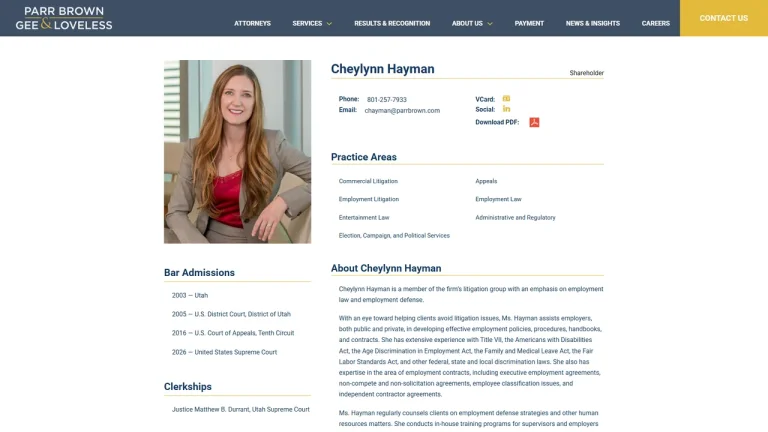
Cheylynn Hayman, Employment Attorney - Salt Lake City, UT
Crook Legal Group PLLC - Salt Lake City, UT

Challenging Unlawful Discharge in Utah: Jurisdiction and Legal Frameworks
While Utah operates under the at-will employment doctrine, which allows employers to terminate employment relationships for any lawful reason, employers do not have unfettered discretion. State common law and statutory frameworks establish concrete protections preventing unlawful discharge. Workers across Salt Lake City, West Valley City, Provo, Ogden, and St. George are shielded when terminations violate clear public policies, breach express employment agreements, or represent illegal retaliation.
Utah recognizes a vital common law exception to at-will employment: termination in violation of a clear and substantial public policy. Under rulings established by the Utah Supreme Court, an employer cannot terminate an employee for refusing to engage in illegal conduct, reporting violations of law, or exercising statutory rights such as filing a workers compensation claim. Wrongful discharge actions asserting public policy violations or breach of implied contract are filed in Utah District Courts, such as the Third Judicial District Court in Salt Lake County or Fourth Judicial District Court in Utah County.
When a discharge involves statutory retaliation or discriminatory animus, administrative exhaustion is mandatory. Claimants must submit formal charges with the Utah Labor Commission's Antidiscrimination and Labor Division (UALD) or the federal Equal Employment Opportunity Commission (EEOC) before pursuing claims in the United States District Court for the District of Utah or state court.
Estimated Legal Costs and Fee Arrangements for Utah Wrongful Termination Cases
| Case Scenario | Fee Structure | Estimated Cost (USD) | Key Cost Determinants |
|---|---|---|---|
| Severance Review & Separation Negotiation | Flat Fee / Hourly | $600 - $2,500 | Non-compete covenant scope, executive equity forfeiture, release terms, employer negotiation readiness. |
| UALD & EEOC Administrative Proceedings | Hourly / Partial Retainer | $1,500 - $4,500 | Investigation documentation volume, witness affidavits, position statement rebuttals, mediation sessions. |
| Wrongful Discharge Lawsuit (District Court) | Contingency (33% - 40%) | $0 upfront (percentage of recovery) | Documented lost wages, availability of punitive damages, employer litigation posture, trial length. |
| Complex Whistleblower & Contract Litigation | Hybrid / Hourly | $8,000 - $35,000+ | Deposition scheduling across corporate leadership, economic loss expert reports, summary judgment practice. |
Critical Legal Deadlines & Statutes in Utah
Strict statutory timeframes govern wrongful discharge actions across Utah. If a termination involves retaliation under the Utah Antidiscrimination Act, an employee must submit an administrative charge to the UALD within 180 days of the discriminatory action under Utah Code § 34A-5-107(1)(c). Dual filing with the federal EEOC extends the federal filing window to 300 days pursuant to 42 U.S. Code § 2000e-5(e)(1).
For common law claims alleging wrongful termination in violation of Utah public policy, actions must generally be filed within the four-year limitations period established under Utah Code § 78B-2-307(3). Where a termination breaches a formal written employment contract, Utah Code § 78B-2-309 grants a six-year statute of limitations, whereas oral contracts are subject to a four-year window under Utah Code § 78B-2-307(1). Additionally, under Utah Code § 34-28-5, an employer that terminates an employee must pay all unpaid wages within 24 hours of separation upon demand.
Small Claims Limitations vs. Formal Legal Representation in Utah
The monetary ceiling for Utah Justice Court small claims actions is $20,000 under Utah Code § 78A-8-102. While small claims courts offer an accessible, streamlined process using Utah's Online Dispute Resolution (ODR) platform, they are strictly limited to simple liquidated monetary claims, such as recovering unpaid final wages or earned bonuses.
Utah Justice Courts have no legal authority to award emotional distress damages, grant job reinstatement, or interpret complex exceptions to at-will employment doctrine. Because wrongful termination actions often involve substantial front-pay, back-pay calculations, and statutory attorney fees, representation by a licensed employment attorney in Utah District Court or the U.S. District Court for the District of Utah is vital to overcome dispositive motions filed by defense counsel.
Red Flags to Avoid When Choosing a Utah Wrongful Termination Lawyer
- Promising a guaranteed monetary recovery without conducting a thorough review of your termination letter, employee handbook, and performance records.
- Failing to advise you regarding the strict 180-day administrative exhaustion deadline with the UALD, which can permanently bar statutory claims.
- Charging exorbitant non-refundable upfront fees for cases that should qualify for a standard contingency fee agreement.
- Lack of substantive litigation experience before Utah District Courts and the United States District Court for the District of Utah.
Frequently Asked Questions
What qualifies as wrongful termination under Utah law?
Wrongful termination occurs when an employer discharges an employee in violation of federal or state anti-discrimination statutes, breaches an express employment agreement, retaliates for reporting workplace safety violations, or violates clear Utah public policy, such as terminating a worker for refusing to commit an illegal act.
Can an at-will employee in Utah file a wrongful termination claim?
Yes. Even though Utah presumes employment is at-will, that status does not permit an employer to terminate workers for reasons prohibited by statute or contrary to established public policy, such as filing a wage claim under Utah Code § 34-28-19 or refusing to engage in criminal conduct.
How quickly must an employer pay my final wages after firing me in Utah?
Under Utah Code § 34-28-5, when an employer discharges an employee, all earned wages become due immediately and must be paid within 24 hours of separation upon the employee's demand. Failure to comply can subject the employer to statutory financial penalties.
Must I file an administrative complaint before suing for wrongful termination in Utah?
If your claim is based on discrimination or statutory retaliation under the Utah Antidiscrimination Act or federal law, you must exhaust administrative remedies with the UALD or EEOC before filing a civil lawsuit. Pure common law claims for violation of public policy or breach of contract may proceed directly to Utah District Court.
What damages can an employee recover in a Utah wrongful termination lawsuit?
Depending on the specific legal claim, damages may include past lost earnings (back pay), future wage loss (front pay), lost benefits, compensation for emotional distress, punitive damages in egregious cases, and statutory attorney fees.