
Defective Product Injury Lawyers in Virginia
Retaining a defective product injury lawyer in Virginia safeguards your rights under state warranty and tort law. Dedicated counsel resolves complex injury claims through structured negotiation, avoiding prolonged litigation. Explore our verified directory below to schedule a case review with a trusted Virginia product liability attorney.

Anchor Legal Group, PLLC - Virginia Beach, VA
Morgan & Morgan - Richmond, VA

Friedman Fisher Verity - Richmond, VA
Shelley Swain Berry Attorney at Law - Virginia Beach, VA

Lutins & Pilgreen, PC - Roanoke, VA

Nelson Mullins Riley & Scarborough LLP - Richmond, VA

Christina Pendleton & Associates - Hampton, VA

Marcari, Russotto, Spencer & Balaban - Chesapeake, VA
Monge & Associates Injury and Accident Attorneys - Virginia Beach, VA

Moran Reeves & Conn - Richmond, VA

The Lemon Law Attorneys - Virginia Beach, VA

Whiting Injury Law - Roanoke, VA
John A. ”Jack” Irvin - Richmond, VA

Patten, Wornom, Hatten & Diamonstein, L.C. - Newport News, VA

Phelan Petty Injury Lawyers - Richmond, VA
Shapiro, Washburn & Sharp - Portsmouth, VA

John C. Shea, Attorney at Law - Richmond, VA
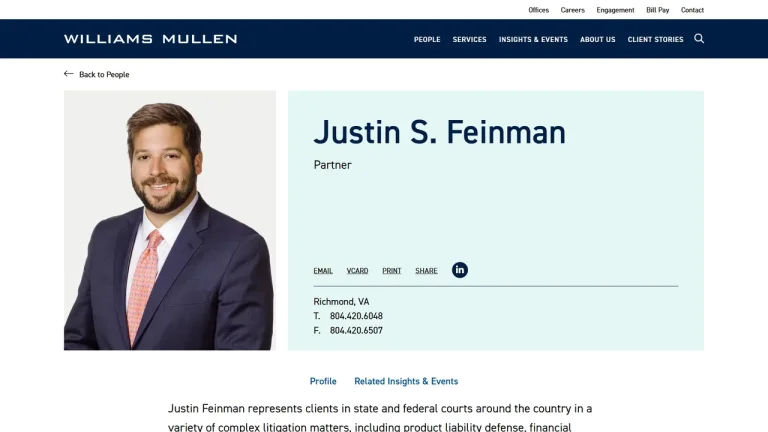
Justin Feinman - Williams Mullen - Richmond, VA
Roy Larsen Carnes & Romm - Chesapeake, VA
Marks & Harrison - Roanoke, VA
Crandall and Katt Attorneys at Law - Roanoke, VA
Brain Injury Law Center - Hampton, VA
Curcio Law - Alexandria, VA

Navigating Product Liability and Manufacturing Defect Claims in Virginia
Consumers harmed by dangerous machinery, defective automobile components, toxic household chemicals, or faulty medical devices across the Commonwealth of Virginia-from Northern Virginia commercial centers to industrial maritime facilities in Hampton Roads and distribution hubs in Richmond-must navigate one of the nation's most distinct product liability frameworks. Virginia does not recognize strict liability in tort for defective products, requiring plaintiffs to establish claims through actionable negligence or breach of warranty.
Lawsuits seeking compensation for severe bodily injuries proceed through Virginia Circuit Courts, which maintain general civil trial jurisdiction over controversies exceeding $25,000 under Va. Code § 17.1-513. Depending on the manufacturer's corporate presence or the incident site, cases are heard in forums such as the Fairfax County Circuit Court, the Richmond Circuit Court, or the Norfolk Circuit Court, or removed to federal jurisdiction in the U.S. District Court for the Eastern or Western District of Virginia.
Retaining counsel admitted to the Virginia State Bar is critical to overcoming the Commonwealth's pure contributory negligence doctrine. Experienced product defect attorneys secure immediate physical possession of the failed item, retain certified forensic engineers, manage electronic case filings via the Virginia Circuit Court E-Filing System, and establish liability under the Uniform Commercial Code and common law negligence principles.
Legal Fee Structures for Virginia Product Defect Claims
| Case Scenario | Fee Structure | Estimated Cost (USD) | Key Cost Determinants |
|---|---|---|---|
| Product Testing & Pre-Suit Defect Investigation | Contingency Fee | No Upfront Cost (33.3% of settlement) | Forensic engineering inspections, chain of custody protocol, and metallurgical analysis. |
| Out-of-Court Manufacturer Settlement Negotiations | Contingency Fee | 33.3% to 35% of gross recovery | Clear breach of warranty proof, medical treatment documentation, and corporate insurer posture. |
| Circuit Court Design & Manufacturing Defect Trial | Contingency Fee | 35% to 40% of awarded damages | Expert witness depositions, destructive testing protocols, and electronic discovery demands. |
| Multi-Plaintiff or Toxic Tort Catastrophic Litigation | Contingency Fee | 33.3% to 40% of recovery | Multi-district coordination, federal court motions, and statutory punitive damages caps. |
Critical Legal Deadlines & Statutes in Virginia
Under Va. Code § 8.01-243(A), actions for personal injury resulting from a defective product must be filed within two years from the date the injury is sustained. This two-year statute of limitations is strictly enforced from the date of physical harm, not from when the product was originally manufactured or purchased. In wrongful death actions resulting from a defective product, surviving statutory beneficiaries must commence litigation within two years from the date of death under Va. Code § 8.01-244.
For claims based on breach of implied warranty of merchantability under Va. Code § 8.2-314 or fitness for a particular purpose under Va. Code § 8.2-315, Virginia's commercial code under Va. Code § 8.2-725 provides a four-year limitations period from the date tender of delivery is made, regardless of the aggrieved party's lack of knowledge of the breach. Crucially, lack of privity of contract is abolished as a defense in personal injury claims under Va. Code § 8.2-318. In Virginia, pure contributory negligence completely bars a plaintiff's recovery on a negligence claim if the plaintiff contributed even one percent to the accident through product misuse. Punitive damages awards in Virginia civil actions are statutorily capped at $350,000 pursuant to Va. Code § 8.01-38.1.
Small Claims Court Restrictions vs. Circuit Court Product Litigation
In Virginia, the Small Claims Court Division of the General District Court operates under a monetary jurisdictional ceiling of $5,000 pursuant to Va. Code § 16.1-122.1. Furthermore, under Va. Code § 16.1-122.4, attorneys are statutorily barred from participating in small claims hearings.
Small claims court is incapable of handling complex product defect litigation. Proving a design, manufacturing, or marketing defect requires expert testimony, formal chain-of-custody protocols, and destructive testing that easily cost tens of thousands of dollars before reaching a courtroom. Catastrophic injuries caused by defective products-such as severe burns, amputations, spinal cord trauma, or internal organ damage-routinely involve hundreds of thousands of dollars in medical costs and lifetime earning loss. Litigating in the Virginia Circuit Courts or Federal District Courts provides formal discovery under civil procedure rules, enabling legal counsel to subpoena manufacturer design blueprints, internal recall memos, and crash-test data while insulating the claimant from aggressive contributory negligence defenses.
Red Flags When Selecting a Virginia Product Liability Lawyer
- Failing to secure immediate physical custody of the defective product, which risks defense claims of evidence spoliation.
- Unfamiliarity with Virginia's rejection of strict tort liability and reliance on warranty theories under Va. Code § 8.2-314 and Va. Code § 8.2-315.
- Hesitation to front the substantial capital needed for qualified engineering experts and materials testing laboratories.
- Demanding upfront non-refundable retainers rather than operating on a standard contingency-fee arrangement.
Frequently Asked Questions
Does Virginia recognize strict liability for defective products?
No. Virginia is one of the few jurisdictions that does not recognize strict liability in tort for defective products. Claimants must prove their claims under common law negligence or breach of implied warranty under Va. Code § 8.2-314.
What is the statute of limitations for a product injury lawsuit in Virginia?
Under Va. Code § 8.01-243(A), you have two years from the date of the personal injury to file a lawsuit in court. Breach of warranty claims under commercial law must be brought within four years of delivery under Va. Code § 8.2-725.
Can I sue the manufacturer if I did not buy the product directly from them?
Yes. Under Va. Code § 8.2-318, lack of privity between the injured person and the manufacturer or seller is no defense in an action for negligence or breach of warranty if the injury was reasonably foreseeable.
How does contributory negligence affect a Virginia product injury claim?
Under Virginia's pure contributory negligence doctrine, if the manufacturer proves you were even one percent at fault-such as through product misuse or ignoring instructions-you can be barred entirely from recovering damages on negligence claims.
What should I do with the defective product after an accident?
Preserve the product exactly as it is without altering, repairing, or cleaning it. Store it safely along with all packaging, receipts, and user manuals so your attorney can maintain an unbroken chain of custody for expert examination.