
Business & Work Visa Lawyers in Washington
Secure corporate talent and navigate complex immigration pathways with top business and work visa lawyers in Washington. Experienced attorneys handle H-1B, L-1, and PERM filings to ensure full compliance and protect your enterprise from regulatory delays. Explore our verified statewide directory below to schedule a consultation with leading Washington corporate immigration attorneys.
ZafiroLaw - Seattle, WA
Metz Law Group, PLLC - Seattle, WA

Rios Immigration Defense, P.S - Seattle, WA

Law Office of Behrad Rahbin, PLLC - Everett, WA
Spero Law Firm, PLLC - Spokane, WA
Rosche Immigration Law PLLC - Seattle, WA

Law Office of Anca Daian - Bellevue, WA

Ingress Legal - Everett, WA
Bright Law Firm PLLC - Bellevue, WA
Amsale Aberra Law PLLC - Seattle, WA
Fisher & Phillips, LLP - Seattle, WA
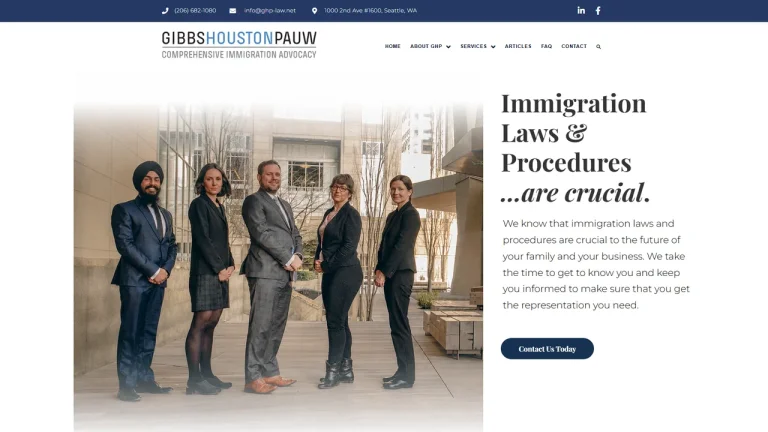
Gibbs Houston Pauw - Seattle, WA

Novo Legal Group - Kent, WA
Quiroga Law Office, PLLC - Vancouver, WA

Bertoni Law | Immigration Solutions - Bellevue, WA
Seifert Law Offices Olympia, WA
EC Immigration Law PLLC - Seattle, WA
Weinrich Immigration Law - Seattle, WA
Ascent Legal - Tacoma, WA
Law Office of Steffani Powell - Olympia, WA
Yushkin Law Office PLLC - Bellevue, WA
Multani Law Group - Immigration Lawyers - Kent, WA
Watson Immigration Law - Seattle, WA

Corporate Immigration Pathways Across Washington State Commercial Centers
Washington State stands as a preeminent global hub for technology, cloud computing, aerospace, agriculture, and life sciences. Commercial enterprises operating across the Puget Sound region-including Seattle, Bellevue, Redmond, and Kirkland in King County-as well as growing commercial hubs in Spokane, Tacoma, and Vancouver, depend extensively on high-skilled international talent. Securing employment authorization and corporate work visas requires strict adherence to both federal immigration statutes and state employment regulations.
Business immigration petitions are adjudicated primarily by the United States Citizenship and Immigration Services (USCIS) and the United States Department of Labor (DOL). Employment-based classifications-including H-1B specialty occupation visas governed by 8 U.S. Code § 1101(a)(15)(H), L-1 intracompany transfers, O-1 extraordinary ability petitions, and TN status under international trade pacts-require detailed corporate documentation and prevailing wage determinations. When federal administrative agencies arbitrarily deny or delay valid petitions, judicial challenges are heard in the United States District Court for the Western District of Washington in Seattle or the Eastern District of Washington in Spokane.
In addition to visa procurement, employers in Washington must navigate strict workplace compliance audits, including Form I-9 verification mandates enforced by Immigration and Customs Enforcement (ICE) under 8 U.S. Code § 1324a. State-level initiatives like the Keep Washington Working Act (RCW 43.17.425) establish clear state guidelines regarding workplace protections, making knowledgeable legal counsel essential. Attorneys registered with the Washington State Bar Association (WSBA) provide the corporate guidance necessary to streamline international hiring while mitigating corporate liability.
Legal Fee Schedules for Business and Work Visa Representation in Washington
| Case Scenario | Fee Structure | Estimated Cost (USD) | Key Cost Determinants |
|---|---|---|---|
| H-1B Specialty Occupation Petition | Employer-Paid Flat Fee | $2,500 - $5,000 | Cap lottery registration, specialty occupation defense, prevailing wage determination, and USCIS RFE responses. |
| L-1A / L-1B Intracompany Transferee Petition | Flat Fee / Retainer | $4,500 - $9,500 | Corporate entity ownership documentation, specialized knowledge or executive capacity proofs, and new office setup. |
| PERM Labor Certification (EB-2 / EB-3 Green Card) | Stage-Based Flat Fee | $6,000 - $14,000 | Mandatory DOL recruitment campaigns, prevailing wage audits, Form ETA 9089 drafting, and I-140 petitions. |
| Corporate Form I-9 Audit & ICE Defense | Hourly Rate ($350 - $600/hr) | $3,000 - $8,500 | Total payroll size, electronic I-9 remediation, E-Verify system review, and mitigation of statutory civil penalties. |
Critical Legal Deadlines & Statutes in Washington
Navigating employment-based immigration requires adherence to rigid federal regulatory windows. The annual H-1B specialty occupation lottery opens for electronic registration each March for a mandatory statutory period. Petitions selected in the lottery must be fully prepared and submitted to USCIS within a strict 90-day filing window. Under 20 C.F.R. § 656.17, employers initiating the PERM labor certification process must conduct mandatory labor recruitment within a 180-day window and observe a mandatory 30-day quiet period before filing Form ETA 9089 with the Department of Labor.
Federal law imposes strict employer payment obligations. Under 20 C.F.R. § 656.12, an employer is strictly barred from seeking or accepting reimbursement from an alien employee for any costs, legal fees, or expenses associated with preparing and filing a PERM labor certification. In contract disputes regarding employment or clawback agreements, Washington enforces a six-year statute of limitations for written agreements under RCW 4.16.040 and three years for oral agreements under RCW 4.16.080. Furthermore, any administrative appeal to the Board of Alien Labor Certification Appeals (BALCA) must be filed within 30 days of a PERM denial under 20 C.F.R. § 656.26.
Small Claims Limitations vs. Corporate Immigration Counsel
Under RCW 12.40.010, the Small Claims Division of Washington District Courts exercises jurisdiction limited to monetary claims up to $10,000 for natural persons and $5,000 for corporations or legal entities. Small claims courts have zero authority over federal administrative agencies, cannot review DOL labor determinations, and possess no power to issue orders regarding visa petitions or work authorizations. Small claims is limited solely to resolving minor contract or invoice disputes.
Attempting to handle complex corporate visa processing or Department of Labor certifications without specialized immigration counsel creates substantial operational liabilities. A single procedural error in a PERM recruitment advertisement can result in an immediate denial, requiring the employer to restart a multi-month process from scratch and jeopardizing an employee's lawful nonimmigrant status. Dedicated corporate immigration attorneys structure compliant wage documentation, navigate complex Requests for Evidence (RFEs), and protect employers from statutory penalties under federal worksite compliance audits.
Red Flags When Hiring a Washington Business Immigration Lawyer
- Requiring Employees to Cover Mandatory Employer Costs: Federal regulations under 20 C.F.R. § 656.12 make it illegal for an employee to pay PERM fees; counsel suggesting such arrangements exposes your business to federal sanctions.
- Promising Guaranteed H-1B Lottery Selection: Because the H-1B lottery is a randomized computer selection managed by USCIS, no attorney can ethically promise selection or expedite the lottery process.
- Lack of Familiarity with the DOL FLAG System: Modern business immigration demands technical proficiency with the Foreign Labor Application Gateway (FLAG) system and Department of Labor prevailing wage classification standards.
- Ignoring Washington Worksite Protection Laws: Counsel should be familiar with the Keep Washington Working Act (RCW 43.17.425) and Washington Law Against Discrimination (RCW 49.60.030) when advising on employment eligibility policies.
Frequently Asked Questions
Can an employee pay for their own PERM labor certification in Washington?
No. Federal regulations under 20 C.F.R. § 656.12 strictly require the sponsoring employer to pay all attorney fees, advertising costs, and recruitment expenses related to the PERM labor certification process. Employees cannot reimburse or cover these costs.
What happens if an H-1B worker is terminated by a Washington employer?
Under 8 C.F.R. § 214.1(l)(2), an H-1B employee has a discretionary grace period of up to 60 consecutive days following cessation of employment to find a new employer sponsor, change status, or depart the United States. Employers are also responsible for reasonable return transportation costs under federal statutes.
What is the difference between an L-1A and an L-1B intracompany visa?
Under 8 U.S. Code § 1101(a)(15)(L), the L-1A visa is reserved for managers and executives and offers a direct pathway to permanent residence via the EB-1C category, whereas the L-1B visa is designed for employees possessing specialized company proprietary knowledge.
How does the Keep Washington Working Act affect corporate employers?
Codified under RCW 43.17.425, the act establishes statewide policies that restrict state and local agencies from collecting unnecessary immigration data, ensuring that workplace standards and public services remain accessible to all Washington workers regardless of status.
Can an employer expedite a business visa petition with USCIS?
Yes. Employers can utilize USCIS Premium Processing for eligible petitions, including Form I-129 (for H-1B and L-1 visas) and Form I-140 (for qualifying employment-based immigrant categories), guaranteeing an adjudicative action within 15 to 45 calendar days depending on classification.