
Probate Lawyers in Vancouver
Retaining an experienced Vancouver probate lawyer helps personal representatives navigate estate administration and resolve creditor claims efficiently under Washington law. Knowledgeable counsel petitions the Clark County Superior Court for nonintervention powers and resolves complex family inheritance disputes. Explore our directory below to connect with trusted probate attorneys in Clark County.

Good Law Clinic - Vancouver, WA

Landerholm, P.S. - Vancouver, WA

SKH Family Law & Estate Planning - Vancouver, WA
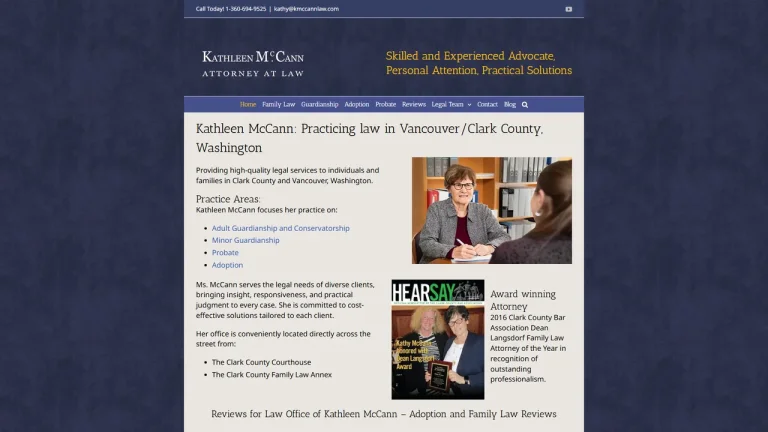
Law Office of Kathleen McCann, P.S. - Vancouver, WA

NW Legacy Law, P.S. - Vancouver, WA

Myatt & Bell, P.C. - Vancouver, WA

Law Office of Jon M. Fritzler - Vancouver, WA

Navigate Law Group - Vancouver, WA

Beckie Pettis - Vancouver, WA

Law Office of Joshua Pops P.L.L.C. - Vancouver, WA

Robert Russell Law Office - Vancouver, WA

Pettis Webber Pacific P.S. - Vancouver, WA

SBLG, PLLC - Vancouver, WA

Holland Kathryn E - Vancouver, WA
Kell, Alterman & Runstein, L.L.P. - Vancouver, WA

Vancouver Wills & Trusts - Vancouver, WA

John Lutgens, Attorney at Law - Vancouver, WA

Law Office of Rachel A. Brooks - Vancouver, WA

Kurtz & Paradis, PLLC - Vancouver, WA

Three Rivers Law Center - Vancouver, WA

Brian H. Wolfe, P.C. Attorney At Law - Vancouver, WA
Gunn MacKenzie PLLC - Vancouver, WA

McKean Smith LLC - Vancouver, WA

Navigating Estate Administration in Clark County Superior Court
Following the loss of a family member, personal representatives and executors in Vancouver, Camas, Ridgefield, and Battle Ground must fulfill fiduciary duties under Washington probate law. Administering an estate requires locating original testamentary documents, validating wills, marshaling real estate and financial accounts, settling creditor liabilities, and distributing residual assets to heirs across Clark County.
All probate filings and estate administration proceedings for decedents residing in Clark County take place in the Clark County Superior Court, located at the Clark County Courthouse, 1200 Franklin Street in Downtown Vancouver. Under Washington law, personal representatives who qualify can petition for "nonintervention powers" under RCW 11.68.010, which substantially streamlines the administration process by allowing the executor to sell property and distribute assets without seeking prior court approval for every transaction.
Retaining an established Vancouver probate attorney ensures that personal representatives comply with statutory notice rules, protect themselves from personal fiduciary liability, and navigate contentious disputes. When will contests or beneficiary conflicts arise, local counsel utilizes the Washington Trust and Estate Dispute Resolution Act (TEDRA) to achieve binding resolutions through mediation or court adjudication.
Estimated Probate Legal Costs and Administration Types
| Case Scenario | Fee Structure | Estimated Cost (USD) | Key Cost Determinants |
|---|---|---|---|
| Uncontested Probate with Nonintervention Powers | Flat Fee / Hourly ($325 - $500/hr) | $2,500 - $6,000 | Solvency status of estate, real estate title conveyances, creditor notice publication, inventory completion |
| Small Estate Affidavit Transfer (Under $100,000) | Flat Fee | $750 - $1,800 | Personal property only (RCW 11.62.010), verifying absence of real estate, 40-day waiting period compliance |
| Contested Probate Litigation & Will Contests | Hourly ($350 - $650/hr) | $10,000 - $40,000+ | Lack of testamentary capacity allegations, undue influence claims, TEDRA mediation, court trials |
| Fiduciary Defense & Accounting Disputes | Hourly ($350 - $600/hr) | $5,000 - $20,000+ | Beneficiary challenges to personal representative accounting, asset valuation disputes, surcharge actions |
Critical Legal Deadlines & Statutes in Washington
Under Washington law, any person holding custody of an original will must file it with the Clark County Superior Court or deliver it to the executor within 30 days after receiving notice of the testator's death pursuant to RCW 11.20.010.
To extinguish potential debts against the estate, the personal representative must publish a formal notice to creditors under RCW 11.40.020. Pursuant to RCW 11.40.051, creditors have exactly 4 months from the date of first publication to present their claims, or 30 days from receiving actual notice if the creditor was reasonably ascertainable. If no creditor notice is published, general creditor claims remain viable for 2 years following the decedent's death.
Heirs or beneficiaries wishing to challenge the validity of a will must file a formal will contest in Clark County Superior Court within 4 months of the will being admitted to probate under RCW 11.24.010. For small estates consisting solely of personal property valued at $100,000 or less, successors may bypass formal probate by utilizing a small estate affidavit under RCW 11.62.010 after waiting 40 days following the death. All estate disputes may be resolved through mediation, arbitration, or nonjudicial agreements under TEDRA pursuant to RCW 11.96A.010 and RCW 11.96A.220.
Small Claims Limitations vs. Formal Probate Representation
The Clark County District Court Small Claims Division enforces a statutory limit of $10,000 for individual actions under RCW 12.40.010, and attorneys cannot appear in small claims court without judicial leave under RCW 12.40.080.
Small claims court possesses no subject-matter jurisdiction over probate administration, will validity, appointment of personal representatives, or testamentary disputes. The probate of an estate requires petitions before the Clark County Superior Court to issue Letters Testamentary, clear creditor claims, file statutory estate notices, and execute personal representative deeds for real estate in Vancouver. Attempting to administer an estate without formal legal counsel risks exposing the personal representative to personal financial liability for improper creditor disbursements or disputed distributions.
Red Flags to Avoid When Selecting a Vancouver Probate Lawyer
- Charging Percentage-of-Estate Legal Fees: Avoid attorneys who seek compensation based on a fixed percentage of the total estate value; Washington probate practice standardly bills on hourly rates or reasonable flat fees based on actual services performed.
- Missing the 4-Month Creditor Claim Window: Ensure your lawyer immediately files and publishes the statutory creditor notice under RCW 11.40.020 to extinguish late creditor claims against estate assets.
- Inexperience with Nonintervention Powers: Steer clear of practitioners who fail to request nonintervention authority under RCW 11.68.010, which forces unnecessary and costly court appearances for routine estate administration.
- Unfamiliarity with TEDRA Mediation: Choose counsel who actively utilizes nonjudicial TEDRA agreements under RCW 11.96A.220 to resolve heir conflicts quickly without draining estate assets in courtroom trials.
Frequently Asked Questions
Is probate mandatory for every deceased person in Washington?
No. Probate is not mandatory if the decedent held all assets in a fully funded living trust, designated valid beneficiaries on nonprobate accounts, executed a community property agreement, or left personal property under $100,000 eligible for a small estate affidavit under RCW 11.62.010.
What are nonintervention powers in Washington probate?
Under RCW 11.68.010, nonintervention powers allow an executor of a solvent estate to manage, sell, and distribute estate property without needing court hearings or judge approval for every single action, substantially reducing legal costs.
What is the deadline for creditors to file claims against a Washington estate?
Under RCW 11.40.051, creditors have 4 months from the first date of published notice (or 30 days from actual written notice) to submit a formal claim. If no notice is published, creditors have 2 years from the date of death.
Where are probate cases filed in Clark County?
Probate petitions are filed with the Clark County Superior Court clerk at the Clark County Courthouse, located at 1200 Franklin Street in Downtown Vancouver.
How long does the probate process take in Vancouver?
An uncontested Washington probate generally takes between 6 to 12 months, largely governed by the mandatory 4-month statutory creditor notice period under RCW 11.40.051, final tax return filings, and property liquidations.