
Wrongful Termination Lawyers in Charleston, WV
Retaining an experienced wrongful termination lawyer in Charleston protects your legal rights if you faced unlawful discharge, discrimination, or retaliation in Kanawha County. Skilled employment attorneys evaluate employment contracts, negotiate severance packages, and advocate vigorously in state and federal courts. Browse our verified directory below to connect with local employment law practitioners.
Ditrapano Law Firm PC - Charleston, WV
Atkinson & Frampton, PLLC - Charleston, WV
Miller & Amos, Attorneys at Law - Charleston, WV
Disability Rights of West Virginia - Charleston, WV

Eric E. Kinder (Spilman Thomas & Battle, PLLC) - Charleston, WV

Hoosier Law Firm, PLLC - Charleston, WV
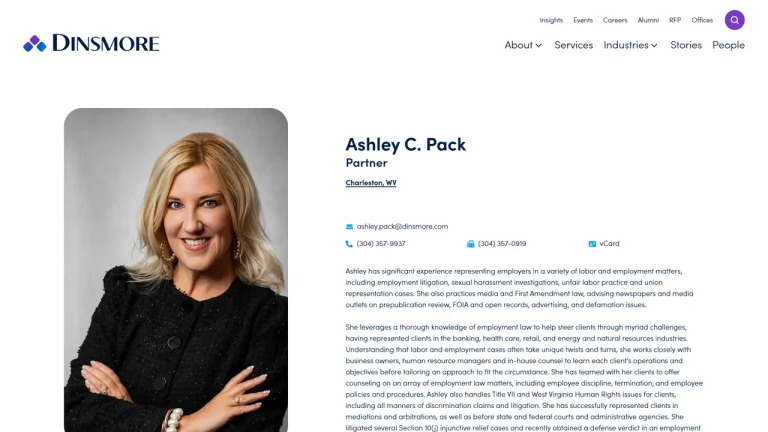
Ashley C. Pack - Dinsmore & Shohl LLP - Charleston, WV

Akers Law Offices, PLLC - Charleston, WV

Addair Entsminger PLLC - Charleston, WV
The Grubb Law Group - Charleston, WV
Joseph U. Leonoro (Steptoe & Johnson PLLC) - Charleston, WV
Hoyer, Hoyer & Smith, PLLC - Charleston, WV

Olivio Law Firm - Charleston, WV

Freeman & Chiartas - Charleston, WV

The Johnson Law Office - Charleston, WV

Samuel M. Brock III - Spilman Thomas & Battle, PLLC - Charleston, WV
Mountain State Justice Inc - Charleston, WV
Ashley W. French, Attorney at Law - Charleston, WV

Littler Mendelson P.C. - Charleston, WV
Griffith Law Center - Charleston, WV

Gary A. Collias, Attorney at Law - Charleston, WV
Kesner & Kesner, PLLC - Charleston, WV
Ranson Law Offices - Charleston, WV
Employment Rights and Wrongful Termination in Charleston
Charleston is the administrative and commercial hub of West Virginia, supporting thousands of workers across state governmental agencies, major healthcare centers like Charleston Area Medical Center (CAMC), chemical manufacturing operations, financial services, and energy companies. Although West Virginia adheres to the common law doctrine of at-will employment, employers are legally prohibited from discharging workers for reasons that violate statutory anti-discrimination laws or established public policy.
When an illegal discharge occurs in Charleston, formal legal actions are initiated in the Kanawha County Circuit Court, located at 409 Virginia Street East in Downtown Charleston. The 13th Judicial Circuit handles extensive civil dockets involving wrongful termination, workplace harassment, and retaliatory discharges. Employees may also pursue administrative remedies through the West Virginia Human Rights Commission, located directly in Charleston, before proceeding with circuit court complaints.
Federal employment claims-including actions under Title VII, the Americans with Disabilities Act, and the Family and Medical Leave Act-fall within the jurisdiction of the U.S. District Court for the Southern District of West Virginia. Retaining an attorney who actively practices before The West Virginia State Bar ensures that your case leverages both West Virginia statutory protections and foundational public policy jurisprudence.
Typical Fee Structures for Wrongful Termination Lawyers in Charleston
| Case Scenario | Fee Structure | Estimated Cost (USD) | Key Cost Determinants |
|---|---|---|---|
| Severance Agreement Review & Negotiation | Hourly / Fixed Retainer | $350 to $750 | Severance package value, non-compete clauses, release terms, executive compensation |
| Workplace Discrimination / Retaliation Claim | Contingency Fee | 33.3% to 40% of recovery | Documentary proof of disparate treatment, employer size, administrative findings |
| Public Policy Retaliation (Harless Tort Claim) | Contingency Fee | 33.3% to 40% of recovery | Clarity of public policy mandate, Kanawha County Circuit Court litigation, back pay |
| Initial Consultation & Case Viability Audit | Complimentary / Low Fixed | $0 to $250 | Review of termination notices, employer handbooks, EEOC/WVHRC correspondence |
Critical Legal Deadlines & Statutes in West Virginia Employment Law
Navigating wrongful termination claims requires strict adherence to statutory deadlines under state and federal law. The West Virginia Human Rights Act, codified under W. Va. Code § 5-11-9, makes it unlawful to discharge an employee on the basis of race, religion, color, national origin, ancestry, sex, age, or disability. Under W. Va. Code § 5-11-10, an administrative complaint must be filed with the West Virginia Human Rights Commission within 365 days of the discriminatory act.
Alternatively, employees may bypass the administrative process and file a direct civil complaint in circuit court. Pursuant to W. Va. Code § 55-2-12, the statute of limitations for personal injury and non-contractual statutory claims establishes a strict two-year filing period from the termination date for actions under the West Virginia Human Rights Act and common law public policy tort claims.
Under the landmark Harless doctrine, employers cannot terminate at-will employees when the dismissal contravenes substantial public policy. Furthermore, W. Va. Code § 23-5A-1 prohibits employers from firing or discriminating against employees because they applied for workers' compensation benefits. Public employees reporting legal violations are protected by the West Virginia Whistle-blower Law under W. Va. Code § 6C-1-3, which requires legal action to be initiated within 180 days of the violation pursuant to W. Va. Code § 6C-1-4.
Magistrate Court vs. Retaining Wrongful Discharge Counsel
The Kanawha County Magistrate Court resolves small civil claims not exceeding $10,000 under W. Va. Code § 50-2-1. While an employee might consider filing in magistrate court for minor unpaid wages, doing so for a wrongful termination claim is inadvisable and financially counterproductive.
Wrongful termination damages typically involve back pay, front pay, loss of fringe benefits, statutory damages for emotional distress, and potential punitive damages. These figures routinely exceed the $10,000 magistrate limit. Furthermore, magistrate courts lack the procedural mechanisms, such as comprehensive subpoena powers and depositions, essential for uncovering internal employer communications and personnel files.
Litigating an employment termination dispute requires filing in the Kanawha County Circuit Court or federal court, where full civil discovery permits your legal team to depose supervisors, examine comparative personnel records, and present economic damage assessments. Retaining experienced counsel equips discharged workers with the resources to confront corporate defense counsel effectively.
Red Flags When Hiring a Charleston Employment Attorney
- Demanding Upfront Retainer Fees for Contingency Claims: Reputable wrongful termination attorneys handle viable retaliation and discrimination actions on contingency, requiring no hourly attorney payments unless they recover funds.
- Promising Definite Financial Outcomes: No ethical lawyer can guarantee a specific settlement amount; employment cases depend on discovery findings, employer documentation, and judicial rulings.
- Advising You to Resign Prematurely: Beware of lawyers who instruct you to quit without evaluating whether resigning undermines your constructive discharge claim under West Virginia law.
- Lack of Circuit Court Litigation Experience: Select an attorney who actively litigates in the Kanawha County Circuit Court and the Southern District of West Virginia rather than an out-of-area advisor unfamiliar with local procedures.
Frequently Asked Questions
What constitutes wrongful termination in West Virginia's at-will environment?
While employers can terminate at-will workers for any lawful reason, a termination is illegal if it violates anti-discrimination statutes, retaliates against an employee for exercising protected rights, or breaches a substantial West Virginia public policy mandate.
What is a Harless public policy claim in West Virginia?
Originating from West Virginia common law, a Harless claim allows at-will workers to sue for wrongful discharge if their termination directly violates an established public policy, such as refusing to participate in unlawful workplace conduct.
How long do I have to file a wrongful discharge claim in Charleston?
You generally have two years from the discharge date to file a lawsuit in circuit court under state law, or 365 days to file an administrative complaint with the West Virginia Human Rights Commission.
Can an employer fire me in Charleston for filing a workers' compensation claim?
No. West Virginia state law strictly forbids employers from retaliating against, disciplining, or firing employees because they initiated or attempted to receive workers' compensation benefits.
How are legal fees structured in Charleston wrongful termination lawsuits?
Most wrongful termination claims are managed on a contingency fee arrangement where the attorney receives a percentage of the total recovery. Hourly or flat fees are typically used only for document audits or severance negotiations.