
Contract Lawyers in Wisconsin
Consulting a skilled Wisconsin contract lawyer ensures your agreements remain legally binding and fully enforceable across all state jurisdictions. Professional legal counsel frequently resolves contractual disagreements through targeted negotiation and pre-suit mediation, preventing costly courtroom battles. Browse our verified directory below to partner with leading Wisconsin contract attorneys for drafting, review, and dispute resolution.

Lin Law LLC - Green Bay, WI

Attorney Scott J. Curtis - La Crosse, WI
von Briesen & Roper, s.c. - Waukesha, WI
Schott, Bublitz & Engel s.c. - Waukesha, WI

Godfrey & Kahn, S.C. - Madison, WI

Pruitt Zabkowicz S.C. - Racine, WI
Wanezek, Jaekels, Daul & Babcock, S.C. - Green Bay, WI

Michael Best & Friedrich LLP - Waukesha, WI
Collins Law Firm, LLC - Wauwatosa, WI

Madrigrano, Aiello & Santarelli - Kenosha, WI
O'Flaherty Law Racine - WI
Harnitz Law Office LLC - Oshkosh, WI

Manske Law Office - Oshkosh, WI

Jackson LLP Healthcare Lawyers - Madison, WI
Vogel Law Firm, Ltd. - Janesville, WI
1 Reason Tax Solutions & Robert W Law - Eau Claire, WI
Lakeside Legal - Fond du Lac, WI
Jansson Munger McKinley & Kirby Ltd. - Racine, WI

Duffey & Associates, S.C. - Waukesha, WI

Amundsen Davis, LLC - Appleton, WI
Herrick & Hart, S.C. - Eau Claire, WI

Carlson Black O'Callaghan & Battenberg LLP - Madison, WI
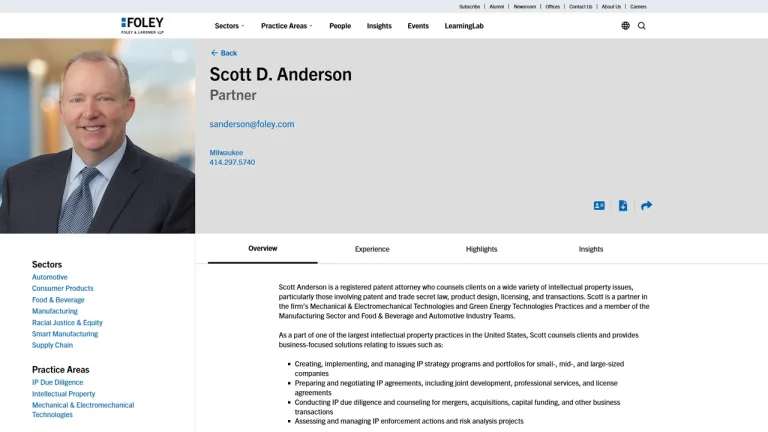
Foley & Lardner LLP: Scott D. Anderson - Milwaukee, WI
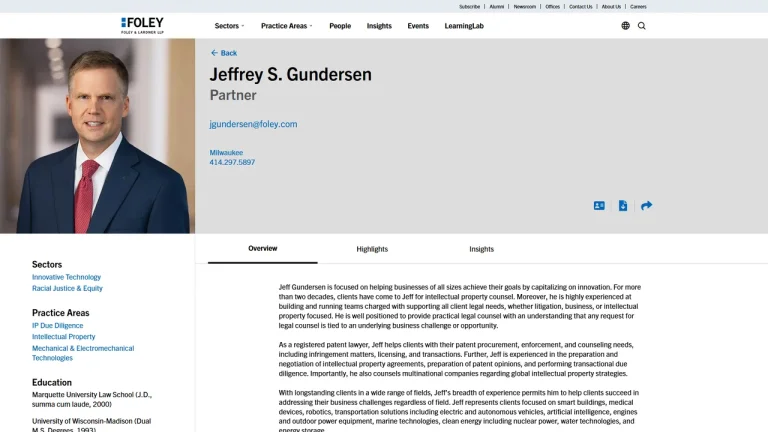
The Framework of Wisconsin Contract Law and Judicial Administration
Contractual agreements form the foundation of commercial, professional, and personal relationships across Wisconsin. Whether drafting vendor service agreements, employment covenants, purchase agreements, or complex commercial licenses, formal instruments must withstand judicial scrutiny. Retaining an attorney who understands Wisconsin statutory provisions ensures that your agreements reflect precise intent while avoiding ambiguous terminology that triggers litigation.
When contract disputes cannot be resolved informally, claims proceed through the Wisconsin Circuit Courts, which maintain general jurisdiction across seventy-two counties. Prominent venues include the Milwaukee County Circuit Court, the Dane County Circuit Court in Madison, the Waukesha County Circuit Court, and the Brown County Circuit Court in Green Bay. Appellate reviews fall within the authority of the Wisconsin Court of Appeals across four appellate districts, with final legal determinations issued by the Supreme Court of Wisconsin in Madison.
Attorneys admitted to the State Bar of Wisconsin utilize the Wisconsin Court System Circuit Court eFiling system to submit pleadings, manage discovery motions, and prosecute breach of contract actions. Local counsel understands regional judicial preferences and enforces contractual rights efficiently while exploring alternative dispute resolution pathways.
Typical Contract Legal Fees and Engagement Models in Wisconsin
| Case Scenario | Fee Structure | Estimated Cost (USD) | Key Cost Determinants |
|---|---|---|---|
| Standard Agreement Review & Redlining | Flat Fee / Hourly | $450 - $1,500 | Document page count, turnaround urgency, routine terms versus customized indemnification. |
| Custom Commercial Contract Drafting | Flat Fee / Hourly | $1,200 - $4,500 | Scope of business operations, intellectual property assignment, termination provisions. |
| Pre-Suit Breach of Contract Negotiation | Hourly Retainer | $2,500 - $8,000 | Damages calculation, volume of correspondence, mediation sessions, financial audit depth. |
| Circuit Court Breach Litigation | Hourly Billing ($275 - $550/hr) | $15,000 - $60,000+ | Discovery complexity, depositions, summary judgment motions, duration of court trial. |
Critical Legal Deadlines & Statutes in Wisconsin
Wisconsin establishes definite statutory deadlines for enforcing contractual obligations. Under Wis. Stat. § 893.43, an action upon any contract, obligation, or liability, whether express or implied, must be commenced within six years after the cause of action accrues. In breach of contract claims, the cause of action typically accrues at the exact moment the breach occurs, regardless of when the non-breaching party discovers the actual damage.
For contracts involving the sale of commercial goods, the governing statute of limitations is set at six years under Wis. Stat. § 402.725, though the parties may by original agreement reduce the period of limitation to not less than one year. Failure to file a formal summons and complaint within these statutory periods permanently extinguishes the right to seek financial recovery in state court.
Special rules also apply to restrictive covenants and non-compete agreements. Under Wis. Stat. § 103.465, any covenant not to compete that imposes an unreasonable restraint is entirely illegal, void, and unenforceable. Wisconsin courts do not rewrite or partially enforce overbroad restrictive covenants, making precise legal drafting essential at the inception of any business or employment agreement.
Small Claims Jurisdiction vs. Formal Circuit Court Representation
Parties facing lower-value contractual defaults may pursue recovery through Wisconsin Small Claims Court. Under Wis. Stat. § 799.01, small claims procedures apply to actions for money judgments where the amount claimed does not exceed $10,000. Individuals may represent themselves pro se in small claims proceedings, presenting unpaid invoices, promissory notes, or cancelled checks directly to a court commissioner or circuit judge.
However, when a dispute exceeds the $10,000 threshold or involves equitable remedies such as specific performance, contract rescission, or formal injunctions, the action must be filed on the general civil docket of the Circuit Court. Moreover, under Wisconsin law, corporations, limited liability companies, and other legal entities must generally appear through licensed counsel in contested Circuit Court proceedings. Retaining a lawyer is critical when defending against substantial damage claims, asserting cross-claims, or navigating the formal rules of evidence during pretrial depositions.
Red Flags to Screen for When Hiring Wisconsin Contract Counsel
- Attorneys who rely on generic, one-size-fits-all online templates without tailoring provisions to Wisconsin statutes and local court interpretation.
- Firms that fail to provide a transparent written fee agreement clearly delineating hourly rates, retainer requirements, and anticipated out-of-pocket costs.
- Lawyers unfamiliar with the strict indivisibility doctrine governing non-compete clauses under Wis. Stat. § 103.465.
- Practitioners who recommend immediate litigation before conducting a cost-benefit analysis of pre-suit formal demand letters and alternative dispute resolution.
Frequently Asked Questions
What is the statute of limitations for breach of contract in Wisconsin?
Under Wis. Stat. § 893.43, the statute of limitations for an action on a contract is six years from the date the breach occurs. Contracts for the sale of goods under the Uniform Commercial Code are likewise subject to a six-year limitation period pursuant to Wis. Stat. § 402.725.
Are verbal contracts legally enforceable under Wisconsin law?
Oral contracts are generally enforceable in Wisconsin, provided there is mutual assent, consideration, and sufficiently definite terms. However, certain agreements, including real estate conveyances and agreements that cannot be performed within one year, must be in writing to satisfy the Wisconsin Statute of Frauds under Wis. Stat. § 241.02.
Can a court rewrite an overly broad non-compete agreement in Wisconsin?
No. Under Wis. Stat. § 103.465, Wisconsin strictly rejects the blue-pencil doctrine for employment non-compete covenants. If any portion of the restriction is found unreasonable in terms of time, territory, or scope of activity, the entire covenant is declared void and unenforceable.
Can I handle a contract dispute in Wisconsin Small Claims Court without a lawyer?
Yes, individuals may proceed pro se in small claims court for monetary disputes not exceeding $10,000 under Wis. Stat. § 799.01. However, complex contracts, counterclaims, or disputes involving registered business entities often benefit significantly from professional legal counsel.
How do Wisconsin contract lawyers bill for their services?
Contract attorneys typically handle drafting and transactional document reviews on a flat-fee or hourly basis, with rates ranging from $250 to $550 per hour. Contested breach negotiations and active courtroom litigation require an initial evergreen retainer billed against hourly legal work.