
Divorce Lawyers in Wisconsin
Retaining an experienced Wisconsin divorce lawyer ensures your rights and marital assets are protected under strict state community property laws. Qualified legal counsel frequently resolves contentious property division and spousal maintenance disputes through structured mediation, avoiding prolonged courtroom battles. Explore our directory below to connect with trusted local attorneys across Wisconsin.

Pittman & Pittman Law Offices - Madison, WI

Severson & Smead, LLP - Madison, WI
Robert F. Nagel Law - Madison, WI

Bandle & Zaeske LLP - Milwaukee, WI

Claringbole Quigley - Appleton, WI

Vargas Law Office, LLC - Milwaukee, WI
Centro Legal - Milwaukee, WI
Kabara Christina J - Green Bay, WI
Dillon Grube, LLC - Janesville, WI
Kelly S. Kelly, Attorney at Law - Appleton, WI

Schott, Bublitz & Engel s.c. - Waukesha, WI

Phillips & Gemignani - Waukesha, WI

Law Offices of Philip E Marry, LLC - Kenosha, WI
Kryshak Law Office, LLC - Kenosha, WI
Hoff Law Offices, LLC - Appleton, WI

Halling & Cayo, S.C. - Milwaukee, WI
Consigny Law Firm, S.C. - Janesville, WI
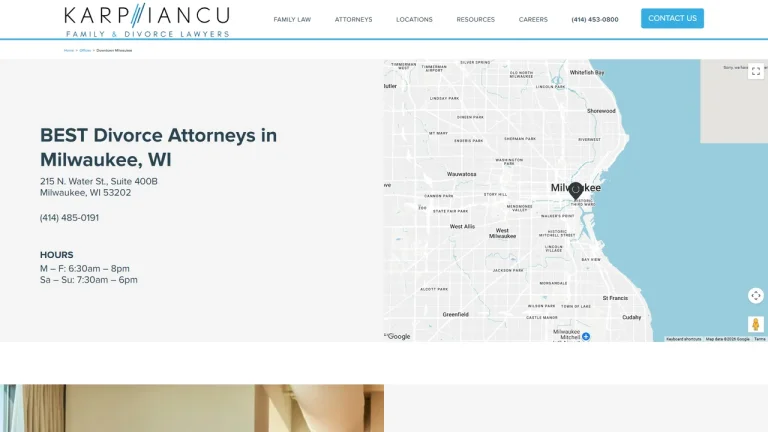
Karp & Iancu, S.C. - Milwaukee, WI

Davis and Associates Attorneys at Law - Milwaukee, WI
Law Office of Mary Losey - Kenosha, WI

Murray Law Office - Madison, WI
Gamiño Law Offices, LLC - Milwaukee, WI
Law Office of Shauntelle Van Beek - Wauwatosa, WI
Navigating Wisconsin Divorce Jurisdiction and Marital Property Laws
Filing for divorce in Wisconsin involves distinct legal procedures governed by state family law and community property principles. Under Wisconsin law, marriage is viewed as an equal economic partnership, and marital property is presumed subject to equal division. Whether your case originates in Milwaukee County, Dane County, Waukesha County, or Brown County, retaining local counsel ensures proper handling of marital assets, business valuations, and debt allocations.
Divorce petitions are adjudicated within the family branch of the Wisconsin Circuit Courts, often beginning before a Family Court Commissioner who oversees temporary financial orders, child placement, and initial scheduling. Navigating these proceedings through pre-trial mediation can resolve disputes over spousal maintenance and property distributions without requiring an adversarial trial.
An attorney admitted to the State Bar of Wisconsin provides crucial guidance regarding court filings on the Wisconsin Circuit Court Access (WCCA) eFiling system. Local counsel understands county-specific court expectations, protecting your long-term economic stability and parental rights throughout the dissolution process.
Legal Fee Structures for Wisconsin Divorce Proceedings
| Case Scenario | Fee Structure | Estimated Cost (USD) | Key Cost Determinants |
|---|---|---|---|
| Uncontested Joint Petition Divorce | Flat Fee | $1,500 - $3,500 | Complete agreement on asset division, absence of minor children, self-prepared disclosures |
| Contested Divorce with Minor Children | Hourly Rate ($275 - $500/hr) | $5,000 - $18,000 | Guardian ad Litem appointment, physical placement disputes, custody mediation sessions |
| High-Net-Worth & Business Asset Division | Hourly Retainer ($350 - $650/hr) | $15,000 - $50,000+ | Forensic accounting, business valuation experts, executive compensation and stock vesting |
| Post-Judgment Maintenance Modification | Hourly Rate ($250 - $450/hr) | $2,500 - $7,500 | Substantial change in financial circumstances, discovery disputes, evidentiary hearing length |
Critical Legal Deadlines & Statutes in Wisconsin
Wisconsin imposes strict statutory timing requirements for marital dissolution. To establish jurisdiction under Wis. Stat. § 767.301, at least one spouse must be a bona fide resident of Wisconsin for at least 6 consecutive months and a resident of the filing county for at least 30 days prior to filing the divorce summons and petition. Grounds are exclusively no-fault under Wis. Stat. § 767.315, requiring an irretrievable breakdown of the marriage.
Once the petition is filed and served, Wisconsin enforces a mandatory 120-day waiting period pursuant to Wis. Stat. § 767.335 before the Circuit Court can hold a final hearing or enter a judgment of divorce. Additionally, under Wis. Stat. § 765.03(2), divorced parties are prohibited from remarrying anywhere in the world for 6 months following the entry of the final judgment. Property division is governed by Wis. Stat. § 767.61, which presumes a 50/50 division of all marital assets, while spousal support requests are evaluated under the statutory criteria of Wis. Stat. § 767.56.
Small Claims Limits vs. Family Court Representation in Wisconsin
The small claims branch of the Wisconsin Circuit Courts operates with a statutory recovery limit of $10,000 pursuant to Wis. Stat. § 799.01. However, small claims courts possess zero jurisdiction over marital dissolution, equitable property division, or spousal maintenance. All divorce actions must be initiated in the family division of the Circuit Court.
While pro se filing is permitted, self-represented parties frequently misapply Wisconsin marital property rules, accidentally forfeiting interests in retirement accounts, pension plans, or accumulated real estate equity. Retaining dedicated divorce counsel ensures qualified domestic relations orders (QDROs) are accurately drafted, financial disclosures are audited, and complex tax liabilities are minimized.
Red Flags to Watch for When Hiring a Wisconsin Divorce Lawyer
- Attorneys promising a specific percentage division that deviates substantially from Wisconsin 50/50 community property baseline without statutory justification.
- Firms that fail to transparently explain retainer replenishment terms, hourly billing increments, or third-party forensic accountant fees.
- Lawyers who encourage contentious litigation over minor household assets solely to accumulate billable hours rather than pursuing structured mediation.
- Attorneys unfamiliar with local county Family Court Commissioner practices and electronic filing requirements under the Wisconsin court system.
Frequently Asked Questions
Is Wisconsin a community property state for divorce?
Yes. Wisconsin is a marital property state under Chapter 766 and Chapter 767. Under Wis. Stat. § 767.61, the court presumes that all property acquired during marriage belongs equally to both spouses and must be divided 50/50, with exceptions for individual gifts and inheritances that have not been commingled.
Can the 120-day divorce waiting period be waived in Wisconsin?
No. The 120-day statutory cooling-off period required under Wis. Stat. § 767.335 cannot be waived by either spouse or the court, even in completely uncontested or joint-petition divorces.
How is spousal maintenance calculated in Wisconsin?
Unlike child support, Wisconsin does not use a fixed percentage formula for spousal maintenance. Circuit Court judges evaluate factors under Wis. Stat. § 767.56, including the length of marriage, earning capacities, age, health, education, and contribution of each party.
How long do I have to wait to remarry after a Wisconsin divorce?
Pursuant to Wis. Stat. § 765.03(2), both spouses must wait exactly 6 months from the date the final divorce judgment is granted before entering into a new marriage, whether within Wisconsin or in any other jurisdiction.
What is the role of the Family Court Commissioner in Wisconsin?
The Family Court Commissioner is a judicial officer who handles preliminary matters in divorce cases, such as entering temporary orders for child support, legal custody, physical placement, and temporary use of property before final hearings before a Circuit Court judge.