
Specialty Courts (Drug, Family, Juvenile) in Bridgeport
Navigating specialty courts in Bridgeport connects families and individuals to dedicated juvenile, family, and treatment court dockets across Fairfield County. Specialized judicial sessions provide structured diversion programs, child protection procedures, and domestic resolution pathways under state statutory oversight. Explore our comprehensive directory below to identify courtroom locations, intake guidelines, and support resources for Bridgeport specialty dockets.

Specialized Judicial Sessions and Targeted Dockets in Bridgeport, Connecticut
Within the Fairfield Judicial District, the Connecticut Judicial Branch operates dedicated specialized courts to address complex family matters, juvenile delinquency, and clinical substance dependency. These specialized court dockets divert eligible cases from traditional adversarial proceedings into structured supervision, rehabilitation, and individualized judicial oversight.
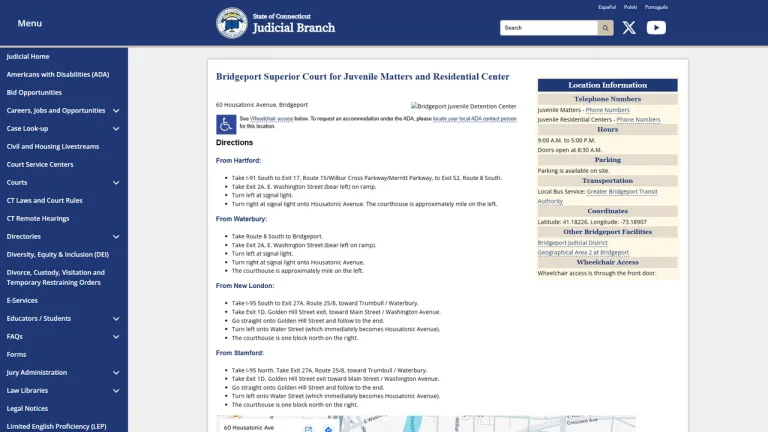
Juvenile proceedings for Greater Bridgeport and surrounding communities such as Fairfield, Stratford, Trumbull, and Monroe are concentrated at the Bridgeport Superior Court for Juvenile Matters at 60 Housatonic Avenue. This specialized courthouse exercises exclusive jurisdiction over juvenile delinquency matters, families with service needs (FWSN), and child protection petitions initiated by the Connecticut Department of Children and Families (DCF). The facility houses dedicated courtrooms and an adjacent juvenile detention center for temporary custody and evaluation.
Family-centered controversies, including legal separations, dissolutions of marriage, child custody disputes, visitation rights, and child support enforcement under Support Enforcement Services, are heard at the Fairfield Judicial District Courthouse at 1061 Main Street. In addition, targeted criminal diversion sessions, including the Bridgeport Adult Drug Court and the Domestic Violence Docket, operate within the Geographical Area No. 2 Courthouse at 172 Golden Hill Street, providing treatment-focused alternatives to incarceration under judicial supervision.
Specialty Court Programs, Filing Prerequisites, and Processing Schedules
| Service / Matter | Required Documents / Prerequisites | Statutory Fee (USD) | Processing Timeline |
|---|---|---|---|
| Juvenile Matters Petition (Delinquency / Care) | Police summons or DCF neglect petition, formal summons to parents or legal guardians | $0.00 (statutorily exempt) | Initial appearance within 10 to 14 calendar days |
| Family Court Custody / Dissolution Filing | Civil summons, complaint for dissolution or custody, proposed parenting plan, financial affidavits | $360.00 base filing fee (or approved fee waiver) | Mandatory 90-day waiting period; status conference within 30 to 60 days |
| Pretrial Drug Intervention Program Application | Verified application, waiver of speedy trial, clinical evaluation through Court Support Services | $100.00 application fee plus $350.00 to $500.00 program cost | Judicial evaluation hearing scheduled within 30 days |
| Family Violence Education Program (FVEP) | Formal motion for diversion, Family Relations assessment, defendant eligibility certification | $100.00 application fee plus $300.00 participation fee | Program supervision for 9 to 12 months upon approval |
Critical Legal Deadlines & Statutes in Connecticut
Navigating Bridgeport specialty court dockets requires adherence to strict statutory timelines and jurisdictional standards. Juvenile delinquency and child protection proceedings are governed by Conn. Gen. Stat. § 46b-120 and Conn. Gen. Stat. § 46b-124, which strictly seal juvenile records from the general public. Emergency orders of temporary custody sought by DCF are subject to rapid judicial review under Conn. Gen. Stat. § 46b-129, requiring a preliminary hearing within 10 days of the ex parte removal order.
Family court proceedings follow statutory frameworks governing child welfare and marital property. Child custody determinations must strictly satisfy the best interests of the child standard pursuant to Conn. Gen. Stat. § 46b-56, while marital property division is governed by equitable distribution rules under Conn. Gen. Stat. § 46b-81. Pretrial diversionary programs for criminal charges require timely application prior to trial: the Pretrial Drug Intervention Program is administered under Conn. Gen. Stat. § 54-56i, the Accelerated Pretrial Rehabilitation program under Conn. Gen. Stat. § 54-56e, and the Family Violence Education Program under Conn. Gen. Stat. § 46b-38c. Civil restraining orders for domestic protection must have a hearing scheduled within 14 days under Conn. Gen. Stat. § 46b-15.
Direct Program Access vs. Retaining Legal Counsel
Certain administrative and specialty court processes allow self-directed participation by individuals. Pro se litigants can independently file emergency applications for relief from abuse (restraining orders) at 1061 Main Street, request fee waivers under the Connecticut Practice Book, or attend court-ordered Family Relations dispute resolution sessions. Parents involved in uncontested marital dissolutions can submit joint parenting agreements directly to the family court clerk.
However, matters involving delinquency adjudications, child removal, or criminal diversion programs strongly necessitate licensed legal representation. Minors in juvenile delinquency proceedings at 60 Housatonic Avenue have a statutory right to counsel under state law, provided through retained attorneys or the Connecticut Division of Public Defender Services. In criminal drug courts and domestic violence sessions, an attorney's advocacy is vital to establish program eligibility, negotiate conditions with prosecutors, and ensure that program completion results in the complete dismissal of charges. Retaining an attorney licensed in Connecticut preserves statutory protections across all specialized courtrooms.
Red Flags & Public Service Scams to Avoid
- Unapproved Private Treatment Clinics: Be wary of unauthorized private substance abuse programs claiming guaranteed dismissals of Bridgeport court cases; the court only recognizes clinical providers approved by the Court Support Services Division (CSSD).
- Confidential Record Solicitations: Avoid private entities claiming they can unseal or expunge juvenile or family records for an upfront fee; juvenile records are sealed by statute and exempt from third-party commercial disclosure.
- Unlicensed Document Preparation Services: Non-attorneys offering commercial custody or divorce packages frequently create defective filings that fail to satisfy Connecticut Practice Book requirements, causing severe delays or dismissal.
- Agency Impersonation Schemes: Fraudulent individuals claiming to represent the Department of Children and Families (DCF) or family court investigators demanding money transfers under threat of child removal or arrest are criminal scams.
Frequently Asked Questions
Where are juvenile court cases heard for Bridgeport families?
Juvenile delinquency, child protection, and child welfare cases for Bridgeport are heard at the Bridgeport Superior Court for Juvenile Matters, located at 60 Housatonic Avenue in Bridgeport.
Who is eligible for the Bridgeport Adult Drug Court program?
Eligibility for the Bridgeport drug session generally requires non-violent criminal charges, documented substance dependency, and a clinical assessment by Court Support Services Division staff confirming that treatment is appropriate.
How does the Family Violence Education Program work in Bridgeport?
The Family Violence Education Program (FVEP) is a diversionary program for individuals charged with misdemeanor domestic violence offenses. Successful completion of classes and compliance with protective orders results in the dismissal of all charges.
Can parents represent themselves in Bridgeport child custody disputes?
Parents have the right to represent themselves pro se in family court at 1061 Main Street, but complex custody evaluations and contested hearings generally benefit from qualified legal representation.
Are Bridgeport juvenile court proceedings open to the public?
No. By Connecticut statute, juvenile delinquency and child protection proceedings are confidential, and court sessions are closed to the general public to protect the privacy of minors.