
County Clerk in Connecticut
Because Connecticut abolished county government, official clerical, public record, and licensing functions are administered directly by Town Clerks across 169 municipalities and Superior Court Clerks within regional judicial districts. Understanding this decentralized framework ensures your filings, vital record requests, and judicial inquiries reach the proper local repository. Explore our directory below to locate the certified municipal and court clerk offices serving your area.

Connecticut Clerk Infrastructure: Town Clerks and Superior Court Clerks
Connecticut maintains a distinct administrative framework that departs from the traditional county structure found throughout much of the United States. In 1960, the state legislature formally abolished county government pursuant to Conn. Gen. Stat. § 6-2a, transferring public property to the state and reallocating civic responsibilities. Consequently, individuals seeking county clerk services must identify whether their matter falls under municipal town administration or the state judicial branch.
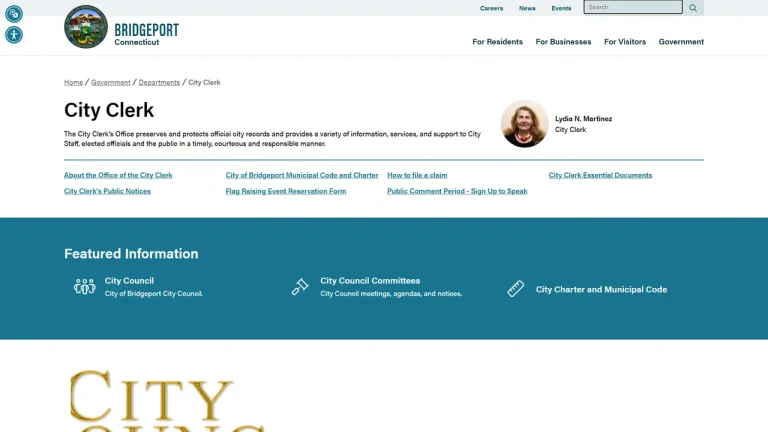
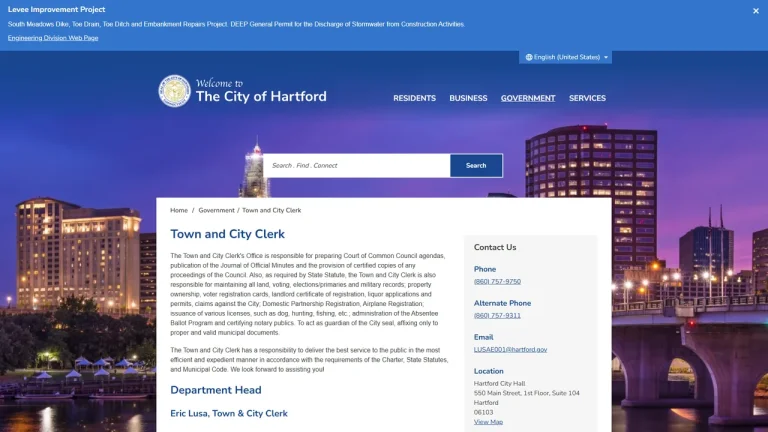
Local administrative matters are conducted by elected or appointed Town Clerks within each of Connecticut's 169 distinct municipalities, including Hartford, New Haven, Stamford, Bridgeport, and Waterbury. Town Clerks serve as keepers of the municipal seal, registering trade names for local businesses, administering absentee ballots, recording local ordinances, and issuing certified vital statistics records such as birth, marriage, and death certificates.
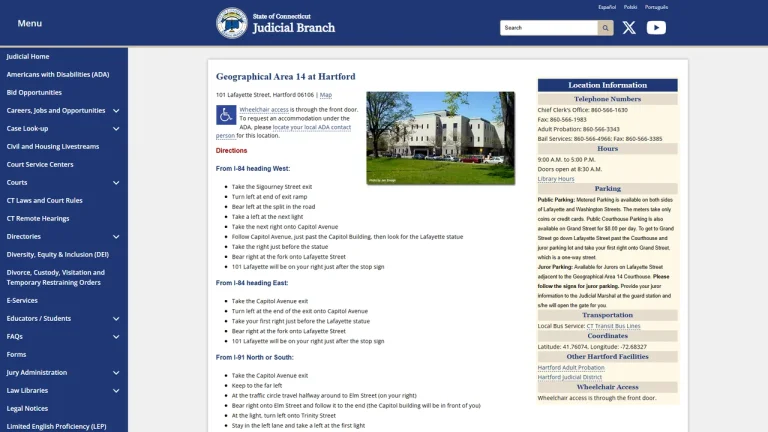
Conversely, all judicial proceedings, court case dockets, civil complaints, and criminal judgments are maintained by the Superior Court Clerks assigned to Connecticut's 13 Judicial Districts and geographical area courthouses. Directing your inquiry to the correct municipal or judicial clerk prevents costly filing errors and procedural delays.
Connecticut Municipal and Judicial Clerk Service Schedules
| Service / Matter | Required Documents / Prerequisites | Statutory Fee (USD) | Processing Timeline |
|---|---|---|---|
| Certified Vital Record Issuance | Valid state photo identification, completed application, proof of direct legal relationship | $20 per certified copy | Immediate in-person processing; 5 to 10 days by mail |
| Municipal Trade Name Certificate (DBA) | Notarized trade name application, business entity details, personal identification | $10 statutory recording fee | Same-day over-the-counter registration |
| Superior Court Civil Case Filing | Summons, formal complaint, civil appearance form, statutory recognizance bond | $360 court filing fee | Immediate electronic filing via Judicial Branch E-Services |
| Exemplified Court Judgment or Docket Copy | Judicial docket number, written copy request, statutory search specifications | $25 certification fee plus $1 per page | 3 to 7 business days for judicial certification |
Critical Legal Deadlines & Statutes in Connecticut
Interacting with Connecticut municipal and judicial clerks requires vigilant adherence to statutory timelines. Under the Connecticut Freedom of Information Act, set forth in Conn. Gen. Stat. § 1-206, a public clerk must provide an initial response to written public records requests within four (4) business days; an unjustified denial must be appealed to the Freedom of Information Commission within thirty (30) days.
For municipal claims, temporal requirements are exceptionally unforgiving. Under Conn. Gen. Stat. § 13a-149, any individual suffering injuries or damages caused by a defective municipal road, bridge, or sidewalk must file formal written notice with the Town Clerk within strictly ninety (90) days of the incident, or the claim is forever barred. In civil litigation, actions must be returned to the Superior Court Clerk at least six (6) days before the designated return date pursuant to Conn. Gen. Stat. § 52-46a.
Direct Municipal Access vs. Professional Legal Counsel
Citizens frequently access town clerk offices independently for administrative transactions that involve standard documentation. Registering a local trade name, submitting voter registration applications, licensing domestic animals, or obtaining copies of town meeting minutes can be performed without legal representation at local municipal halls.
By contrast, judicial matters before the Superior Court Clerk require strategic legal evaluation. Court clerks are statutorily prohibited from providing legal advice, recommending pleadings, or assessing the merits of filings. Navigating complex civil litigation, filing pre-judgment remedies, recording notices of lis pendens, or appealing administrative agency determinations necessitates retaining an experienced Connecticut attorney who ensures compliance with the Connecticut Practice Book and statutory rules of procedure.
Red Flags and Public Records Fraud Warnings
- Commercial websites that charge excessive handling markups ($50 to $100) to order basic vital records that cost only $20 directly from the municipal Town Clerk.
- Deceptive mailings from private enterprises demanding annual business certificate maintenance or corporate compliance fees that mimic official state or town notices.
- Unlicensed document preparers attempting to file legal instruments or lawsuits in Superior Court without attorney oversight, risking immediate dismissal.
- Third-party companies requesting payments to search municipal land records or town ordinances that are freely viewable in municipal vault rooms.
Frequently Asked Questions
Why does Connecticut not have traditional county clerk offices?
Connecticut eliminated county government in 1960, transferring public functions to the state government and distributing record keeping to Town Clerks in each of the 169 municipalities and Superior Court Clerks within judicial districts.
Where do I file a lawsuit or court motion in Connecticut?
Lawsuits, civil motions, and criminal appearances must be filed with the Superior Court Clerk at the appropriate Judicial District or Geographical Area courthouse serving the geographical jurisdiction of the dispute.
Where can I obtain a certified copy of a birth or marriage certificate in Connecticut?
Certified vital records must be obtained directly from the Town Clerk in the municipality where the vital event occurred, where the parties resided, or through the Connecticut Department of Public Health State Vital Records Office.
What is the statutory fee for registering a trade name with a Connecticut Town Clerk?
Under Connecticut statutes, the fee for filing and recording a business trade name certificate (DBA) with a municipal Town Clerk is set at ten dollars.
How quickly must a Connecticut public clerk respond to a freedom of information request?
Under state freedom of information statutes, a public agency or municipal clerk must provide an initial response or acknowledge receipt of a formal public records request within four business days.