
Federal Courts in Concord
Navigating federal court matters in Concord requires procedural precision under the Federal Rules of Civil Procedure and local District of New Hampshire rules. Whether handling constitutional claims, bankruptcy restructuring, or federal criminal charges, timely filings protect your statutory rights. Explore our verified directory below to access official clerk information, docket search systems, and courthouse guidelines.
Federal Judicial Jurisdiction in Concord and the District of New Hampshire
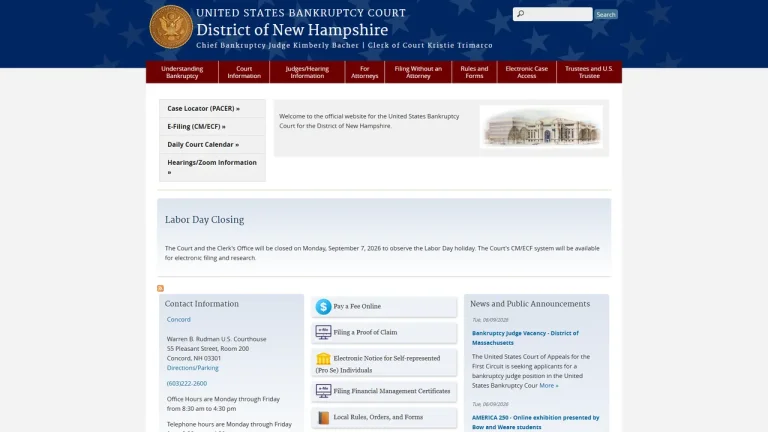
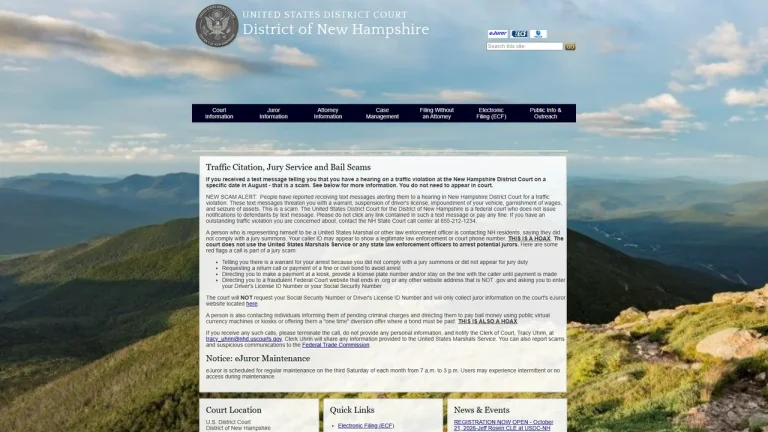
Federal judicial administration for the entire state of New Hampshire is centered in Concord at the Warren B. Rudman United States Courthouse on Pleasant Street. This modern federal facility houses both the United States District Court for the District of New Hampshire and the United States Bankruptcy Court for the District of New Hampshire. Litigants from Merrimack County, the Greater Concord area, and surrounding communities throughout the Merrimack Valley access this federal forum for disputes involving constitutional issues, federal statutory violations, and substantial interstate controversies.
As the sole federal trial district in New Hampshire, the Concord courthouse exercises exclusive original jurisdiction over federal offenses investigated by federal law enforcement, maritime claims, patent litigation, and disputes where the United States is named as a plaintiff or defendant. Appellate review of decisions rendered by the District of New Hampshire falls under the purview of the United States Court of Appeals for the First Circuit, situated in Boston, Massachusetts, creating a structured hierarchical path for federal appeals originating in Concord.
The Clerk of Court for the District of New Hampshire manages case intake, trial scheduling, jury administration, and naturalization ceremonies from within the Rudman Courthouse. Practicing before this court requires compliance not only with national procedural codifications but also with specific Local Rules adopted by the District of New Hampshire, governing mandatory electronic filing, motion practice, and attorney admission.
Federal Court Filing Fees, Document Requirements, and Case Timelines
| Service / Matter | Required Documents / Prerequisites | Statutory Fee (USD) | Processing Timeline |
|---|---|---|---|
| Civil Complaint Filing | Form JS-44 civil cover sheet, original complaint, proposed summons, electronic filing account | $405.00 ($350 statutory filing fee plus $55 administrative fee) | Docketed within 24 business hours; summons issued in 1-2 business days |
| Chapter 7 Bankruptcy Petition | Voluntary petition, schedules A through J, statement of financial affairs, credit counseling certificate | $338.00 total statutory filing fee | Automatic stay immediate upon filing; discharge typically 90-120 days |
| Notice of Appeal (to First Circuit) | Notice of appeal, judgment order designation, representation statement, filing fee | $605.00 ($5 statutory notice fee plus $600 docket fee) | Transmitted to the First Circuit Court of Appeals within 24-48 hours |
| Federal Court Record Certification | Formal request with civil or criminal docket number, document identification, PACER registration | $12.00 per certification plus $0.50 per page | Same-day walk-in request; 2-4 business days via mail or electronic portal |
Critical Legal Deadlines & Statutes in New Hampshire Federal Practice
Litigating before the federal bench in Concord entails strict observance of statutory filing limits and jurisdictional timing triggers. Original federal civil actions rooted in federal question jurisdiction are governed by 28 U.S. Code § 1331, while disputes based on diversity of citizenship between parties from different states must meet the $75,000 amount-in-controversy threshold under 28 U.S. Code § 1332. When civil rights violations are asserted against state or municipal officials, actions proceed under 42 U.S. Code § 1983, borrowing New Hampshire's three-year personal injury limitation period set forth in N.H. Rev. Stat. Ann. § 508:4.
Defendants seeking to remove a civil case from Merrimack County Superior Court to the United States District Court in Concord must file a notice of removal within 30 days after receiving the initial pleading or summons pursuant to 28 U.S. Code § 1446. Once a final judgment is entered in the District of New Hampshire, an appealing party must file a notice of appeal within 30 days under Fed. R. App. P. 4(a)(1)(A), or within 60 days under Fed. R. App. P. 4(a)(1)(B) if the United States government, a federal agency, or a federal officer is an official party to the action. Bankruptcy proceedings operate under strict proof-of-claim filing deadlines governed by Fed. R. Bankr. P. 3002, where late submissions commonly result in forfeiture of creditor distributions.
Direct Agency Access vs. Legal Counsel in Federal Litigation
Citizens maintain the statutory right to represent themselves as pro se litigants in civil proceedings and bankruptcy petitions before the federal court in Concord pursuant to 28 U.S. Code § 1654. Self-represented individuals can register for electronic document submission, access the Warren B. Rudman Courthouse law library, and utilize standard civil intake templates provided by the clerk office. Pro se debtors frequently navigate individual Chapter 7 bankruptcy filings when personal asset liquidations are straightforward and uncontested.
Nevertheless, federal procedure is remarkably rigorous, and pro se status offers no exemption from strict adherence to the Federal Rules of Civil Procedure or local district orders. Corporations, limited liability companies, and partnerships are legally prohibited from proceeding pro se and must appear through licensed counsel. Retaining an attorney admitted to the District of New Hampshire Bar is crucial when handling complex discovery disputes, summary judgment motions, federal criminal indictments, or First Circuit appellate briefs, where inadvertent procedural missteps routinely lead to case dismissal with prejudice.
Red Flags & Avoiding Federal Court Document Scams
- Deceptive online record portals that charge exorbitant subscription fees of $40 to $70 to deliver basic federal court records that can be inspected directly via PACER for $0.10 per page.
- Fraudulent settlement collection notices or bogus federal subpoenas demanding immediate wire transfers or gift card payments, which legitimate federal clerks and the U.S. Marshals Service never demand.
- Unauthorized document preparation mills offering cheap bankruptcy filing assistance that fail to fulfill mandatory pre-bankruptcy credit counseling or lead to unlawful concealment of assets.
- Third-party websites advertising guaranteed outcomes or private backdoor settlements in federal forfeiture, civil rights, or government tort claims pending in Concord.
Frequently Asked Questions
Where is the federal district court located in Concord?
The United States District Court for the District of New Hampshire is located inside the Warren B. Rudman United States Courthouse at 55 Pleasant Street in downtown Concord.
How do I search public federal court records for the District of New Hampshire?
Federal dockets, pleadings, and orders are publicly accessible online through the nationwide PACER (Public Access to Court Electronic Records) system or at public terminal kiosks in the Rudman Courthouse clerk office.
Can a corporate entity represent itself in Concord federal court?
No. Under federal statutory precedent and local court rules, corporate entities, including LLCs, corporations, and partnerships, must be represented by an attorney admitted to practice before the court.
What is the statutory deadline to appeal a federal judgment in Concord?
In standard civil cases, a notice of appeal to the First Circuit Court of Appeals must be filed within 30 days from the entry of final judgment, extended to 60 days when the federal government is a party.
Where are bankruptcy petitions filed for New Hampshire residents?
All New Hampshire consumer and business bankruptcy cases are filed with the United States Bankruptcy Court for the District of New Hampshire, located within the Warren B. Rudman Courthouse in Concord.