
Federal Courts in New Hampshire
The federal court system in New Hampshire exercises constitutional jurisdiction over federal statutory claims, diversity actions, and bankruptcy proceedings across the state. Operating through strict federal procedural rules, these tribunals resolve complex commercial, criminal, and constitutional disputes. Browse our directory below to find New Hampshire federal courthouses, clerk contacts, and verified legal filing resources.
Jurisdiction and Administration of the Federal Court in New Hampshire
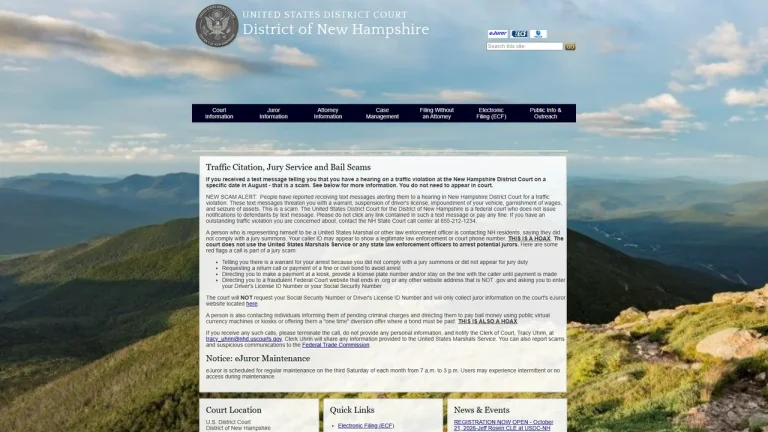
Federal judicial power within the State of New Hampshire is exercised by the United States District Court for the District of New Hampshire, organized under Article III of the United States Constitution. Unlike larger states divided into multiple districts, New Hampshire constitutes a single comprehensive federal judicial district. All district proceedings, federal grand juries, and magistrate hearings are conducted inside the Warren B. Rudman United States Courthouse, located at 55 Pleasant Street in the state capital of Concord in Merrimack County.
The District Court maintains limited subject matter jurisdiction strictly restricted by federal statute. Cases heard in the Concord federal courthouse primarily involve matters arising under the Constitution or federal statutes pursuant to 28 U.S. Code § 1331 (Federal Question jurisdiction) or civil controversies between citizens of different states involving an amount in controversy exceeding $75,000 pursuant to 28 U.S. Code § 1332 (Diversity of Citizenship jurisdiction). Appeals originating from the District of New Hampshire fall under the appellate jurisdiction of the United States Court of Appeals for the First Circuit.
Housed within the same judicial complex in Concord is the United States Bankruptcy Court for the District of New Hampshire, which exercises exclusive original jurisdiction over consumer and business insolvency proceedings under Title 11 of the United States Code. All federal court filings and public dockets across the district are administered through the Case Management/Electronic Case Files (CM/ECF) portal and the nationwide PACER system.
Federal Court Services, Entry Filings, and Statutory Costs
| Service / Matter | Required Documents / Prerequisites | Statutory Fee (USD) | Processing Timeline |
|---|---|---|---|
| Civil Action Entry / Complaint | Form JS-44 Civil Cover Sheet, Summons Form, Complaint, Corporate Disclosure | $405 statutory fee ($350 filing fee + $55 administrative surcharge) | Immediate timestamp via CM/ECF; 1 to 2 business days for pro se review |
| Notice of Appeal to First Circuit | Notice of Appeal, Certificate of Service, District Court Judgment copy | $605 ($5 statutory fee + $600 First Circuit docket fee) | Transmitted to First Circuit Clerk within 24 to 48 hours |
| Chapter 7 Bankruptcy Petition | Voluntary Petition, Schedules A-J, Financial Affairs, Credit Counseling Certificate | $338 ($245 filing + $78 administrative + $15 trustee fee) | Automatic stay initiated immediately; 341 meeting set in 21 to 40 days |
| PACER Public Record Search | National PACER login credentials or clerk public kiosk access in Concord | $0.10 per page ($3.00 cap per document; quarterly usage under $30 free) | Instant online access or same-day clerk terminal search |
Critical Legal Deadlines & Statutes in New Hampshire
Practicing within the federal system requires unbending observance of federal procedural timetables. Following the filing of a civil complaint, Fed. R. Civ. P. 4(m) requires the plaintiff to complete formal service of the summons and complaint upon all named defendants within 90 days, or the action faces dismissal without prejudice. Once served, a responding defendant must serve an answer or defensive motion within 21 days pursuant to Fed. R. Civ. P. 12(a)(1)(A)(i).
Appellate deadlines are strictly enforced under federal law. For parties seeking to challenge a final judgment or appealable order of the District of New Hampshire, Fed. R. App. P. 4(a)(1)(A) requires that a Notice of Appeal be lodged with the District Court clerk within 30 days from the docket entry date of the judgment. Furthermore, federal practice in Concord is governed by the Local Rules of the U.S. District Court for the District of New Hampshire, including LR 7.1, which mandates that counsel certify good-faith efforts to resolve issues prior to filing non-dispositive motions and adhere strictly to 25-page memorandum limits.
Direct Court Navigation vs. Legal Representation
Under federal statute, individual litigants have the right to represent themselves pro se in civil proceedings in the District of New Hampshire. Self-represented parties can access the clerk's intake office inside the Warren B. Rudman Courthouse, review filings at public PACER terminals, submit administrative filings, and consult the court's dedicated Pro Se Information Guide. Similarly, individuals can file Chapter 7 or Chapter 13 consumer bankruptcy petitions directly with the bankruptcy clerk.
However, federal litigation involves complex pre-trial procedures, mandatory Rule 26 disclosures, expert depositions, and summary judgment briefing under Rule 56 that present severe risks for unrepresented parties. Additionally, under federal common law and local court rules, corporate entities, limited liability companies, and partnerships cannot appear pro se and must be represented by an attorney admitted to practice before the district. Retaining legal counsel admitted under LR 83.1 ensures strict compliance with local rules, protects evidentiary privileges, and presents complex federal claims effectively.
Procedural Warnings & Public Scams
- Watch for fraudulent phone calls where scammers impersonate federal marshals or clerks from the Concord courthouse, claiming you have missed federal jury duty and threatening arrest unless money is transferred via wire or prepaid cards; federal courts never demand fines over the phone.
- Avoid third-party web portals charging inflated recurring subscriptions to search or retrieve federal dockets; all official federal dockets are accessible directly through the PACER system or at the courthouse clerk counter.
- Do not rely on non-lawyer petition preparers in bankruptcy cases; unauthorized legal advice often results in improper exemptions, loss of protected assets, or summary dismissal of bankruptcy petitions.
- Pay close attention to local motion rules under LR 7.1; failing to include a certification of a good-faith meet-and-confer with opposing counsel can result in the automatic denial of your motion.
Frequently Asked Questions
Where is the federal district court located in New Hampshire?
The United States District Court for the District of New Hampshire is located exclusively in the Warren B. Rudman United States Courthouse at 55 Pleasant Street in Concord.
Can a corporation or LLC represent itself in New Hampshire federal court?
No. Federal procedural law establishes that artificial business entities, including corporations and LLCs, cannot proceed pro se in federal court and must be represented by an attorney admitted to the district bar under LR 83.1.
Which federal appellate court reviews decisions from New Hampshire?
Appeals from the United States District Court for the District of New Hampshire are heard by the United States Court of Appeals for the First Circuit.
How much time do I have to file an appeal in a federal civil case?
Pursuant to Fed. R. App. P. 4(a)(1)(A), a Notice of Appeal in a civil case must be filed with the District Court clerk within 30 days of the entry of judgment, or within 60 days if the United States is a party.
How can the public access federal court records in New Hampshire?
Members of the public can access federal court dockets and documents online through the nationwide PACER service or in person using public access terminals at the Rudman Courthouse in Concord.